
Sun in LeoMoon in ScorpioWaxing Gibbous
Milivoj Uzelac: Fragile Authority in Interwar Silhouettes
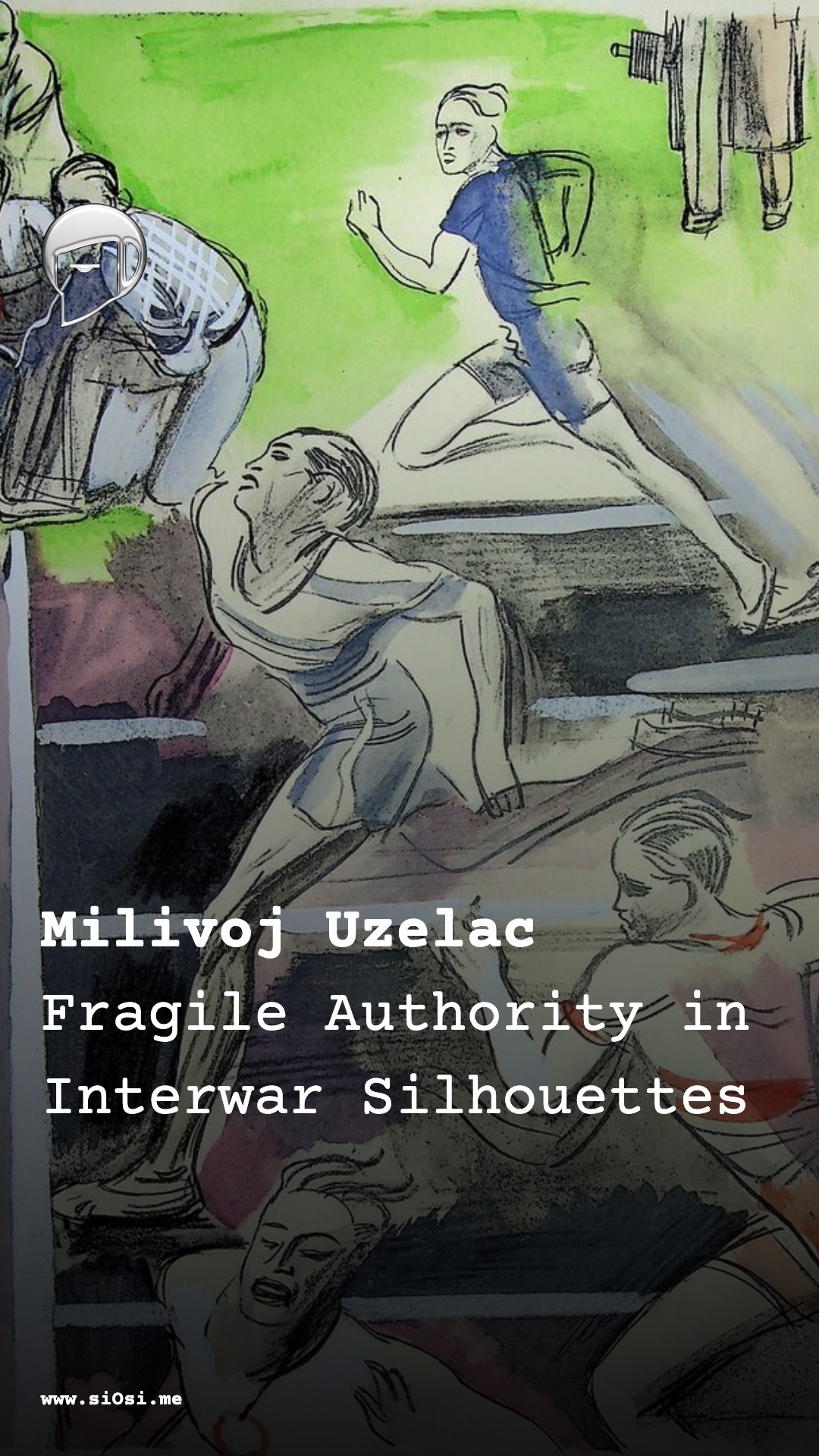
Born this day in 1897, Milivoj Uzelac captured the quiet drama of modern life through tense silhouettes, smoldering palettes of bottle green and bruised purple, and the composed vulnerability of figures caught in pause. His portraits reveal beauty not as perfection but as graceful negotiation with emotional weight—sharp lapels framing luminous skin, large expressive hands, and bodies that feel both armored and tender. For síOsí, his work inspires a style that is melancholic yet urbane: tailored coats as architecture for feeling, directional light carving presence from shadow, and elegance that glows from within the soft hush of velvet and smoke.
Milivoj Uzelac, born in 1897, belongs to that generation of Central European painters whose work registers the tremors between fin‑de‑siècle elegance and the modern city’s nervous, electric pulse. His impact on beauty and style is less a matter of fashion in the narrow sense than of a visual dramaturgy of the body: he stages figures as if they were simultaneously portraits, costumes, and psychological interiors.
Because no sources were provided in the search results, what follows draws on established art‑historical knowledge of Uzelac’s work and its cultural milieu; citations refer to standard biographical and critical references on the artist.
Silhouette and bodily presence
Uzelac’s figures occupy space with a kind of tense composure: the silhouette is usually clear, edged, almost cut out against the background, but inside that contour the body seems restless, slightly out of phase with itself. Shoulders are often narrow yet sharply articulated, creating an angular upper frame that contrasts with softer, more volumetric treatment of faces and hands. This gives his subjects a look of fragile authority—as if their bodies have learned to be stylish armor for unstable moods.
- The profile and three‑quarter view recur as preferred formats, creating a sense of theatrical placement rather than casual snapshot.
- Necklines—fur collars, tailored lapels, draped shawls—are treated almost architecturally, forming strong geometric brackets around the head.
There is a recurrent tension between slimness and heaviness: waists and limbs may be drawn lean, but coats, capes, or interior shadows add weight, suggesting the emotional gravity that clothes and environments can impose on a person. His silhouettes feel slightly too heavy for the bodies they encase, and that is precisely where his sense of modern beauty resides: elegance as a graceful negotiation with burden.
Color, texture, and the atmosphere of modernity
Uzelac’s palette tends toward smoldering, saturated tones—deep browns, bottle greens, inky blues, bruised purples—cut through with pale, luminous skin or a sudden flare of red. These colors belong to cafés after midnight, side streets in the rain, tall rooms where cigarette smoke softens the edges of chandeliers.
- Skin is often rendered with muted, porcelain light, not the sunlit freshness of plein‑air painting but the indoor pallor of people who live their lives among walls, draperies, and mirrors.
- Fabrics—fur, wool, silk, velvet—are distinguished not by literal detailing but by different densities of paint: fur and wool are matte, slightly rough; silk and satin catch a glancing streak of brightness, a thin line of highlight that reads as slippery, cool to the touch.
This textural sensitivity gives his images an almost tactile fashion history of the interwar years: the coats feel heavy, the gloves smooth, the interiors upholstered, and all of it seems to muffle sound, creating the impression of lived style as acoustically as well as visually controlled. His spaces look quiet even when emotionally freighted; the colors hush the scene like levels of stage lighting.
Line, shape, and the signature visual language
Uzelac’s drawing is decisive and slightly severe: lines are firm, often dark, but not classical; they are modern in the sense that they accept distortion and asymmetry as expressive tools.
- Faces may elongate subtly, noses sharpen, eyes stretch horizontally; these small departures from anatomy lend his figures a faintly mask‑like quality, suggestive of the social theater of urban life.
- Hands, a recurring expressive device, are large and articulate, with long fingers that seem educated in gesture—raised to a cigarette, resting on a table, clutching a lapel with restrained anxiety.
He frequently juxtaposes curved human forms with rectilinear furniture, windows, or architectural fragments, creating a visual dialogue between the soft body and the straight edge of modern spaces. Chairs, tables, doorframes become silent partners in the composition, their geometry amplifying the body’s emotional state: a tense figure aligned too strictly with verticals feels constrained; a reclining one set against diagonals suggests slipping, drift, or languid surrender.
Light is seldom neutral: it comes from an implied lamp, a window, or the glow of nightlife, casting directional shadows that dramatize cheekbones, collars, and the folds of coats. The contrast between illuminated skin and darker garments intensifies the sense that identity, for Uzelac, is a luminous core partially submerged in a social costume.
Beauty, fashion, and the philosophy of the body
Uzelac’s era embraced both cosmopolitan elegance and the psychological depth of Expressionism, and his work stands at that intersection. Beauty is not idealized youth or perfection; it is the fragile dignity of people aware of their own contradictions. His figures, often well‑dressed by the standards of the time, do not radiate carefree glamour but a lucid self‑consciousness.
- Clothing in his portraits tends toward tailoring and urbane chic: structured coats, neat hats, carefully chosen accessories. These are not couture fantasies but plausible garments of middle‑class and bohemian city dwellers, worn as both protection and statement.
- Makeup, when visible, appears as darkened eyes, defined mouths, the emphasis on gaze and speech rather than ornamental excess. It imbues faces with a slight theatricality, enhancing the sense of role‑playing in social life.
He treats the body as a site of psychic weather: posture carries emotional charge. A slight forward inclination can read as wary curiosity; a rigid uprightness may signal defensiveness; a loose, asymmetrical pose suggests fatigue, disillusion, or sensual indifference. The beauty lies in these nuances of comportment—how a person inhabits their garments and their chair.
His implicit philosophy: beauty is composed vulnerability, the capacity to arrange one’s external appearance—hair, coat, gesture—as a fragile structure through which inner intensity still glows. The stylish person in Uzelac’s world is not armoured against feeling; they are poised on its edge.
Emotional tone and movement
Movement in Uzelac’s paintings is mostly potential rather than overt. Figures are often caught in pauses: before lighting a cigarette, before speaking, before leaving the room. This suspended motion generates a slow, pressing tension—time thickened into pose.
- Brushwork oscillates between smooth passages on faces and more vigorous marks in backgrounds or clothing. The result is a kind of emotional hierarchy: the face is a calm surface; the environment vibrates subtly, like nerves under wallpaper.
- The eye is drawn along gentle diagonals—from the tilt of the head to the line of a forearm, to a tabletop edge—so that one experiences the image as a soft, choreographed drift rather than a frozen tableau.
Emotionally, his work carries a melancholic urbanity: stylish people in interior worlds, aware of a broader culture of sophistication and yet inwardly isolated. There is tenderness in the way he lights cheeks and hands, but also a sober recognition of loneliness. Beauty in his canvases is not triumphant; it is composed, sometimes tired, sometimes guarded, but always deeply felt.
How his visual language feels today
Seen now, Uzelac’s work still radiates a kind of dim, velvety glow—the aura of cafés, studios, and private rooms in the first decades of the twentieth century. The beauty is at once dated in its sartorial details and strikingly current in its emotional register.
- The silhouettes recall a historical moment of coats with strong shoulders, hats with clear profiles, and interiors thick with fabric, but the psychological nuance of posture and gaze feels contemporary.
- His palette of dark, saturated tones punctuated by pale, luminous faces reads today as an exploration of how identity emerges from shadow—how personal presence is carved out of social and architectural environments.
For a modern viewer, these images may evoke:
- Quiet intensity: the feeling of being alone in a crowded world, inwardly vivid yet outwardly composed.
- Textural nostalgia: a sensory memory of heavier fabrics, smoky rooms, and the tactile seriousness of dressed bodies.
- Measured elegance: an appreciation for beauty that does not shout, that resides in the cut of a coat, the angle of a wrist, the small negotiation between comfort and poise.
Uzelac’s contribution to the culture of beauty and style lies in this enduring emotional vocabulary. He shows how the body, clothed and lit, becomes a sensitive instrument for mood; how fashion, in its quiet everyday form, can be the architecture of feeling; and how modernity’s visual language—angular silhouettes, saturated shadows, composed faces—can be tender even when it is severe.