
Sun in LeoMoon in SagittariusWaxing Gibbous
Born This Day: Alphonse Mucha and the Ethereal Art of Beauty
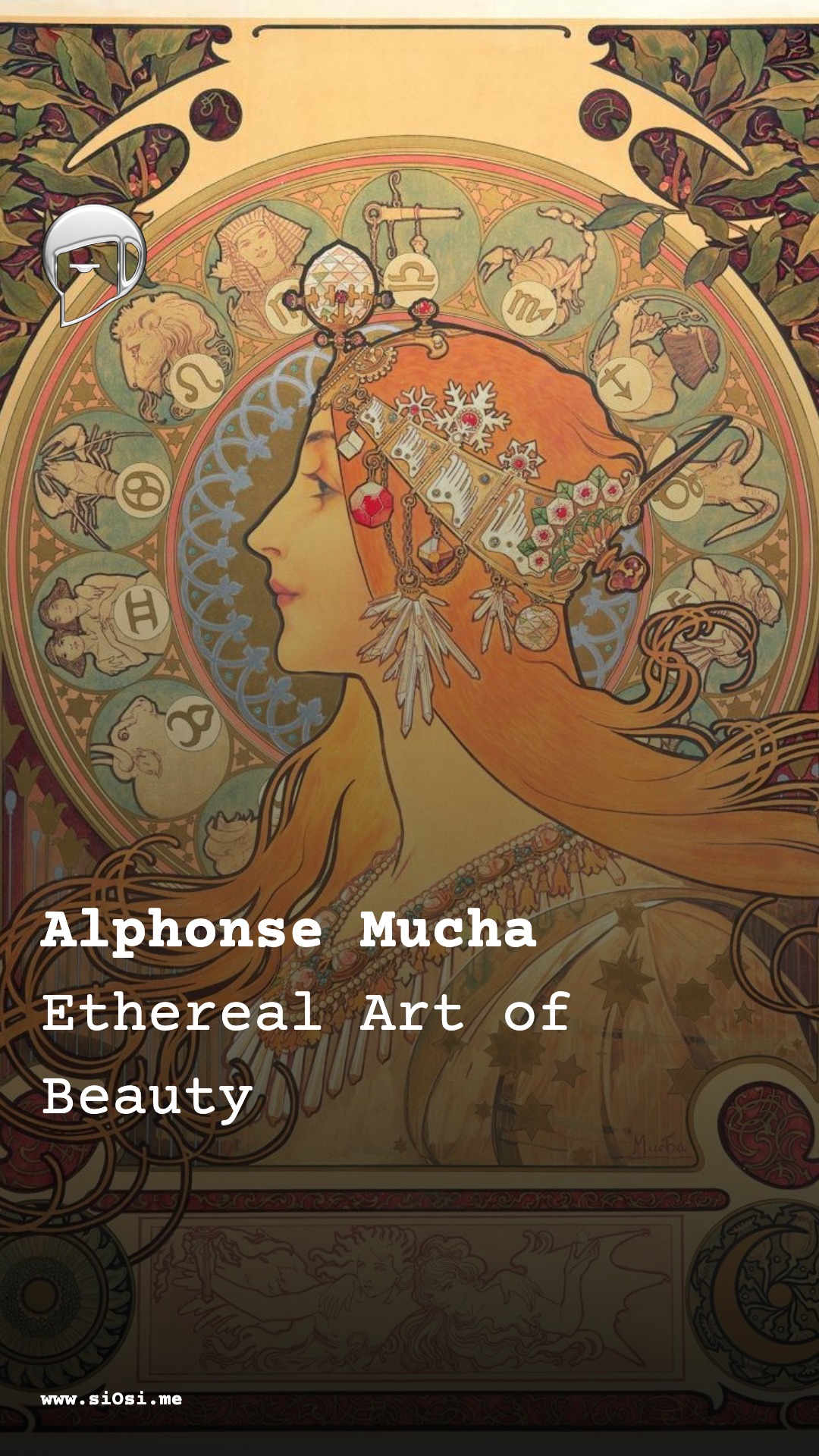
On July 24, 1860, Alphonse Mucha arrived, reshaping how we see beauty forever. His flowing silhouettes, hair like living architecture, and sinuous lines turned women into radiant icons wrapped in floral halos and soft, devotional light. Long draped gowns, languid poses, and muted peach-and-gold palettes created an atmosphere of timeless calm and sensual dignity that still inspires modern style. Mucha made ornament emotional, framing the body as a symbol of grace rather than spectacle. Today we honor his legacy of poetic presence, where beauty radiates outward in unbroken curves and quiet power. Step into his world of Art Nouveau reverie and let every strand of hair and fold of fabric tell its story.
Alphonse Mucha’s birth on 24 July 1860 marks the quiet origin of a visual language in which beauty unfurls as an ornamental force: women become emblems, hair becomes architecture, and the curve of a line carries almost musical emotion. His work crystallized Art Nouveau into an atmosphere—an enveloping, sensual style in which bodies, plants, lettering, and light move together like a single, continuous breath.
1. The transformation of beauty: silhouette, presence, and emotional atmosphere
Mucha’s influence on beauty and style lies less in clothing as mere fashion and more in the way the body is framed, idealized, and staged. In his posters and panels, especially those for the actress Sarah Bernhardt, the female figure becomes both person and icon: a living presence engulfed in halos of ornament, floral whorls, and patterned light.
His typical silhouette is not sharp or tailored; it is expansive and softened, almost vaporous.
- The body is usually cloaked in long, flowing garments, draped in generous folds rather than rigid seams.
- Shoulders and arms slope gently, with the fabric hanging in a continuous cascade from neckline to hem; the figure often widens as it descends, like an opened flower or a tapering column.
- Mucha rarely emphasizes strict anatomical precision; instead he prioritizes the emotional contour of the pose—tilted heads, slightly bent wrists, a languid weight in the hips and spine that suggests reverie, calm, or dreamy alertness.
This produces a soft, devotional aura. His women do not stride or confront; they radiate, as though beauty is something that suffuses outward from a still center. The emotional register is rarely violent or dramatic; even when his subject is a theatrical star, the mood is contemplative, gently exalted, suffused with quiet confidence.
The emotional atmosphere of his compositions is built through repetition and rhythm. Circular frames, mandorlas, and halos contain the figure, echoing religious icon painting, but instead of ecclesiastical severity he offers sensual restfulness: beauty as a continuous, unbroken line. This has had a lasting effect on visual culture—Mucha made ornament itself emotional, turning decorative motifs into carriers of feeling rather than mere embellishment.
Line: the sinuous, organic script of Art Nouveau
Mucha’s line is the defining instrument of his style: long, sinuous, organic, and unbroken, it glides around figures and motifs like a calligraphic caress.
- Hair becomes a forest of lines: tendrils coil, loop, and drift in thick, sculptural waves around the face and shoulders.
- Fabric folds are traced not as stiff planes but as rippling, rhythmic curves, each contour echoing the next.
- Botanical motifs—flowers, leaves, stems—extend this vocabulary, mingling with the human figure so that bodies and plants seem to grow from the same continuous root.
Art Nouveau as a movement is defined by this elongated, organic line, and Mucha is among its most archetypal exponents. His posters demonstrate how the line can be both graphic and sensuous: it has the crispness of print design, but its curves suggest touch, fragrance, and the softness of skin. This duality—precise yet voluptuous—remains central to how we imagine “Art Nouveau” today.
Color: muted lushness and atmospheric palettes
Mucha’s colors are distinctive: delicate, tempered, and harmonious, rarely harsh.
- Palettes often revolve around shades of peach, gold, ochre, and the pale green known as eau de Nil.
- These tones are warm but not saturated to excess; they evoke aged tapestry, dried petals, polished brass, and sunlit stone more than jewel-like brilliance.
- He frequently uses gentle contrasts: pale skin against deeper, earthy backgrounds; soft greens and creams offset by gold outlines and deep browns.
This color language produces a sensation of ambient warmth, like light filtered through stained glass or mist. It suggests nostalgia and timelessness—beauty at one remove from reality, as if already remembered. Even in advertising, the colors refuse aggression; they invite lingering, a slow reading of the image.
Texture: the ornamental surface as tactile dream
Although his works are printed and drawn, Mucha infuses them with a tactile imagination. He suggests texture through ornament:
- Hair appears thick and weighty, nearly sculptural, its waves layered so densely that they resemble carved wood or embossed leather.
- Cloth becomes an opulent surface—fine, rippling, and abundant—more like draped velvet or silk than simple cotton; it visually conveys softness and a slight heaviness, suggesting gravity and languor.
- Backgrounds are often crowded with decorative motifs—mosaics, radial patterns, floral encirclings—that mimic the sensation of carved stone, ceramic tiles, or brocade wall hangings.
The visual effect is of a sensory envelope—as if the viewer could feel the weight of the hair, the rustle of the garments, the cool hardness of the ornamental frame. Beauty in Mucha’s world is not only seen; it is imagined as physically experienced.
Movement: suspended motion, poised between gesture and stillness
While many of his figures are technically static, there is always an implication of slow, continuous movement:
- Hair appears wind-touched, curling and drifting, as though caught in a perpetual soft breeze.
- Hands and arms often adopt delicate, choreographed poses—fingers slightly splayed, wrists gently angled, suggesting speech, invocation, or a theatrical flourish just completed.
- Drapery flows along diagonal and curved compositional lines, hinting at recent movement that has come to rest.
This results in an impression of arrested motion: the figure is frozen in a moment of emotional intensity—contemplation, enchantment, sensual awareness—rather than merely in a physical stance. The viewer feels a time just before and after the image, a slow cinematic atmosphere, which lends his posters their enduring sense of drama.
3. Beauty, the body, and the philosophy of ornament
Mucha’s work is inseparable from Art Nouveau and its broader philosophy: the belief that art should permeate daily life and that the organic forms of nature offer a model of beauty that is at once modern and eternal. Within this, his attitude toward the body is notable.
The body as emblem, not spectacle
Mucha repeatedly paints women as central archetypes—Muses, Seasons, Arts, Virtues—rather than as individualized portraits. Their faces are idealized, serene, slightly distant; their gaze is often reflective, turned away or softened. This suggests a view of beauty as symbolic presence: the female body stands for music, perfume, theatre, the calendar months, or abstract qualities such as wisdom and hope.
Unlike many contemporaneous depictions of women, which emphasize erotic display, Mucha leans into sensual dignity. Necklines may be open, hair abundant, but the emotional tone is reverent. Ornament does not humiliate or fragment the body; it exalts and cradles it, setting it within an elaborate frame as one precious element among many.
Ornament as ethics of care
In Mucha’s imagery, ornament is not mere decoration added to a finished figure; it appears as a natural emanation from the body. Floral garlands, jewels, patterned halos, and radiant backgrounds all seem to sprout from the figure’s presence, implying that beauty generates its own environment.
This suggests a subtle philosophy of beauty:
- Beauty is relational—it thrives in context, in the interplay between body, nature, typography, and design.
- The body is honored through framing and attention; the care taken in line, color, and motif implies respect and tenderness.
- Ornament becomes a form of visual devotion, as if the image is a shrine to a particular mood, season, or art form.
His approach deeply influenced poster design and commercial imagery by insisting that even advertisements could be suffused with this ethical ornamental care—that daily life, including publicity, could be touched by a quasi-sacred aesthetic.
4. Lasting stylistic impact: posters, typography, and the decorative imagination
Mucha’s fame in Paris in the 1890s, especially after the success of his poster “Gismonda” for Sarah Bernhardt, helped redefine the poster as a high aesthetic object rather than a simple announcement.
Poster as stage and halo
He transformed the poster format into a vertical, theatrical proscenium:
- The central figure—often a woman—occupies the tall, narrow space like a star on stage, her body elongating the rectangle.
- Above or around her, lettering and ornament intertwine; typography is integrated into the decorative system rather than simply overlaid.
- Circular frames, medallions, and floral bands create a sense of haloed focus, drawing the eye to the face and hands.
This visual architecture influenced subsequent graphic design, from commercial posters to book covers, by demonstrating how hierarchy of attention could be shaped through ornament, line, and framing rather than only through bold contrast.
Typography and visual language
Mucha’s posters helped consolidate a mode of typography in which letterforms echo the organic curves of the imagery:
- Titles and names often appear in stylized fonts with rounded terminals, asymmetrical thickness, and soft curves that harmonize with the flowing hair and drapery around them.
- This approach treats text as part of the ornamental field—words are visual objects, not merely carriers of meaning.
The result is a unified visual language where body, nature, and text occupy the same decorative universe. This harmony remains a key aspiration in contemporary graphic and fashion imagery that recalls Art Nouveau: the desire to make every element sing the same song of line and curve.
5. How Mucha’s work feels today: contemporary emotional resonance
Encountering Mucha’s images now, one feels an immediate soft glow of nostalgia and gentle opulence. The works evoke several overlapping sensations:
- Timeless calm: The serene expressions and poised gestures convey a quietness that seems detached from modern speed. Faces appear lost in thought, unhurried, absorbing and releasing emotion very slowly.
- Romantic idealization: His women are impossibly composed—they embody a dream of beauty that is not meant to be strictly realistic but emblematic, a poetic condensation of grace and allure.
- Decorative embrace: The dense, surrounding ornament produces a feeling of being held within pattern; the eye is enveloped, moving from figure to mandala to floral trace in a circular drift.
There is also a contemporary sense of melancholic sweetness:
- The colors, slightly muted, feel like aged paper, perfume bottles on an old dressing table, theatre posters from a vanished boulevard.
- The style has become emblematic of an era; thus it carries the mood of a past dream, a memory of a world where beauty could be formalized into curving lines and fragrant palettes.
Yet the images retain an undeniable freshness. The organic line feels perennially modern: it suggests fluidity, growth, and connection with the natural world—concerns that remain vivid today. The integration of art, design, and daily life anticipates current interest in holistic aesthetics. Mucha’s sensibility continues to offer a vision of beauty as immersive environment, not merely surface, inviting viewers into a softly lit realm where every curve, petal, and strand of hair participates in a shared, luminous mood.
6. Emotional and visual legacy in fashion and beauty
Although Mucha was not a fashion designer, his visual language has deeply permeated fashion and beauty culture through silhouettes, motifs, and ideals of feminine presence.
- The long, flowing dresses and draped fabrics he favored anticipate and inspire later romantic styles: gowns that move like water, sleeves that bell and flare, textiles that emphasize fluidity over structure.
- His hair imagery—abundant, swirling, and central—contributes to an enduring ideal of hair as a primary site of expression and sensuality, framing the face with movement and volume.
- The emphasis on ornamental headpieces, jewelry, and floral crowns recurs in numerous later aesthetic moments, linking beauty to botanical and celestial symbolism.
In terms of emotional presence, Mucha proposes a model of beauty that is:
- Self-contained: the women in his images seem complete in themselves, surrounded but not overwhelmed by ornament.
- Softly powerful: their stillness radiates authority; they command the space not by force but by luminous composure.
- Poetic rather than literal: beauty is felt as atmosphere and rhythm before it is understood as clothing or product.
This legacy continues to inform how visual culture imagines “ethereal” or “romantic” beauty: serene faces, elaborate halos of hair and ornament, muted yet glowing color, and a body that exists as the calm center of an elaborate decorative world.