
Sun in LeoMoon in CapricornFull Moon · Buck Moon
Duchamp's Quiet Revolution: Beauty as Thought, Not Sight
On this day in 1887, Marcel Duchamp arrived, quietly dismantling beauty as mere visual pleasure. He traded retinal dazzle for conceptual clarity—plain porcelain, industrial metal, transparent glass, and the poised artifice of Rrose Sélavy. His readymades turned everyday objects into questions, while fragmented motion in Nude Descending a Staircase replaced soft flesh with angular diagrams. Today his legacy whispers through minimalist silhouettes, honest textures, and the idea that style is a performance of ideas rather than ornament. At síOsí we celebrate this cool, lucid elegance: beauty that thinks, ironizes, and invites you to look twice.
Marcel Duchamp’s birth on 28 July 1887 marks not only the arrival of a pivotal conceptual mind, but the quiet beginning of a long, deliberate undoing of beauty itself as a fixed visual law. His impact is less a single image than a slow rearrangement of how images, bodies, and objects are allowed to appear, to be looked at, and to mean.
1. Rewriting Beauty: From Retinal Pleasure to Mental Style
Duchamp is famously associated with a refusal of “retinal” art—the idea that painting should exist primarily to please the eye. Instead, he proposed a beauty located in thought, irony, and displacement, shifting style from surface to structure.
Visually, this meant a stark reduction of sensual flourishes and a preference for plain, manufactured surfaces, neutral colors, and industrial textures over lush painterly effects. What earlier artists had wrapped in chiaroscuro and ornament, he stripped to bare objecthood: metal bolts, glass panes, the dull satin of porcelain, the matte utility of a bottle rack or snow shovel.
This austerity—however humorous—reshaped the emotional climate of modern art. Instead of the intoxication of color and form, Duchamp offered a cool, lucid temperature, a sense that the artwork is something to puzzle over rather than to be seduced by. Beauty became a question, a proposition, a joke whose elegance lay in its conceptual precision.
Fragmented Motion
Early works such as Nude Descending a Staircase, No. 2 (1912) condense a figure’s movement into overlapping planes and rhythmic shards of brown, ochre, and black, like a single body caught in multiple exposures. The silhouette dissolves into a mechanical cascade of angles, a body rendered as a system of articulated parts rather than soft flesh. The lines are sharp, directional, and almost metallic; they suggest joints, hinges, and gears.
The emotional feeling of this image is strangely impersonal: instead of erotic nudity, one encounters a kind of kinetic diagram, movement itself as an aesthetic object. Traditional sensual beauty is replaced by the beauty of structure—of motion abstracted and cooled.
Industrial Objects and Readymades
Duchamp’s readymades—ordinary manufactured items designated as art—introduced a visual language of serial production and functional form.
Typical elements include:
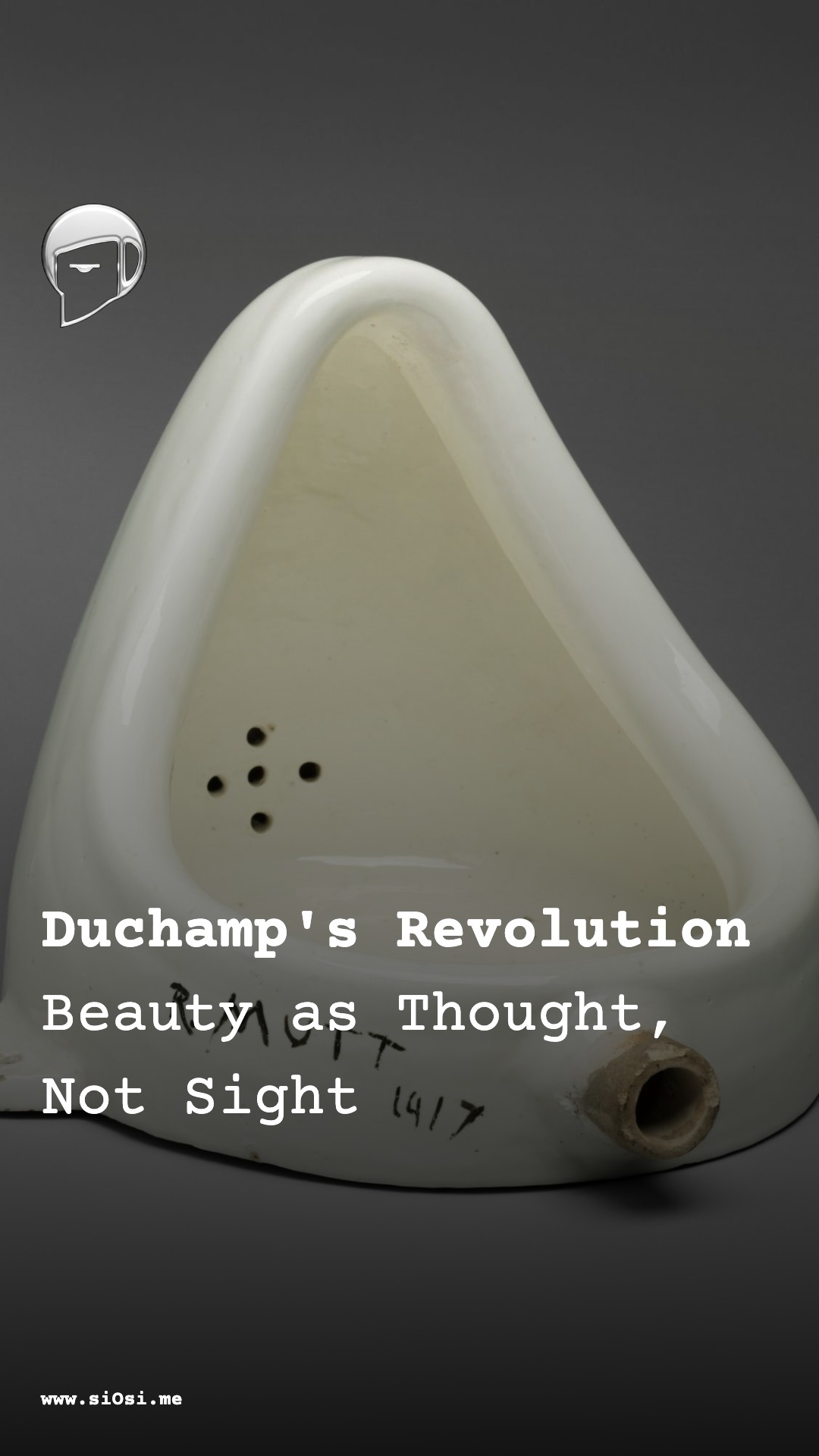
- Shape: simple, geometric contours—curves of a bicycle wheel, the rectilinear frame of a bottle rack, the pure oval of a urinal.
- Color: largely non-expressive; creams, whites, metallic greys, commercial glazes, factory finishes.
- Texture: smooth porcelain, cold metal, standard wood—surfaces meant for utility, not caress.
- Line and posture: the object stands or hangs as it would in a shop or workshop, with no theatrical posing; its “posture” is that of bare function.
By refusing painterly intervention, he allowed industrial finish itself to become the aesthetic. This is a radical inversion: the artist’s signature is not a brushstroke but a choice, a title, a context. The visual drama lies in the tension between the object’s banal appearance and its elevated status.
Glass, Transparency, and Layered Space
In works like The Bride Stripped Bare by Her Bachelors, Even (The Large Glass), Duchamp used actual glass as support, allowing light to pass through the work and mingle with its surroundings. Dust, cracks, and time become part of the composition, softening mechanical diagrams with the patina of accident.
The visual language here is one of transparency, suspended forms, and faint, almost ghostly line—a mixture of technical drawing and erotic allegory. Shapes hover in an ambiguous space, neither fully present nor absent, suggesting machinery and bodies without fully describing either. The emotional presence is delicate and unsettling: desire rendered as a system, then left to age under real dust and gravity.
3. Attitude Toward the Body: Eroticism, Irony, Disguise
Duchamp never abandoned the human body; he transformed how it appears. His attitude is at once erotic and anti-sentimental. Bodies become diagrams, allegories, or mechanical metaphors: brides as apparatuses, bachelors as component parts, nudity as motion study.
There is a persistent sense of distance: even where desire is invoked, it is filtered through intellectual play and symbolic machinery rather than indulged in direct sensual depiction. Beauty of the body becomes a problem to be solved, not a given.
His adoption of the alter ego “Rrose Sélavy”—captured in photographic portraits in which he appears in feminine dress and makeup—extends this inquiry to gender and presentation. The visual effect is restrained yet striking:
- Makeup: carefully applied lipstick, defined eyebrows, an almost mask-like clarity of features.
- Hair: styled in modish waves, framing the face with controlled softness.
- Posture: composed, poised, self-aware; the body as a performance of gender rather than a natural fact.
These images carry a cool, hypnotic charm: beauty as role, as costume, as sign, underscoring how style can be fundamentally conceptual, an arrangement of cues.
4. Silhouette, Color, Texture: Anti-Luxury Elegance
Duchamp’s broad influence on fashion and style is felt less in specific garments than in an aesthetic of refusal and understatement. His work makes room for an elegance that is dry, sparse, and skeptical of decorative excess.
- Silhouette: where painting once celebrated swelling curves and opulent drapery, Duchamp’s figures and subjects lean toward lean, angular, and assembled forms. Even his more organic shapes are subordinated to a structural rhythm.
- Color palette: often hushed—browns, greys, muted yellows, whites—favoring the tonal range of aged paper, metal, and utility ceramics rather than sumptuous pigments.
- Texture: the visual fascination shifts to the factual texture of things: rough industrial metal, smooth glazing, the fine film of dust, the dull gleam of glass. His choice to leave The Large Glass cracked after an accident, integrating fracture into the work, exemplifies this acceptance of material reality as aesthetic.
Emotionally, this palette and texture produce a reserved, almost ascetic mood. Instead of intoxication, one feels a quiet alertness, the silver light of a workshop rather than the warm glow of a salon. It is a beauty that stands back from itself, as if watching how taste operates.
5. Movement and Emotional Presence
Across his career, Duchamp’s presence is marked by a deliberate slowing of movement: away from the feverish production of paintings toward sparse, carefully timed interventions. This refusal to continually generate new visual spectacle becomes, in itself, a stylistic gesture.
Emotionally, his work often radiates:
- Cool irony: a gentle, dry humor that empties pathos from objects, leaving them to sit plainly under our gaze.
- Tension: the friction between everyday banality and elevated status—between a urinal’s blunt functionality and its recontextualization—produces a quiet, electric unease.
- Detachment with a trace of tenderness: his acceptance of chance, accident, and aging gives his works an almost melancholy light, as though the world’s incongruities were being observed with a calm, slightly amused sympathy.
The “glow” they emit today is not luminous in a traditional sense; it is the glow of conceptual clarity, of objects lit by thought rather than spotlight.
6. How Duchamp’s Aesthetic Feels Today
Viewed now, Duchamp’s work carries the emotional timbre of a carefully lit laboratory or a reflective studio at dusk. His surfaces—porcelain, glass, metal—catch a thin, disciplined light, stripping away the romantic haze and leaving form to stand with austere precision.
The impact on contemporary beauty and style lies in the space he opened for:
- Minimal, idea-driven aesthetics, where a single altered object can rival a vast painted spectacle.
- Gender and identity as stylized constructs, as seen in the poised artifice of Rrose Sélavy.
- Material honesty, where cracks, dust, and wear are not flaws but integral to the visual and emotional texture.
His legacy feels like a steady, quiet pressure against ornament for ornament’s sake. The emotional presence is one of clear-headed skepticism mixed with subtle, playful charm—an enduring reminder that beauty can be as sharp as a question, as weightless as a thought, and as visually precise as a well-chosen object set under steady light.