


Sun in LibraMoon in CancerThird Quarter
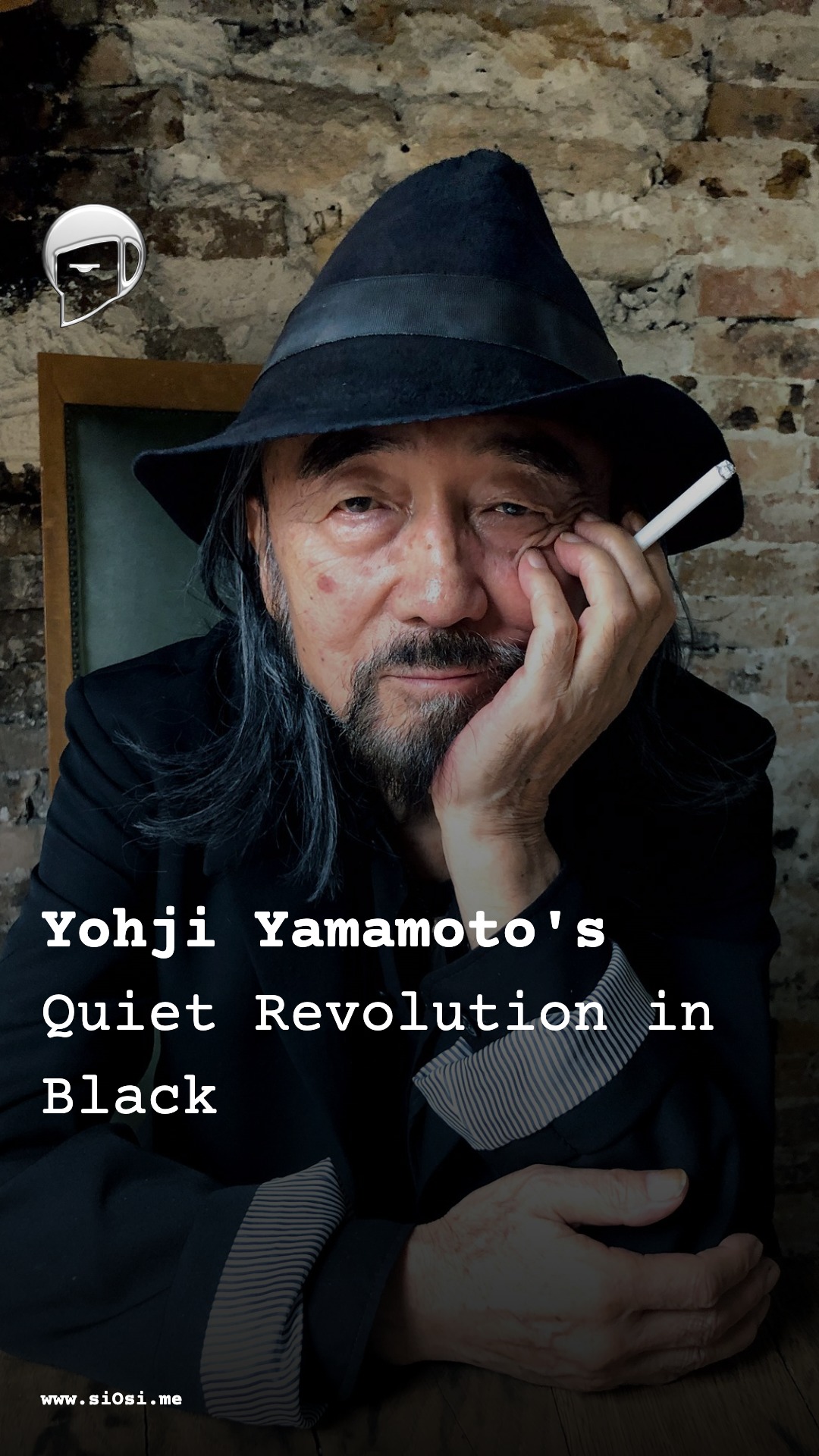
Yohji Yamamoto's Quiet Revolution in Black
Yohji Yamamoto landed in 1943 and made black feel like armor with attitude. His loose silhouettes and raw seams turned the body into something private and powerful, never screaming for attention. The "Shock of Black" hit Paris hard when those floor-grazing coats first floated down the runway. He treats imperfection like a feature, not a flaw, letting asymmetry and volume create space for real movement and thought. One line sums it up: black is modest and arrogant at the same time.
Yohji Yamamoto, born in Tokyo in 1943, entered fashion history as a quiet radical: a poet of black, a constructor of shadows, and a designer who treated the body less as a surface to be idealized than as a presence to be veiled, protected, and complicated. His work redefined beauty through looseness, asymmetry, and imperfection, exchanging the glitter of fashion for a darker, contemplative radiance.
Yamamoto’s aesthetic impact is inseparable from his monochrome palette. From the early 1980s, his collections were predominately black, occasionally relieved by charcoal, slate, white, and rare, strategic flashes of red. He described black as “modest and arrogant at the same time… lazy and easy – but mysterious… above all black says: I don’t bother you – don’t bother me.” In his hands, black ceased to be mere absence of color and became a field of nuance: warm and cool, understated and flamboyant, protective and subversive. Where Western fashion had long associated black with mourning or chic minimalism, Yamamoto expanded it into a philosophical condition – neutrality, distance, autonomy, and attitude. The press spoke of the “Shock of Black” when his loose, dark silhouettes first appeared in Paris, replacing bright color with shade, fitted shapes with volume, symmetry with asymmetry.
The silhouette is where his revolution is most viscerally felt. Yamamoto’s clothes often envelop the body in long, fluid, and voluminous forms that blur the conventional demarcations of waist, hip, and bust. Coats that graze the floor, jackets with dropped shoulders, trousers that widen and taper by unexpected degrees: these garments surround the wearer in folds and drapes that create distance between cloth and skin. The resulting silhouettes are neither traditionally masculine nor feminine but instead hover in a space of unisex ambiguity, a presence that is strong yet uninsistent. He plays with oversize in precise ways – loose but not baggy, with carefully judged proportions that keep the form architectural rather than slack. This handling of volume produces a particular emotional effect: bodies appear calm, shielded, and self-possessed, occupying more space without performing aggression.
Deconstruction is the second pillar of his visual language. Critics have called him a “master of deconstruction” and even the “father of deconstruction,” recognizing his tendency to take garments apart and reassemble them in unconventional shapes. Seams are shifted or exposed, hems left raw, closures displaced or undone. Pieces seem unfinished, tattered, haphazardly put together, though the apparent disorder conceals exacting craft. The clothing often looks as if it is caught mid-process: panels misaligned, fabrics layered at odd angles, sleeves of different lengths, jackets sliced and reattached. This visible construction gives the garments a conceptual clarity – the wearer carries not only fabric but evidence of thought, cutting, and recomposition.
Yamamoto has articulated a philosophy of imperfection that underlies this practice. He speaks of “the negation of perfection” and “the beauty of imperfection,” declaring that “perfection is ugly” and that human-made things should contain flaws and distortions. This affinity aligns with Japanese aesthetics that value the natural, the organic, and the incomplete, and it manifests in dressmaking techniques related to non‑Western methods of construction. His garments mask the body with layers and folds, diminish frontality, and blur the inside and outside of clothing. Instead of the sleek, exposed curves of Western fashion, one encounters the irregular, the asymmetrical, the slightly off. Beauty appears not in polished finish but in the tension between control and accident.
Texture and material reinforce this mood. Yamamoto’s collections frequently combine cotton, linen, mesh, leather, and tulle in overlapping configurations, collaging different surfaces to produce quiet drama. Black coats with red tulle bustles, for instance, juxtapose dense, matte outer layers with sudden eruptions of translucence and color. Fabrics are often chosen for their drape and weight, so that movement remains slow, considered, with a gentle swing rather than a sharp flutter. The presence of raw edges and exposed seams transforms texture into narrative – fraying threads and visible stitching suggest wear, memory, and process. The body is never simply wrapped; it is surrounded by evidence of cutting, unmaking, and remaking.
In motion, Yamamoto’s clothes acquire a particular choreography. His silhouettes are designed to create spaces between fabric and skin – a concept tied to the Japanese notion of ma, negative space that allows air and movement to circulate. As the wearer walks, the garments do not cling but breathe. Coats open slightly around the legs, panels lift and fall, layers slide against each other. This movement is not flamboyant but theatrical in a gentle, shadowy sense: the figure seems to glide in a personal atmosphere. The looseness invites gestures that are less rigid, more contemplative; shoulders can relax, steps lengthen, the body can withdraw or emerge at will. The emotional presence is one of composed privacy rather than display.
Yamamoto’s attitude toward the body and beauty stands against mainstream fashion’s emphasis on revelation and perfection. His clothes often mask the body, obscuring conventional erotic markers and sidestepping the demand for visible ideal form. Instead of sculpting a narrow waist or accentuated bust, he offers volumes that float around the torso, trousers that cut a strong line without clinging, coats that become portable architecture. The body inside remains real, fallible, unidealized. This withholding produces a different kind of beauty: introspective, serious, and independent of normative attractiveness. By favouring unisex cuts and silhouettes that resist categorization, he quietly challenges gendered codes of dress and expands the visual language available to both men and women.
His use of light and contrast is subtle yet decisive. On an all‑black runway, variation comes through gloss, matte, transparency, and the interplay of dark with occasional white or red. Bright red appears as a disruption – a bustle, a lining, a flash beneath a coat – slicing through the shadow and heightening the depth of the surrounding black. White garments, when they appear, read not as purity but as negative prints of his dark pieces, emphasizing cut and space with almost surgical clarity. The overall atmosphere is of low‑key contrast, where the eye reads edges and layers slowly, discovering the garment through time rather than instant spectacle.
Though Yamamoto is primarily discussed as a fashion designer, his work touches broader cultural currents in art and style. Scholars have examined the influence of conceptual art on his designs, noting how deconstruction and black function as conceptual devices as much as stylistic ones. His practice, rooted in postwar Japan and his mother’s widowhood, inflects black with biography and inheritance: a color of neutrality that refuses melodrama yet speaks of history. In the 1980s his bleak, deconstructed clothing was initially perceived in the West as disaster, war, or ruin, but he insisted on black as a space of calm, a refusal of spectacle. Over time, this recalibration has seeped into urban aesthetics, making layered black and asymmetry a favored look for those who seek a serious, non‑ornamental style.
Today, Yamamoto’s work continues to evoke a particular emotion – a quiet glow of autonomy, introspection, and resistance to superficiality. All‑black ensembles with theatrical drapes and radical asymmetry still feel contemporary, even as trends cycle through maximalism and normcore. His clothes preserve a sense of shelter and remove: the wearer appears present yet untouchable, alone yet dignified in the crowd. The beauty he proposes is not one of youth, sparkle, or perfection, but of endurance, shadow, and thoughtful imperfection. In an era saturated with visual noise, his black remains not a void but a concentrated field of feeling – modest and arrogant, lazy and mysterious, softly luminous in its refusal to explain itself.