
Sun in LibraMoon in LibraNew Moon
Rei Kawakubo and the Beauty of Fashion's Voids
Rei Kawakubo turned fashion inside out the day she arrived in 1942. She built presence from absence, letting raw seams and lopsided hems speak louder than any ornament. Black became her weapon, swallowing light and refusing the cute hyper-femininity of the time. Those Karasu Zoku kids in layered silhouettes proved you could vanish the body on purpose and still feel powerful. Her work keeps asking what beauty even means when you stop trying to decorate it.
Rei Kawakubo: The Aesthetic Philosophy of Negation and Renewal
Born on October 11, 1942, in Tokyo, Rei Kawakubo emerged into a Japan still bearing the visible and psychological scars of post-war reconstruction. This temporal positioning would prove foundational to her entire aesthetic vision—a vision that would ultimately redefine how the world understood the relationship between body, garment, beauty, and meaning itself.
The Visual Language of Absence
Kawakubo's design philosophy rests upon a paradoxical foundation: the creation of presence through absence, of beauty through apparent negation. Her signature visual language emerged not from ornamentation or embellishment, but from what she chose to remove, to deconstruct, to leave deliberately incomplete or ambiguous. This approach represents a fundamental departure from Western fashion's traditional pursuit of enhancement and idealization of the body.
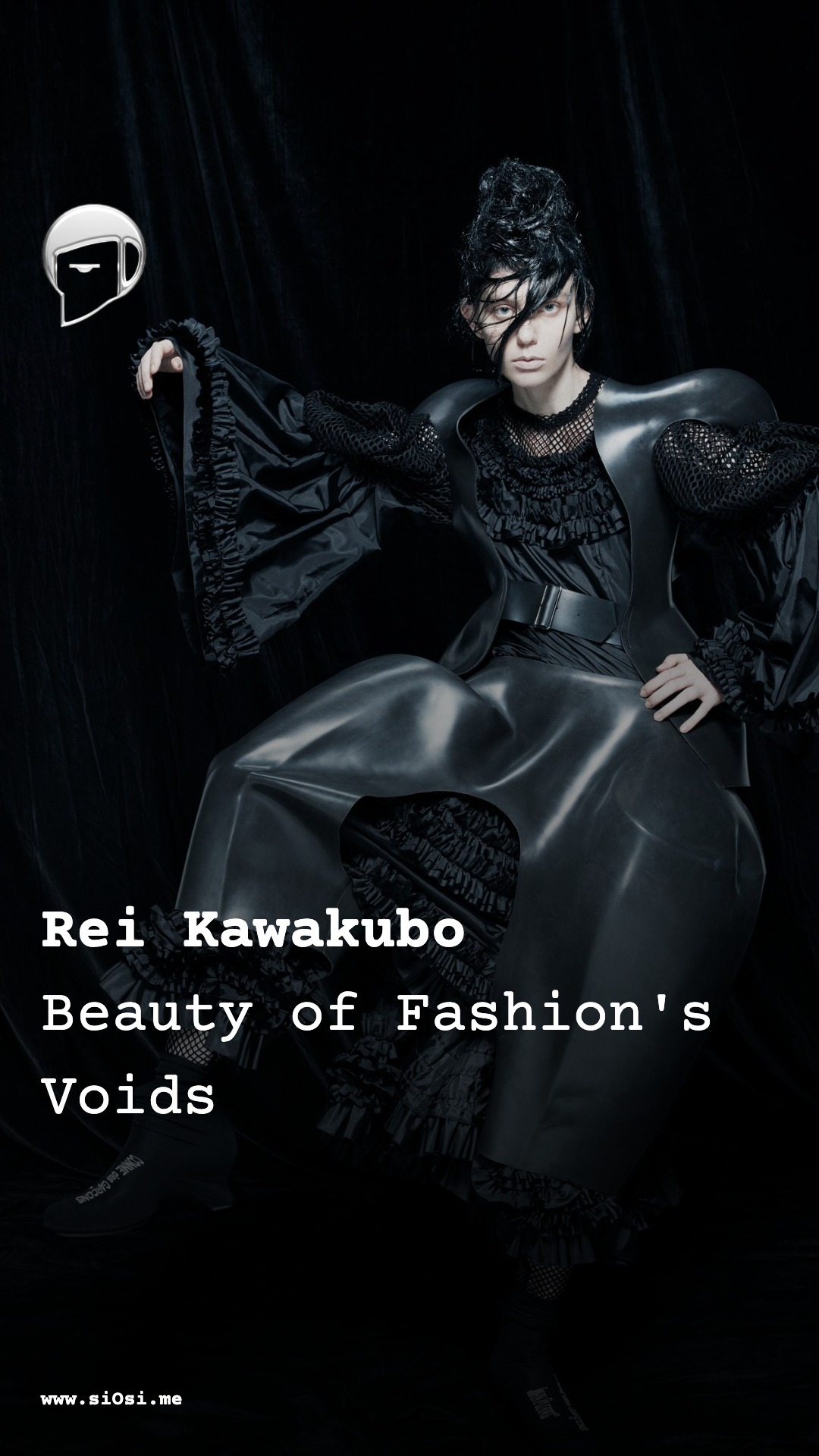
The silhouettes that emerged from Comme des Garçons—the label she founded in 1969—rejected the conventional fashionable body entirely. Rather than sculpting fabric to flatter predetermined notions of feminine form, Kawakubo's garments created what might be described as architectural voids. Shoulders were padded to monumental proportions, then left to hang with an almost sculptural weight. Hems were deliberately uneven. Seams appeared on the exterior, exposing the skeleton of construction itself. The body within these garments became secondary to the conceptual statement of the garment itself—a radical inversion of fashion's traditional hierarchy.
The Chromatic Rebellion
The introduction of total black as Kawakubo's signature palette carried profound cultural resonance, particularly within the Japanese context. In a nation where black held associations exclusively with mourning and funeral rites, her insistence on this color as the foundation of contemporary style represented an act of cultural defiance. This was not the black of elegance or evening wear in the Western tradition, but rather a black that absorbed light, that seemed to negate rather than reflect, that positioned the wearer as a figure of deliberate negation against conventional beauty standards.
When this aesthetic was adopted by Japanese youth in the form of the Karasu Zoku movement—the "crow tribe"—the cultural implications became unmistakable. Young women, particularly, adopted Kawakubo's and Yohji Yamamoto's layered, androgynous black silhouettes as an explicit rejection of the dominant cute and hyper-feminine aesthetic that had come to define Japanese popular culture. The visual effect was one of deliberate opacity: multiple layers obscuring the body's contours, creating silhouettes that refused easy categorization or sexualization. This represented not merely a fashion choice, but a philosophical stance toward beauty itself.
The Texture of Deconstruction
Kawakubo's approach to fabric and construction introduced a new vocabulary of texture to fashion discourse. Rather than seeking perfection in finish, her garments often displayed raw edges, exposed seams, and deliberately imperfect hems. Fabrics were sometimes treated to appear weathered or damaged, as though the garment had already lived a life before being worn. This aesthetic choice—which critics would later term "Hiroshima chic," a designation Kawakubo herself did not embrace—created garments that seemed to carry historical weight and emotional complexity within their very fiber.
The visual impact was one of controlled chaos: structured forms containing apparent disorder, precision in the service of disruption. Kawakubo's designs occupied what she herself would describe as "the in-between"—the liminal spaces between opposing concepts that Western fashion had long treated as natural rather than constructed. Between masculine and feminine, between finished and unfinished, between beauty and its negation, her work generated a visual language that refused resolution.
Philosophy of the Body and Beauty
Kawakubo's approach to the fashionable body emerged directly from her intellectual formation. Having studied art and literature at Keio University rather than fashion design, she brought to garment construction the conceptual rigor of visual art and literary theory. Her designs consistently questioned what constituted beauty, what made a body "fashionable," and whether conventional notions of elegance and proportion were natural or merely cultural constructs imposed through repetition and habit.
This questioning manifested visually in garments that obscured rather than revealed, that padded and distorted rather than refined, that created silhouettes bearing no relationship to idealized body forms. A Kawakubo garment did not promise to make the wearer more beautiful in conventional terms; instead, it offered the possibility of transcending beauty altogether, of existing in a space beyond the binary of attractive and unattractive.
The Emotional Resonance of Negation
The emotional impact of Kawakubo's work—then and now—derives from its refusal of easy comfort. Her garments do not soothe or flatter; they challenge and provoke. Yet within this challenge lies a peculiar form of liberation. By rejecting the conventional markers of beauty and desirability, her designs offered wearers the possibility of existing outside the surveillance and judgment that typically accompanies fashion. The body within a Kawakubo garment becomes less visible, less subject to evaluation, less trapped within predetermined categories.
This represents a fundamentally different emotional register from most fashion design. Where conventional design seeks to evoke admiration, desire, or aspiration, Kawakubo's work evokes contemplation, discomfort, and intellectual engagement. The visual experience of encountering her designs—whether on a runway or in a gallery context—generates a kind of productive uncertainty. The viewer must work to understand what they are seeing, must resist the impulse to categorize and dismiss, must remain present with ambiguity.
The Lasting Visual Legacy
Decades after her Paris debut in 1981, Kawakubo's aesthetic continues to exert profound influence on how designers approach the relationship between body and garment, beauty and negation, East and West. Her visual language—the deconstructed seam, the oversized silhouette, the deliberate imperfection, the chromatic severity—has become so thoroughly absorbed into contemporary fashion that its revolutionary origins are sometimes forgotten.
Yet the emotional and philosophical stance underlying these visual choices remains as radical as ever. In an era of increasing visual saturation and the relentless pursuit of enhancement through digital and physical means, Kawakubo's insistence on absence, on the beauty of incompleteness, on the liberation possible through visual negation, continues to resonate with particular intensity. Her work suggests that beauty need not be decorative, that the fashionable body need not be revealed or idealized, and that the most profound aesthetic experiences may emerge from what is deliberately withheld rather than what is generously displayed.