
Sun in LibraMoon in CancerThird Quarter
Makoto Aida's Kawaii Meets the Grotesque
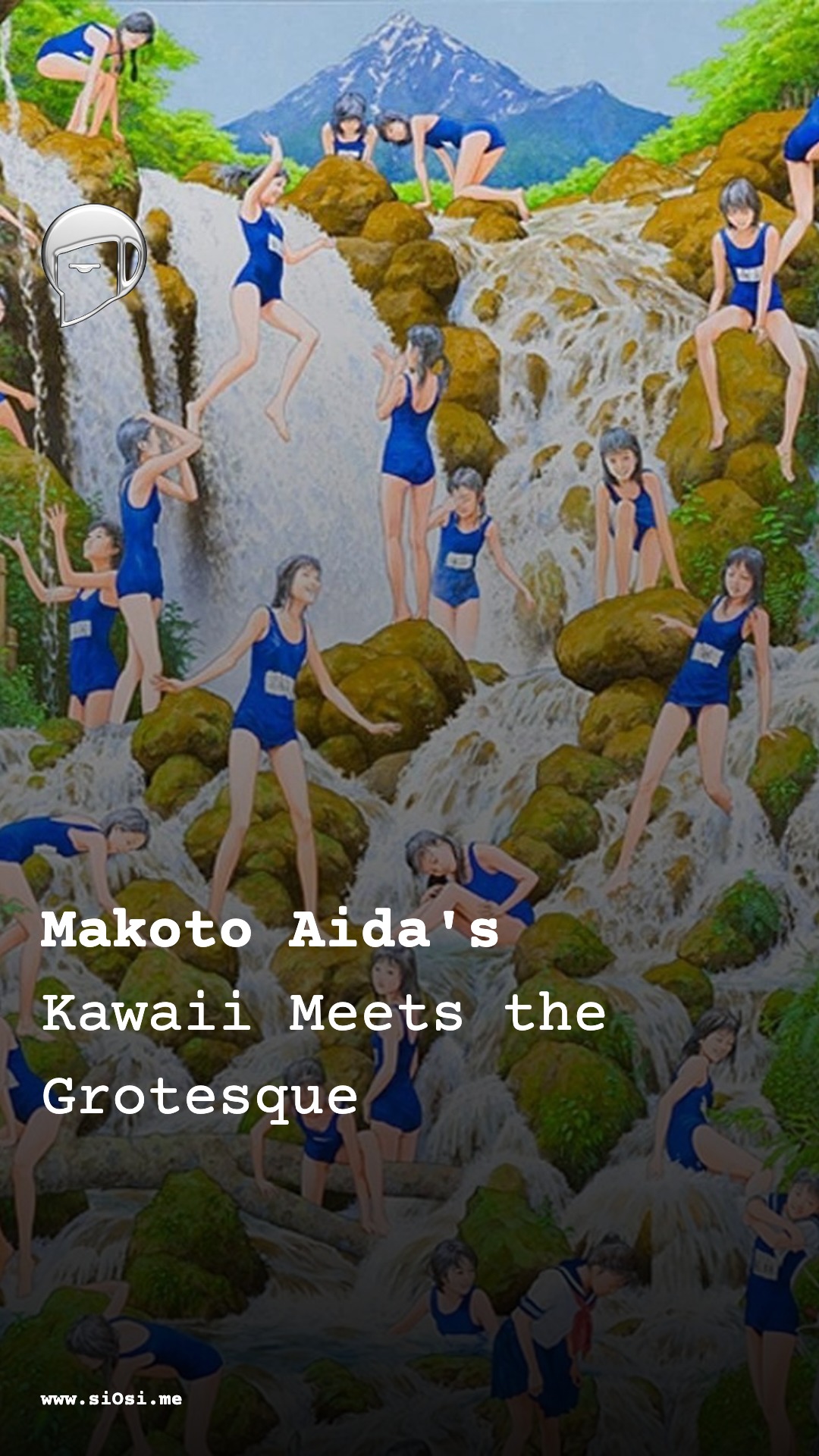
Makoto Aida flips sweet manga faces into something that stings. Born in 1965, he paints school uniforms next to ritual violence and leaves the eye unsure where to land. His Harakiri Schoolgirls series keeps the clean lines and pastel glow while the scene turns unbearable. Bright synthetic colors sit beside ash-grey ruin, making every polished surface feel slightly toxic. The result is beauty that refuses to stay polite.
Makoto Aida, born on October 4, 1965, in Niigata Prefecture, is a Japanese contemporary artist whose visual language turns beauty into a site of friction. His work moves between oil painting, Japanese painting, manga, photography, sculpture, performance, film, and installation, crossing the boundaries between the traditional and the contemporary, the Eastern and the Western, the refined and the vulgar.
Aida’s importance to fashion and beauty culture lies less in the creation of a wearable style than in his exposure of the systems that make bodies appear attractive, obedient, comic, erotic, patriotic, or disposable. He repeatedly borrows the polished surfaces of popular illustration, schoolgirl imagery, historical painting, advertising, and manga, then places them beside violence, absurdity, bodily excess, or political unease. The resulting image often begins with seduction and ends in discomfort.
His formation in oil painting at Tokyo National University of the Arts gave him command of an inherited pictorial vocabulary, while his subject matter drew heavily from contemporary Japanese visual culture. He completed his undergraduate and graduate studies in oil painting, receiving his MFA in 1991. Yet his mature practice deliberately refuses the dignity traditionally associated with academic painting. The surface may be technically controlled, but the image is unstable, as if classical finish had been invaded by pulp fiction, children’s drawing, erotic fantasy, and the blunt visual grammar of mass culture.
Aida has been associated with the Japanese tradition of ero-guro, or erotic grotesque, a sensibility in which beauty and repulsion remain physically close. His imagery frequently places the delicate beside the abject: smooth skin near wounds, decorative color near death, youthful innocence near cruelty. His own style has also been described as a rejection of cheerful, submissive modes of representation in favor of what he called a more “democratic” artistic language, one willing to show the graphic and politically uncomfortable. In this sense, the body is not presented as a stable ideal. It becomes a contested surface, shaped by fantasy, discipline, militarism, commerce, and social expectation.
The most recognizable visual tension in his work comes from the collision between kawaii codes and violent content. Large eyes, simplified contours, immaculate faces, school uniforms, ribbons, and youthful postures suggest the compact visual sweetness of manga and anime. Against this, Aida introduces dismemberment, self-destruction, war, or grotesque theatricality. In works associated with the Harakiri Schoolgirls series, seductive schoolgirl imagery is fused with the ritual violence of disembowelment, bringing the codes of youth, femininity, national history, and spectacle into one deliberately unbearable image.
The effect is not merely shocking. It is also formal. Aida understands that cuteness depends upon clarity: a clean outline, an immediately legible pose, a bright color, a face reduced to expressive essentials. By preserving that clarity while changing the emotional content, he makes sweetness feel brittle. The eye is drawn by the same visual fluency that then implicates it. Pink, pale flesh, black hair, white socks, lacquered surfaces, and blood-red interruption form a palette in which innocence is not erased but stained.
His treatment of femininity is especially difficult and central. Women and girls in his work are often stylized through the visual conventions of Japanese popular culture, their bodies made smooth, symmetrical, and icon-like. But that apparent idealization is repeatedly broken by injury, bondage, erotic threat, or political reference. The body becomes an image of how beauty can be disciplined into a pose. A school uniform, ordinarily associated with order and belonging, may become a costume of submission or a historical quotation. A polished face may retain its prettiness while the surrounding scene makes that prettiness morally unstable.
This instability extends to posture and movement. Aida’s figures often appear caught between display and collapse. They kneel, crouch, stand at attention, crawl, or hold themselves in rigid theatrical poses. The body is rarely relaxed. Even when the composition is static, it carries the pressure of performance, as if each figure were acting out a role assigned by school, family, nation, gender, or mass entertainment. The contrast between controlled posture and extreme subject matter gives his images a strange stillness. Violence becomes tableau rather than blur, frozen with the precision of a fashion plate or a devotional icon.
His work with war imagery further complicates the visual vocabulary of beauty. Aida has moved between scenes of young women, soldiers, salarymen, and historical violence, treating the past and present as adjoining pictorial spaces. In works such as War Picture Returns, he engages the conventions of Japanese war painting while filtering them through contemporary irony and popular imagery. The result is not the solemn monumentality of official history. It is a contaminated pageant, where heroic composition, decorative surface, and national mythology are made visibly artificial.
Color in Aida’s work often carries this contradiction. Bright, synthetic hues can suggest the commercial world of toys, packaging, animation, and consumer fantasy. Muted greys and ash tones, by contrast, evoke smoke, ruins, institutional interiors, and the residue of history. His palette may alternate between candy-like intensity and the dull mineral atmosphere of devastation. This movement between saturation and pallor creates an emotional temperature that is difficult to settle. The image glows, but the glow may be toxic, feverish, or post-apocalyptic.
Texture is equally important. Oil paint, traditional Japanese pictorial references, deliberately crude marks, and the smooth finish of popular illustration may coexist within the same artistic field. Aida chooses a style according to the subject, rather than maintaining one signature surface. This refusal of stylistic purity is itself an aesthetic position. A refined brushstroke can be placed beside an apparently childish mark; a grand historical format can carry an obscene joke; a flat illustrative field can contain the density of an old master painting. The eye is asked to move across incompatible textures and to recognize that no single manner is innocent.
His interest in salarymen adds another form of bodily and sartorial expression. The businessman’s suit, white shirt, dark tie, and standardized posture represent a different kind of uniformity from the schoolgirl’s sailor collar or pleated skirt. Both figures are organized by institutions and collective codes. The office worker’s silhouette is sober, narrow, and repetitive, while the schoolgirl’s is youthful, sharply legible, and culturally charged. Aida’s practice places these bodies within the same larger field of social performance, where clothing reveals not individuality but the pressures of belonging.
The emotional atmosphere of his work is often described through terms such as dark humor, grotesque comedy, and misanthropy. Yet the humor is not weightless. It produces an uneasy laughter that exposes the viewer’s own appetite for spectacle. Aida’s images can feel aggressively funny and suddenly cold, with the comic surface acting as a trapdoor into shame, grief, or anger. Their emotional presence is theatrical rather than intimate, but the theatre is crowded with real histories: wartime memory, gendered violence, national identity, consumer fantasy, and the uneasy inheritance of manga and modern Japanese painting.
The exhibition Monument for Nothing, held at the Mori Art Museum in Tokyo in 2012 and 2013, brought together the breadth of this practice, including painting, sculpture, video, installation, and related forms. The title is suggestive of Aida’s larger attitude toward grandeur. He repeatedly constructs monumental images only to puncture their authority. The monumental may be beautiful, but it is also ridiculous; the ridiculous may be politically serious. His art finds its force in that unstable interval.
Seen today, Aida’s work retains a hard, fluorescent afterimage. It does not offer the consolations of harmony, tasteful restraint, or easily recoverable innocence. Its beauty is sharpened by contamination. Smooth faces, bright colors, immaculate outlines, and theatrical bodies continue to attract the eye, but they no longer permit passive looking. The glow is seductive and abrasive at once, like colored light falling across a damaged surface.
His enduring visual contribution is therefore an expanded idea of beauty. Beauty can be cute, lurid, academic, vulgar, militarized, comic, or wounded. It can appear in the finish of a painting and in the deliberate ugliness of its subject. Aida’s art insists that style is never only decoration. It is a social language, and every polished surface carries the possibility of concealment, coercion, fantasy, or revolt.