
Sun in LibraMoon in LibraNew Moon
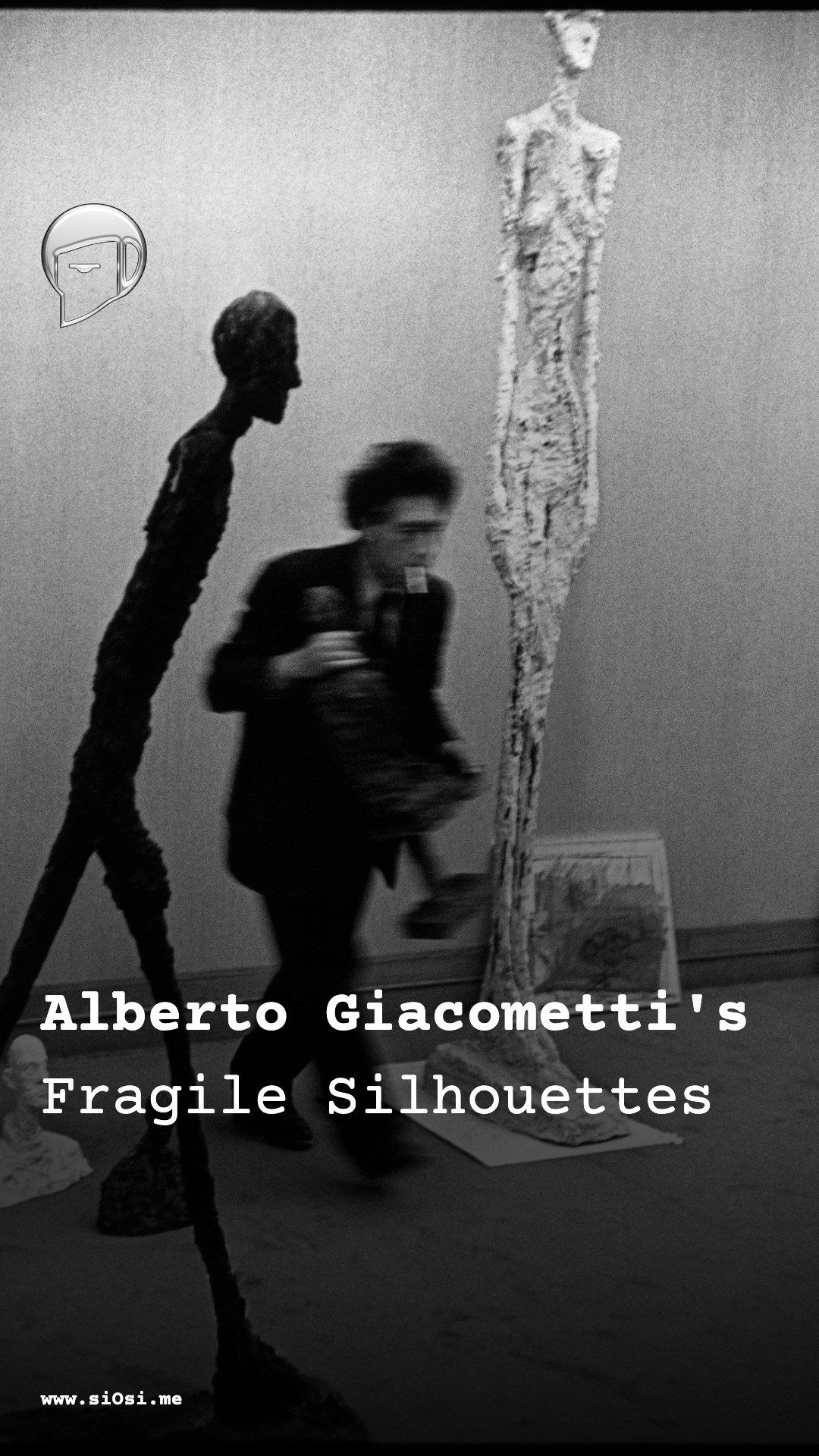
Alberto Giacometti's Fragile Silhouettes
Alberto Giacometti turned bodies into trembling lines that still feel alive. Born in a steep Swiss valley, he chased how people actually look across distance and time. His postwar bronzes stretch tall with rough surfaces that catch light like weathered stone. Those narrow figures walk without ever arriving, holding solitude and presence in one frame. The result feels like modern endurance dressed in raw edges.
Alberto Giacometti was born on 10 October 1901 in Borgonovo, a mountain village in the Italian-speaking Swiss valley of Bregaglia. His later art transformed the appearance of the human figure into something attenuated, tremulous, and intensely present: a body reduced almost to a vertical signal, yet charged with the emotional weight of solitude, memory, and perception.
Alberto Giacometti: the body as a line of presence
Giacometti’s early visual world was shaped by the Alpine landscape of his childhood and by his father, the Post-Impressionist painter Giovanni Giacometti. The surroundings were physically imposing: steep mountains, narrow valleys, changing atmospheric distances, and a light that could make solid forms appear briefly weightless. This sensitivity to distance would become central to his mature work.
After studying in Geneva, Giacometti moved to Paris in 1922, where he attended the Académie de la Grande Chaumière, studied with Antoine Bourdelle, and repeatedly visited the Louvre. His development passed through post-Cubist simplification and Surrealism before he returned, in 1935, to sustained observation of the living model. That return was decisive. The body was no longer primarily an emblem, a symbol, or an arrangement of abstract volumes. It became a problem of seeing: how a person persists in space, how a face remains recognizable across distance, and how presence can be conveyed without descriptive fullness.
His sculpture therefore altered the conventional idea of beauty. Instead of fullness, balance, and tactile abundance, Giacometti offered fragility, imbalance, and exposed structure. His figures are long and narrow, their surfaces worked into rough, granular ridges. They often seem less carved than continually searched for, as if the artist’s hands had followed the outline of a body through darkness and stopped just before certainty.
The effect is not decorative thinness. It is an anatomy of attention.
Silhouette, proportion, and the new elegance of severity
Giacometti’s postwar figures are among the most recognizable silhouettes in twentieth-century art. The body rises from a small base in a narrow column: elongated legs, compressed torso, slight shoulders, and a head that may appear almost too small for the length beneath it. In works such as Walking Man, the stride is formal rather than athletic. Movement is implied through the separation of the legs and the forward inclination of the body, yet the figure remains precarious, nearly motionless.
This contradiction gives the sculptures their particular emotional tension. They are walking, but they do not arrive. They occupy space, but they appear to be withdrawing from it. The body is materially present and visually vanishing at once.
The Guggenheim Museum describes Giacometti’s figures as “massless and weightless,” perceived from a specific frontal viewpoint and understood through their relation to distance and space. Their slenderness is therefore not merely a stylization of the human form. It is an attempt to reproduce the way a person may appear when seen across a street, at the end of a corridor, or through the unstable atmosphere of recollection. The full body, in this vision, could seem false. The attenuated body felt more faithful to experience.
This produced a new kind of modern silhouette: severe, vertical, and emotionally unadorned. It has affinities with the visual language of narrow tailoring, long coats, spare columns, and garments that let the body read as an uninterrupted line. Yet Giacometti’s figures resist fashion’s promise of polish. Their elegance is weathered, raw, and almost ascetic. It belongs less to luxury than to endurance.
Surface, texture, and the beauty of incompletion
The surfaces of Giacometti’s bronzes retain the evidence of making. Rather than presenting an immaculate skin, he allowed the material to remain visibly disturbed. Scraped planes, ridges, pits, and irregular accumulations catch the light unevenly. A cheek may appear illuminated at one angle and disappear at another. The figure’s surface seems to flicker between flesh, ash, bark, and stone.
This texture changes the emotional temperature of sculpture. Smooth bronze traditionally invites the eye to travel without resistance. Giacometti’s bronze interrupts the gaze. It makes looking tactile. One does not simply see the figure’s outline; one feels the labor, hesitation, and repeated revision embedded in its skin.
The result is a beauty of incompletion. The work does not conceal its instability. It acknowledges that likeness is never fully possessed, that the visible body continually shifts according to light, distance, and the observer’s state of mind. Giacometti sought a likeness between art and what he saw before him, but the likeness remained restless rather than conclusive.
His sculptures can therefore feel intimate and remote at the same time. Their surfaces are close enough to invite inspection, but their figures seem to stand beyond complete access.
Space as a garment around the body
Giacometti’s art gives unusual importance to the space surrounding the figure. In works such as The Forest, several elongated forms stand together like trees, their relationship defined not only by bronze but by the negative spaces between them. In his “cage” sculptures, bodies and architectural frameworks establish a measured field in which the figure appears contained, isolated, or suspended.
Space operates almost like an invisible fabric. It presses against the body, separates one person from another, and determines how presence is felt. A figure is never simply an object. It is a point within an atmosphere of distance.
This spatial sensitivity also appears in his paintings and drawings. The sitter is frequently surrounded by a pale, tense field, often gray or brown, crossed by innumerable searching lines. The room does not recede into calm perspective. Instead, it seems to gather around the person, holding the figure in a dense web of perception. Background and body become mutually dependent: the sitter exists because the surrounding space has been measured, and the space becomes charged because a solitary body occupies it.
Color, light, and emotional weather
Giacometti is often associated with a restricted palette of gray, ochre, brown, black, and muted white. These colors do not produce decorative harmony. They create an atmosphere resembling winter light, studio dust, weathered plaster, or the mineral tones of an Alpine landscape.
In his painted portraits, color is less a description of complexion than an instrument of emotional pressure. Gray may flatten the distinction between flesh and air. Brown can make the body feel earthen, old, or vulnerable. White does not necessarily brighten the figure; it may instead expose the emptiness around it. Black establishes a concentrated vertical presence, like a line drawn into silence.
The light in Giacometti’s work is rarely radiant. It is provisional and oblique. It grazes surfaces, catches a shoulder, divides a face, or dissolves the edges of a body. This produces an impression of continual emergence. The figure seems to be appearing from light rather than standing securely within it.
The emotional glow of his work is consequently subdued. It is not the glow of sensual abundance or theatrical glamour. It is the faint illumination of recognition: the moment when an indistinct person across a room becomes, briefly, unmistakably human.
The philosophy of the body
Giacometti’s treatment of the body expresses a profound distrust of fixed appearances. The human figure cannot be reduced to anatomical accuracy, ideal proportion, or stable volume. It is experienced through distance, movement, memory, and the observer’s attention.
His elongated figures suggest that physical presence is vulnerable. They are upright, but their narrowness makes them seem exposed. They appear resilient precisely because they are not invulnerable. Moderna Museet has described these fragile, strangely elongated figures as associated with an image of resilient humanity.
That resilience is visual rather than triumphant. Giacometti’s people do not dominate their surroundings. They persist within them. Their dignity comes from standing, walking, waiting, or looking while remaining visibly subject to space and time.
This attitude toward beauty has lasting force. It rejects the body as a perfected object and presents it instead as an event of consciousness. Beauty resides in the effort to remain visible.
The continuing emotional presence of Giacometti’s style
Giacometti’s work still feels startling because it makes solitude tangible without turning it into melodrama. A bronze figure can seem almost weightless, yet its isolation is heavy. A painted face may be surrounded by a gray field, but the eyes hold an exacting, concentrated presence. The work’s emotional register is quiet: apprehension, tenderness, fatigue, endurance, and the fragile relief of recognition.
Its visual language also remains unusually adaptable. The narrow vertical figure can evoke austerity, modern alienation, spiritual discipline, or a stripped-down elegance. The rough surface can feel geological or bodily. The restrained palette can appear contemporary because it refuses spectacle. Nothing is excess, yet nothing is empty.
Giacometti’s enduring glow lies in this tension. His figures seem diminished in mass but enlarged in feeling. They are reduced to almost nothing, and from that almost nothing a complete human presence begins to rise.