
Sun in LibraMoon in SagittariusWaxing Crescent
Ruth Bernhard's Quiet Radiance in Black and White
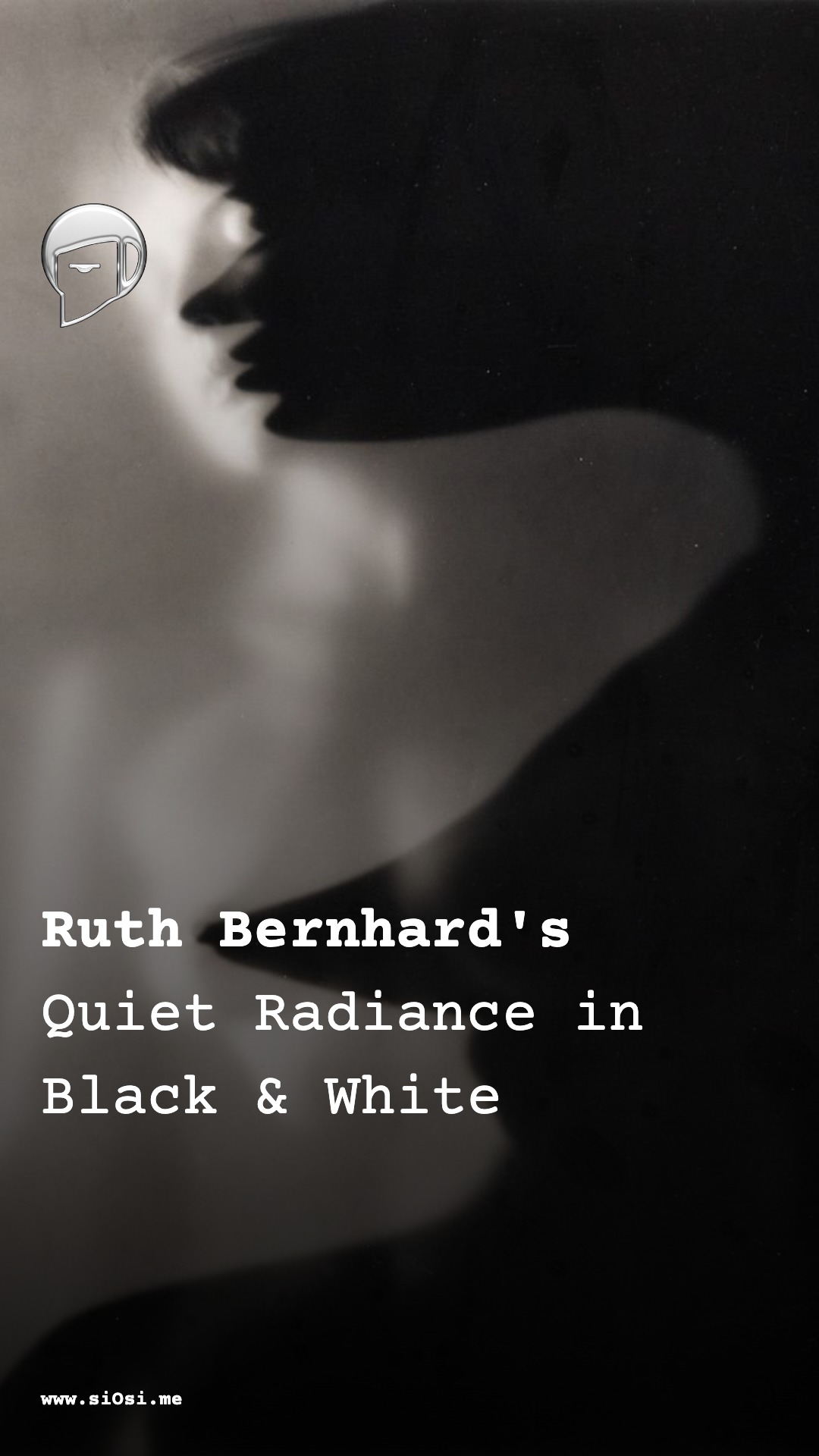
Ruth Bernhard made bodies look like living sculpture under soft studio light. She cropped out faces to let curves and shadows speak instead. A single highlight sliding across skin like water turned every torso into something timeless and still. Her approach feels like a slow conversation between light and form, no rush, just presence. The everyday shell or folded fabric got the same reverent treatment as the human figure.
Ruth Bernhard, born in Berlin on October 14, 1905, transformed the nude and the still life into studies of quiet radiance. Her photographs ask the eye to linger over the body not as spectacle, but as sculptural presence, where light, contour, and silence become forms of emotional knowledge.
Ruth Bernhard: the body as luminous structure
Bernhard’s visual language was built from restraint. Working primarily in black and white, she reduced her subjects to essential arrangements of mass, contour, texture, and light. The resulting images often feel less like conventional portraits than intimate studio sculptures: a shoulder becomes a rounded plane, a hip a soft architectural curve, a hand an instrument of balance. Her close framing and deliberate cropping suppress anecdote and personality, allowing the body to appear as an elemental form rather than as an individualized likeness.
This approach was especially important in her photographs of the female nude. Bernhard frequently concealed or excluded the face, directing attention away from expression and toward the body’s structure. In Classic Torso with Hands, she described her intention as an effort “to raise, to elevate, to endorse with timeless reverence the image of woman.” The image’s beauty rests in its solemnity: the torso is not displayed as an object of availability, but composed as a dignified, nearly monumental presence.
Her nudes possess a distinctive stillness. They do not seem to perform for the camera. Instead, they inhabit a concentrated interval between repose and revelation. Limbs fold inward, hands cover or frame the body, and curves emerge gradually from surrounding darkness. The resulting emotional atmosphere is sensual but not theatrical, intimate but not confessional. Bernhard’s figures seem to exist outside ordinary time, their silence giving the flesh the gravity of stone, polished wood, or alabaster.
Light, shadow, and the tactile image
Light was Bernhard’s principal material. She used it not simply to illuminate, but to shape and edit reality. A narrow highlight might travel across a breast or shoulder like a thin veil of water. A deep shadow could erase the edge of a form, making the body appear to continue beyond the frame. Her photographs depend on the tension between what is revealed and what remains withheld.
This tonal discipline gave her work a tactile intensity. Skin appears alternately matte, satin-like, velvety, or almost mineral, depending on the pressure of the light. Against dark grounds, pale forms seem to float with a soft internal glow. In other images, shadow gathers heavily around the subject, producing a sense of enclosure and inwardness. Her compositions are therefore felt as much as seen. They invite the imagination to supply warmth, weight, and breath beneath the still surface of the print.
Bernhard’s mastery extended beyond the nude. She photographed seashells, found objects, skulls, flowers, and ordinary materials with the same seriousness she brought to the human body. A shell could become a curled anatomical form; a folded fabric could echo a torso; a skull could become an emblem of light passing through mortality. The boundary between organic and inanimate matter remains deliberately porous.
This was part of what Bernhard called a “celebration of the commonplace.” Her aesthetic did not depend on rarity or luxury. Beauty emerged through concentration, through the patient observation of objects usually passed over. Under her lighting, the everyday acquired a ceremonial presence, as though the studio had become a small chamber of revelation.
Modernist precision and sensual restraint
Bernhard’s images belong to the history of modernist photography, yet their severity is softened by an unmistakable sensuality. The compositions are carefully ordered, often symmetrical or geometrically balanced, but they never become cold exercises in design. Their precision gives sensual feeling a stable vessel.
Her affinity with formalist photography can be seen in the clarity of her shapes and the elimination of distracting detail. At the same time, the body remains emotionally charged. Curves, folds, and intervals between forms create a visual rhythm that is almost musical. The photograph may contain no gesture in the conventional sense, yet the eye moves through it slowly, following the passage from highlight to shadow, from rounded surface to sharp edge, from concealment to disclosure.
This controlled movement distinguishes Bernhard’s work from images that depend on overt drama. Her photographs are quiet, but never inert. Their energy lies in compression. A cropped torso contains the suggestion of a whole person; a shell contains the memory of the sea; a darkened room seems to hold an entire emotional climate. The image becomes powerful by refusing excess.
Beauty without ornament
Bernhard’s philosophy of beauty was grounded in attention rather than adornment. Her work does not rely on fashionable clothing, cosmetics, elaborate hairstyles, or decorative settings. The body is presented with little external ornament, allowing surface, proportion, and posture to carry the expressive burden.
That spareness has a particular cultural significance. In an era when the female body was frequently framed through commercial desirability or erotic display, Bernhard offered another mode of looking. Her nudes are sensual, but their sensuality is contemplative. The viewer is asked to recognize density, strength, vulnerability, and formal beauty rather than consume a personality or narrative.
The omission of the face also complicates the idea of identity. Bernhard’s subjects are not reduced to anonymity, because the body remains intensely present. Instead, the absence of facial expression removes some of the familiar codes through which women are interpreted: seduction, coyness, submission, theatrical emotion. What remains is a body with its own gravity and compositional authority.
Her images therefore suggest a form of beauty that is neither decorative nor aggressively idealized. It is beauty as presence, proportion, and inward coherence. Wrinkles, folds, asymmetries, and bodily weight are not treated as defects requiring correction. They belong to the visual truth of the form.
The emotional temperature of her photographs
The emotional atmosphere of Bernhard’s work is often described through words such as reverence, sensuality, and lyricism, but its deepest quality may be calm. Her photographs do not rush toward climax. They sustain a prolonged, almost devotional attention.
That calm can feel protective. The darkness surrounding a body does not necessarily threaten it. Often, the shadow acts as a velvet enclosure, shielding the figure from the noise of the outside world. The studio becomes a place where the body can exist without explanation, performance, or demand.
At other times, the stillness becomes elegiac. Images such as Skull and Rosary use light to join beauty with mortality. The objects are rendered with the same compositional care as the nude, suggesting that flesh, bone, shell, and textile all participate in a larger cycle of material transformation. Bernhard’s beauty is therefore never entirely innocent. It carries an awareness of impermanence, but the awareness is quiet rather than mournful.
Lasting visual presence
Bernhard’s photographs still feel remarkably contemporary because they resist visual noise. Their black-and-white tonal range has none of the urgency associated with rapid image circulation. Instead, the prints offer a slower optical experience, one based on proximity, silence, and repeated looking.
Their continuing force lies partly in the way they make minimalism sensuous. A simple crop, a curved back, a hand placed across the abdomen, or a shell turned toward the light can generate an entire emotional world. The images remain fresh because their elegance does not depend on a period silhouette or a passing fashion. It rests on the enduring drama between the body and the dark, the visible and the hidden, the fragile and the monumental.
Bernhard’s work also retains a gentle defiance. She demonstrated that the nude could be both intimate and formally rigorous, both erotic and self-possessed, both vulnerable and monumental. The body in her photographs does not ask to be perfected. It asks to be seen with patience.
The glow that remains is not the brightness of glamour. It is a low, concentrated radiance, like afternoon light held on a pale wall or the final warmth inside a seashell. Bernhard made beauty feel less like decoration than recognition: a moment in which the ordinary body, under disciplined light, becomes mysteriously complete.