
Sun in LibraMoon in SagittariusWaxing Crescent
Paul Strand Turned the Lens on Raw Reality
Paul Strand showed up in 1890 ready to rewrite the rules of seeing. He traded misty pictorial vibes for crisp geometry that made every face and building feel solid and real. His hidden-lens street portraits caught raw New York energy without any pose. Clarity became the new cool, turning ordinary moments into something that sticks. Those rich, velvety shadows in his prints still pull you right into the frame.
Paul Strand was born in New York City on October 16, 1890. His importance to fashion, beauty, and visual culture lies less in direct costume design than in the transformation of photographic seeing: he made the camera attentive to the severe elegance of bodies, machines, streets, architecture, and light. Alongside Alfred Stieglitz and Edward Weston, he helped establish photography as a modern art form, replacing pictorial softness with a precise, tactile, and emotionally concentrated image.
Paul Strand, born 1890
Strand’s early photographs emerged from Pictorialism, a style associated with atmospheric softness, diffused contours, and prints that aspired to the status of painting. His first landscapes and portraits could possess a veiled, almost powdery beauty, as if the world had been seen through mist or silk gauze. Yet by 1915 he had moved decisively away from that manner. He rejected photographic manipulation and began to pursue the camera’s own visual truth through abstraction, candid portraiture, movement, and sharply observed form.
This change altered the emotional temperature of the photograph. The image no longer depended upon prettiness, sentiment, or painterly blur. Strand’s beauty was built from clarity, weight, proportion, and surface. A face could be beautiful because its planes were direct and unprotected. A building could possess the authority of a body. A machine could appear almost sculptural, its polished metal and repeated structures transformed into an austere kind of ornament.
His visual language was founded on strong geometry. Rectangles, diagonals, circles, shadows, window frames, stairways, and architectural grids organize the image with a disciplined rhythm. In his abstract studies, ordinary objects become fields of black, white, and gray, reduced to essential shapes. The effect recalls Cubist painting and modern sculpture, but photography gives these forms a particular physical insistence. They retain the evidence of the world: the density of metal, the grain of wood, the hard edge of glass, the granular richness of the photographic print.
For fashion and beauty culture, this way of seeing was consequential because it offered an alternative to decorative femininity and theatrical presentation. Strand’s portraits do not generally idealize the sitter through elaborate styling. Instead, they attend to presence. The face is treated as structure, weather, expression, and fact. Clothing becomes a secondary but meaningful architecture: a collar frames the head, a hat creates a dark horizontal plane, a coat gathers around the body, and a work garment records social position through its worn fabric and practical cut.
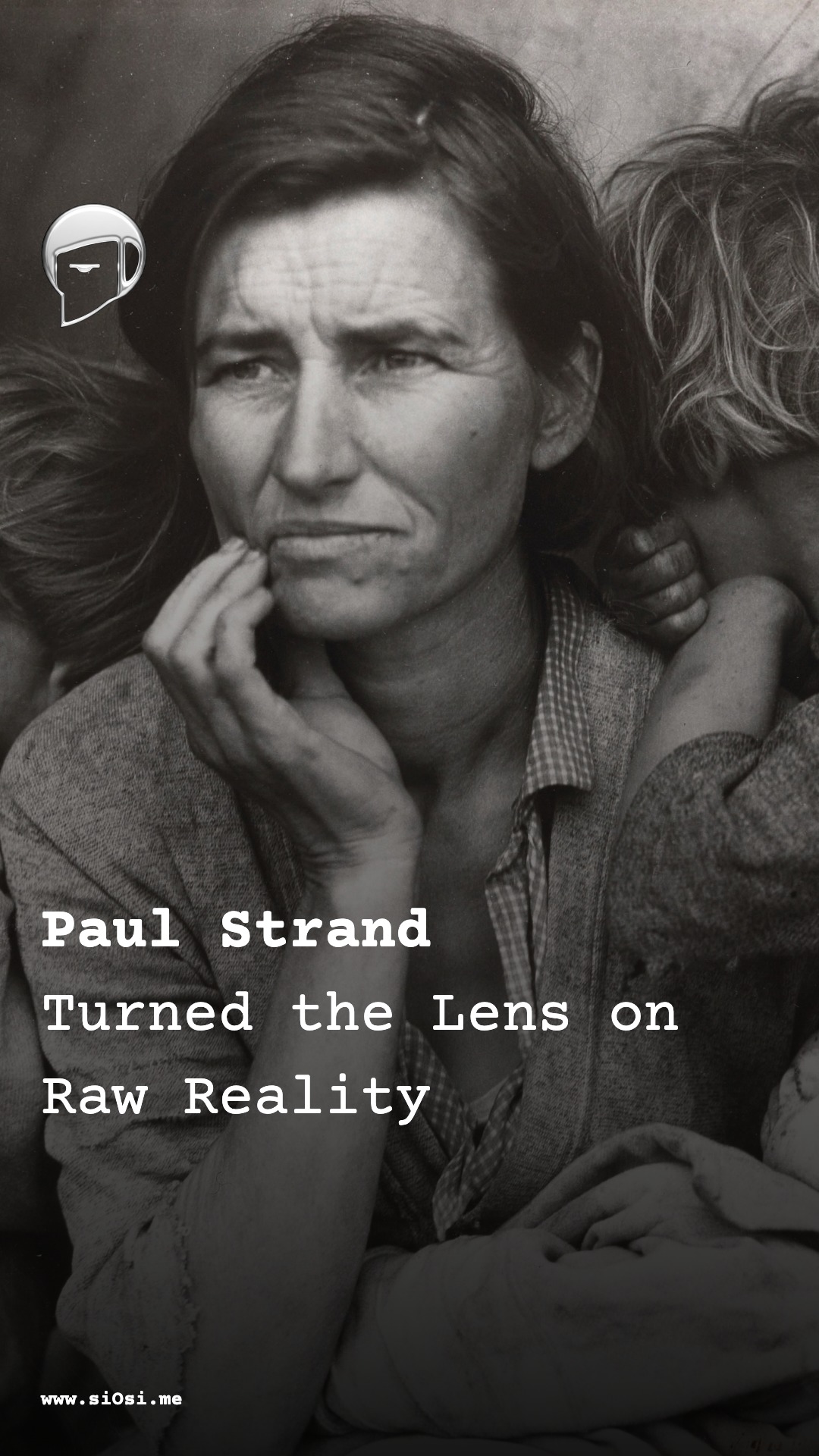
His New York street portraits of 1916 are especially powerful in this regard. Made with a concealed camera lens, they record people encountered in the city with an unusual directness. Their expressions can feel guarded, distant, exhausted, or inwardly absorbed. The emotional atmosphere is not one of glamour but of urban estrangement. Faces emerge from the street as brief, intense encounters, surrounded by the anonymity of crowds and the hard light of the modern city.
The portraits also changed the visual meaning of posture. A sitter need not pose elegantly to command attention. A lowered gaze, a fixed stare, a tilted head, or a body held stiffly against the pressures of the street becomes expressive. Beauty resides in the singularity of the person rather than in conformity to an ideal. Strand’s camera makes emotional reserve visible. It gives dignity to the unperformed face.
His photographs of movement brought another dimension to the body. In early studies of New York, motion is not rendered as graceful choreography but as a problem of time, rhythm, and interruption. Figures pass through streets; shadows lengthen across pavements; architectural forms divide the city into zones of light and darkness. The result is a modern silhouette, fragmented and mobile, in which the body is understood through its relation to the built environment.
Strand’s machine photographs of the 1920s extended this interest in structure. Industrial forms appear cool, polished, and monumental. Cylinders, gears, pipes, and mechanical surfaces become a new kind of still life, stripped of domestic softness. Their visual appeal lies in repetition and precision, in the contrast between matte shadow and reflective metal. They possess the controlled sensuality of modern design: clean edges, functional shapes, and an almost tactile coolness.
This industrial aesthetic altered the emotional vocabulary of beauty. Instead of warmth, ornament, and abundance, Strand proposed exactness. Instead of fluid decoration, he offered balance and compression. His images can feel quiet but never passive. They hold a restrained energy, like a body standing perfectly still or a garment cut so cleanly that its discipline becomes visible.
At the same time, Strand’s work never abandoned the natural world. Trees, stones, snow, fields, and distant horizons are presented with the same seriousness as machines and buildings. His landscapes often depend on a nearly tactile contrast between surface and atmosphere: snow becomes a pale plane, bark a dark vertical texture, water a field of reflected light. The natural world is not romantic scenery but an arrangement of forms with its own gravity.
The material quality of his prints is central to their beauty. Strand was deeply concerned with the photographic print as an object, and museums have emphasized the richness of surface detail that characterizes his work. His images can appear velvety in the shadows, chalky in the highlights, or metallic where light strikes a hard surface. This tonal range creates a sensory experience close to touching. The photograph is not merely a window onto a subject. It is a physical thing with grain, density, weight, and skin.
His later portraits and landscapes, made in places including Mexico, France, Italy, Egypt, Morocco, Ghana, and Romania, continued this search for the inner character of a place. Strand photographed architecture, clothing, faces, and landscapes without treating them as picturesque accessories. He sought what the Philadelphia Museum of Art describes as the spirit of his subjects, embodied in the materials of the print itself. A wall, a garment, a hand, or a village street could carry the emotional identity of an entire community.
This approach gives his later work a particular calm. The images are attentive without being hurried. Their emotional force accumulates slowly through proportion, silence, and detail. Faces seem to hold histories beyond the frame. Fabrics appear shaped by labor and climate. Buildings carry the color of dust, sun, age, or stone. The visual world becomes intimate without becoming sentimental.
Strand’s attitude toward beauty was therefore neither purely aesthetic nor purely documentary. He believed that the camera could reveal an order already present in the world, provided the photographer looked with patience and discipline. His photographs resist easy prettiness, but they are not austere in the sense of being empty. Their severity allows small sensations to intensify: the pale glow of winter light, the blunt darkness of a hat, the roughness of a wall, the solemnity of a face, the soft recession of a distant landscape.
What remains vivid today is the glow of attention. Strand’s photographs make the familiar appear newly composed without making it artificial. A street becomes a field of planes and shadows. A face becomes a landscape of experience. A machine becomes an object of sculptural elegance. A landscape becomes an arrangement of breath, distance, and silence.
His influence on visual culture is ultimately a lesson in restraint. Strand showed that beauty could emerge from unembellished facts, from a hard edge, an unguarded expression, or a precisely placed shadow. The emotional presence of his work comes from the tension between intimacy and distance. We are brought close to the texture of the world, yet the world retains its silence. That silence is part of his modern beauty.