
Sun in LibraMoon in ScorpioNew Moon
Al Held's Bold Grids Still Hit Different at 98
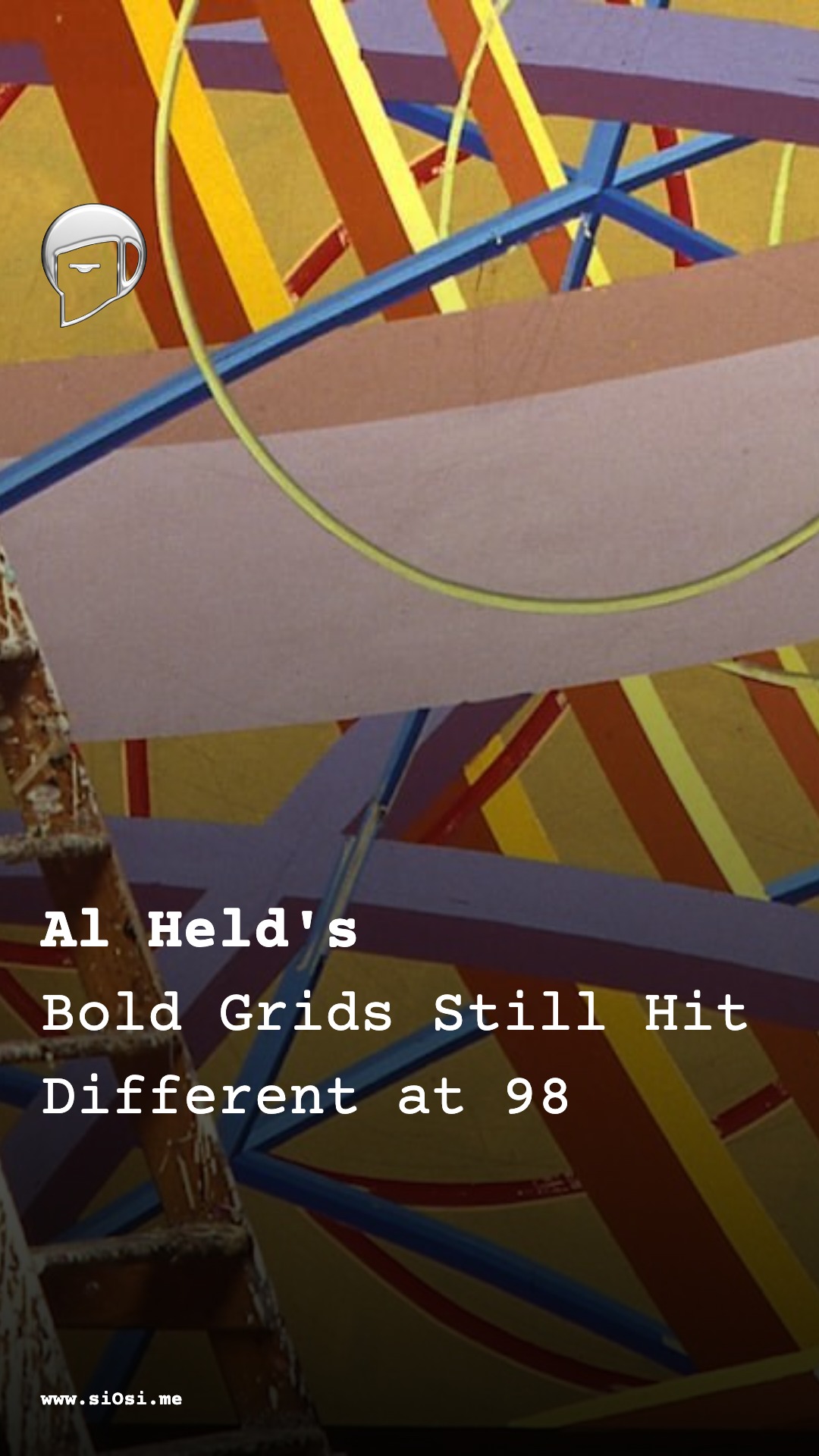
Al Held turns 98 today and his shapes still feel like walking through a city that won't sit still. Thick black lines slice across white like blueprints for buildings that only exist in your head. Those hard edges and tumbling cubes capture the exact rush of New York streets without showing a single taxi. Color later crashes in like neon signs at midnight, all volume and no softness. The eye has to keep moving or it loses the whole game.
Al Held was born in Brooklyn on October 12, 1928, and became one of the defining American painters of postwar geometric abstraction. His cultural impact lies less in depicting fashion or the body directly than in transforming painting into an environment of visual pressure: immense planes, hard contours, architectural grids, and chromatic fields that make the eye feel physically present inside the work.
Held’s early paintings of the 1950s belonged to the charged atmosphere of Abstract Expressionism. They were built from raw pigment and thick impasto, with overlapping geometric forms and a dense, tactile surface that retained the force of gesture. The effect was bodily rather than decorative. Color appeared to have weight, as though pigment had been pressed, piled, and made to resist the gaze. His later ambition was to reconcile expressive freedom with formal order, a project described as giving “the gesture structure.”
During the 1960s, Held moved toward a severe, controlled visual language. The paintings became flatter, harder-edged, and more monumental, aligning him with the emerging culture of post-painterly and hard-edge abstraction. His forms were not soft ornaments but commanding silhouettes: enlarged letters, interlocking blocks, cubes, arcs, and angular structures whose contours often pushed beyond the edges of the canvas. In the Alphabet paintings, linear forms were reduced into immense graphic characters, giving the picture the presence of an architectural sign or an unfamiliar monumental script.
This emphasis on contour changed the emotional temperature of abstraction. The line no longer trembled like a private mark. It stood upright, clean and declarative, with the visual authority of a beam, a threshold, or a cut in stone. Held’s shapes suggest bodies only indirectly, through scale and posture. They lean, collide, recede, and loom. Their presence is architectural, yet the eye experiences them almost somatically, as if navigating a room whose walls are constantly rearranging themselves.
One of Held’s most influential decisions was his temporary rejection of color. Beginning in 1967, he worked extensively in black and white to produce compositions resembling architectural drawings and engineering diagrams. In paintings such as Solar Wind I, thick black lines, thin arcs, triangles, grids, dots, and wireframe cubes occupy a white ground. The contrast is stark, nearly surgical. White becomes not emptiness but light, while black operates as structure, shadow, and incision. The visual language recalls plans for impossible buildings, diagrams of invisible forces, or the exposed framework of a machine.
The black-and-white works possess a distinctly modern emotional register. They feel lucid, impersonal, and tense. Their beauty is not ornamental; it emerges from precision, balance, and the uneasy sensation that depth is being constructed and withdrawn at the same moment. The eye cannot settle into a single foreground. Forms seem to float, overlap, and turn through indeterminate space, creating a quiet vertigo.
In the early 1970s, Held reintroduced illusionism into abstraction. Cubes, pyramids, and other sharply outlined forms began to occupy complex spatial fields, appearing to hover within an uncertain depth. This was a significant shift in the philosophy of the picture. The canvas no longer insisted on flatness alone. It became a stage for contradiction, where solid forms could appear weightless and where geometry could produce sensations of infinity.
His Taxi Cab series brought this language into a more metropolitan register. The geometric forms tumble, collide, and overlap across expanses of paper, recalling the careening traffic and cacophonous energy of New York. Yet the work does not reproduce the city literally. Instead, it translates urban experience into rhythm: acceleration, interruption, compression, and sudden release. The forms behave like a crowd seen from above, or like fragments of illuminated signage passing through a night window. Their emotional force is alert and kinetic, but never chaotic in the ordinary sense. Beneath the collision lies a strict compositional intelligence.
Color returned with particular force after 1978, when Held began experimenting with vibrant hues in illusionistic geometric compositions. These colors do not soften the architecture. They intensify it. Saturated reds, blues, yellows, greens, and oranges give volume to the forms, making color function almost as a material surface or a source of illumination. A plane may appear to advance because of its hue, while another recedes into shadow. The result is a kind of chromatic architecture, brilliant but disciplined.
The late work has a different glow from the monochrome paintings. Black and white create tension through opposition; vivid color creates tension through simultaneity. Multiple hues occupy the same visual instant, producing an atmosphere that can feel both euphoric and immense. The paintings suggest an interior universe made from hard edges and radiant depth, a place where color is not applied to form but generates form from within.
Held’s relationship to beauty was therefore neither intimate nor naturalistic. He did not treat beauty as softness, surface prettiness, or the flattering description of the body. His beauty was constructed, resistant, and spatial. It belonged to proportion, interval, weight, contrast, and the disciplined control of movement. The paintings ask the viewer to experience looking as an active physical event. Their visual pleasure is inseparable from effort: the eye must measure, adjust, follow, and reconsider.
For fashion and style history, Held’s importance is found in this transformation of silhouette into structure. His sharply bounded forms anticipate a broader modern taste for architectural clothing, graphic contrast, modular surfaces, and bodies understood through planes rather than drapery. The sensibility is not one of ornament but of construction. It favors the severe shoulder, the clean panel, the interrupted grid, the disciplined field of color, and the silhouette that seems designed from within rather than gathered from the outside.
Held’s work still feels emotionally vivid because it holds two opposing impulses in suspension. One is the desire for order: the grid, the contour, the measured plane. The other is the desire for release: the tumble of forms, the illusion of depth, the sense that the composition might continue beyond the frame. This tension gives the paintings their lasting presence. They are controlled without being still, monumental without becoming mute, and cerebral without losing the pulse of the body.
Seen today, Al Held’s paintings emit a cool, architectural radiance. Their surfaces can feel like polished enamel, white paper, black wire, raw pigment, or colored light. The eye moves through them as through a city of impossible rooms. What remains is not a single image but a sensation of expanded space, sharpened perception, and disciplined exhilaration.