
Sun in LibraMoon in SagittariusWaxing Crescent
Squares That Shift When You Move
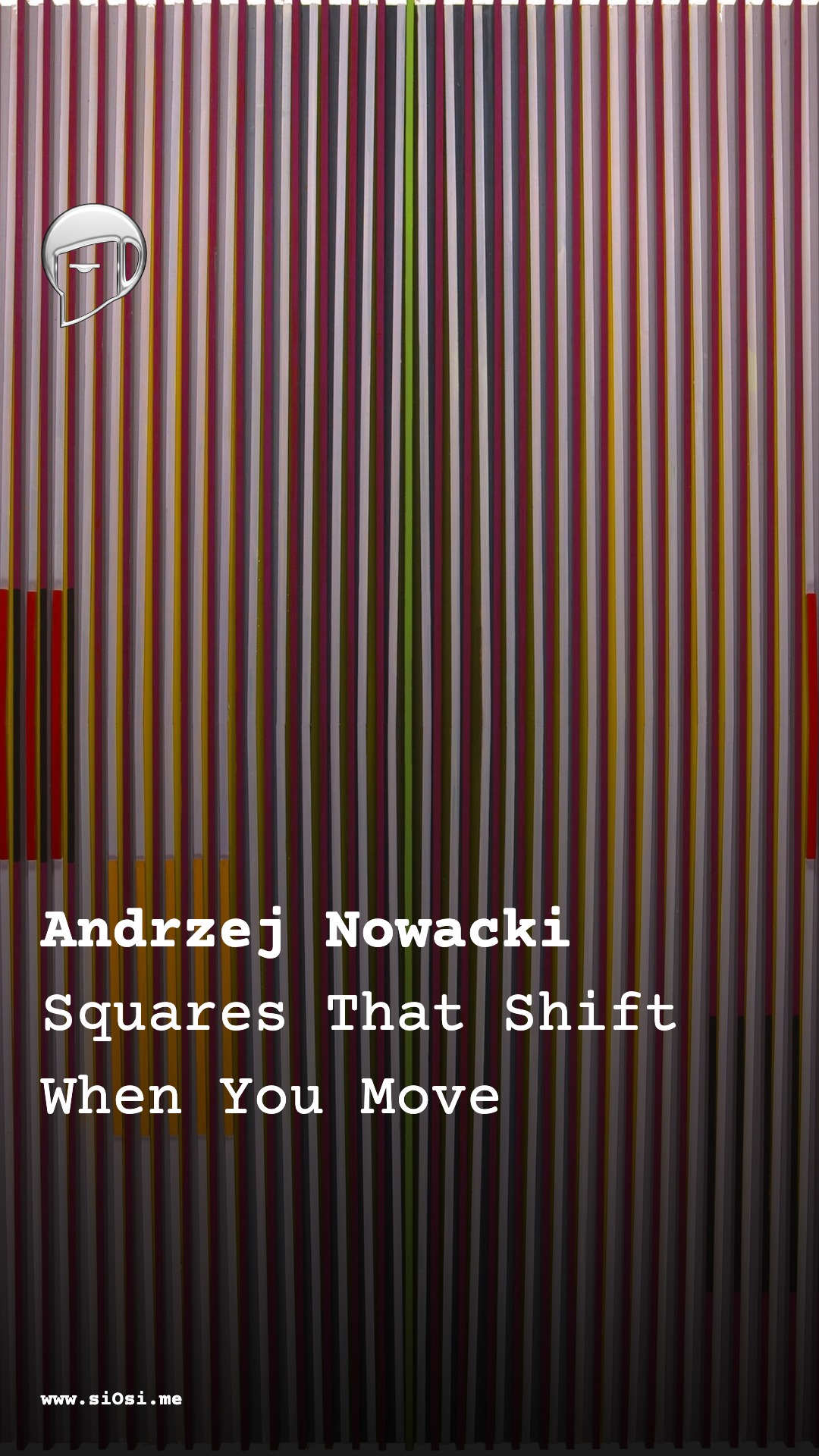
Geometry turns emotional fast. Andrzej Nowacki builds reliefs where squares advance and recede with every step you take. Hard edges meet soft optical uncertainty while color vibrates like enamel under changing light. The square holds everything in check yet lets feeling leak through rhythm and shadow. Stand still too long and the whole surface rearranges itself.
Andrzej Nowacki, born on 15 October 1953 in Rabka, Poland, is a Polish artist associated with Op art, concrete art, and geometric abstraction. His work has made the square, the relief, and colour into instruments of perception, transforming painting from a static image into a shifting encounter between body, light, and space.
Andrzej Nowacki: geometry as an emotional surface
Nowacki’s art belongs to a tradition of disciplined abstraction, yet its effect is not austere. The square provides order, but within that order the eye encounters vibration, interruption, and unstable movement. His reliefs are constructed from geometric forms, often squares, circles, divided planes, bars, and lines that appear to advance or recede according to the viewer’s position.
The works are neither simply paintings nor sculptures. Their surfaces project outward from the support, creating shallow architectural structures in which light settles along edges and gathers in recesses. The result is a visual language of hard contour and soft optical uncertainty. A line may seem fixed, yet the surrounding colour causes it to tremble. A square may appear whole in one moment, then fragmented or displaced in the next.
This dependence on the spectator is central to Nowacki’s aesthetic. The viewer is not placed before a sealed composition, but drawn into a changing field in which perception becomes part of the work. Colours and shapes alter with movement, producing the sensation of a momentary image rather than a final one. The body therefore becomes an instrument of looking. A slight change in posture, distance, or angle can alter the balance of the composition.
Colour, light, and the body
Nowacki has described colour as the fundamental value of his artistic practice, capable of supplementing or even replacing light. This gives his work a distinct emotional temperature. Colour is not applied merely as decoration or description. It carries energy directly, operating before interpretation and outside the distance of representation.
His palette often depends on contrast: saturated tones against dark grounds, luminous bands beside quieter planes, and sharply separated fields whose boundaries create internal pressure. The colour relationships can feel almost tactile. They suggest enamel, lacquer, polished painted wood, or the dense surface of a woven textile, while the relief itself introduces shadows that change as natural or gallery light moves across it.
The square acts as a restraint, but also as a resonating chamber. Colour is enclosed, divided, and repeated until it begins to generate sensation through rhythm. The boundaries between tones produce what Nowacki describes as inner vibration and tension, emotions less defined than those awakened by figurative imagery. His paintings do not depict feeling. They make feeling occur through the eye.
The relief as silhouette and movement
The relief is Nowacki’s signature medium. From the late 1980s onward, he concentrated on sculptural forms built from wooden panels and arranged on a square base. These forms may be read as a kind of abstract silhouette: not the outline of a human figure, but a body-like presence composed of projection, recession, balance, and stance.
Some elements appear to lean, divide, or rotate. Others function like frames, interrupted bands, or partial enclosures. Their relations create a sense of contained motion, as though a geometric structure had been caught halfway through transformation. The eye moves across the surface in stages, following repeated intervals and abrupt changes of direction. This movement is quiet but insistent, closer to measured breathing or a carefully executed dance than to mechanical repetition.
The works’ physicality also lends them a fashion-like quality, although they are not ornamental in the conventional sense. Their planes behave like pleats, panels, seams, or folded architectural garments. Colour blocks sit beside one another with the precision of cut fabric, while projecting forms create a shallow, rigid drapery. Yet the impression remains resolutely abstract: the body is evoked through rhythm and spatial tension rather than represented.
A dialogue between severity and feeling
A recurring characteristic of Nowacki’s work is the counterpoint between emotional expressiveness and strict geometry. This tension prevents the compositions from becoming merely decorative or purely mathematical. The underlying structures are lucid, but their colour and optical instability introduce a private, almost atmospheric intensity.
His relationship to geometry is therefore not one of submission to rules. Geometry becomes a means of releasing sensation without relying on narrative. The square disciplines the surface, while colour disturbs its calm. Lines establish order, while relief and viewpoint produce uncertainty. The work holds these opposing conditions together: control and freedom, stillness and motion, clarity and emotional resonance.
This attitude extends to the body. There is no pictured human figure, no face, gesture, or costume, yet the works remain bodily because they require physical presence. Their meaning changes with the viewer’s position. To look is to move, and to move is to alter the work’s appearance. The body is not an object within the image. It is the silent participant that completes the image.
Historical and visual context
Nowacki grew up in Kraków and left Poland in 1977, later studying Scandinavian studies in Göteborg and German studies and art history in Innsbruck. In the early 1980s he encountered the work of Polish abstractionists Kajetan Sosnowski and Henryk Stażewski. His contact with Stażewski, in particular, influenced his later exploration of geometric abstraction.
After moving to West Berlin in the 1980s, Nowacki began painting and soon developed his relief practice. His first solo exhibition took place in 1987. By the end of the decade, the relief had become the defining vehicle of his work, allowing him to move beyond the flat pictorial field without abandoning the discipline of abstraction.
His visual language also belongs to the wider postwar history of optical and concrete art, in which repetition, colour, serial structure, and visual instability challenged the idea that a painting should offer a single fixed image. Yet Nowacki’s work remains distinctive in its combination of geometric severity with strongly felt colour. The compositions are built with precision, but they do not feel impersonal.
The afterimage of Nowacki’s work
Seen today, Nowacki’s reliefs retain a peculiar freshness because they resist instant possession. They do not yield their full appearance from one frontal glance. Their colours brighten or darken with distance, their shadows shift with illumination, and their forms seem to reorganize themselves as the viewer moves.
The emotional effect is one of alert stillness. The works are calm in their proportions, but alive at the edges. They evoke the cool glow of enamel, the clean tension of architectural planes, and the moment when sunlight crosses a polished surface and briefly changes its character. Their beauty is not soft or picturesque. It is concentrated, lucid, and physical.
Nowacki’s lasting contribution lies in this union of discipline and sensation. He demonstrates that abstraction can remain deeply embodied, that a square can contain movement, and that colour can function as both structure and feeling. His art leaves behind not an image to remember, but an afterimage: a field of colour and shadow that continues to shimmer after the eye has turned away.