

Sun in LibraMoon in LeoWaning Crescent
The Designer Who Made Hollywood Glow
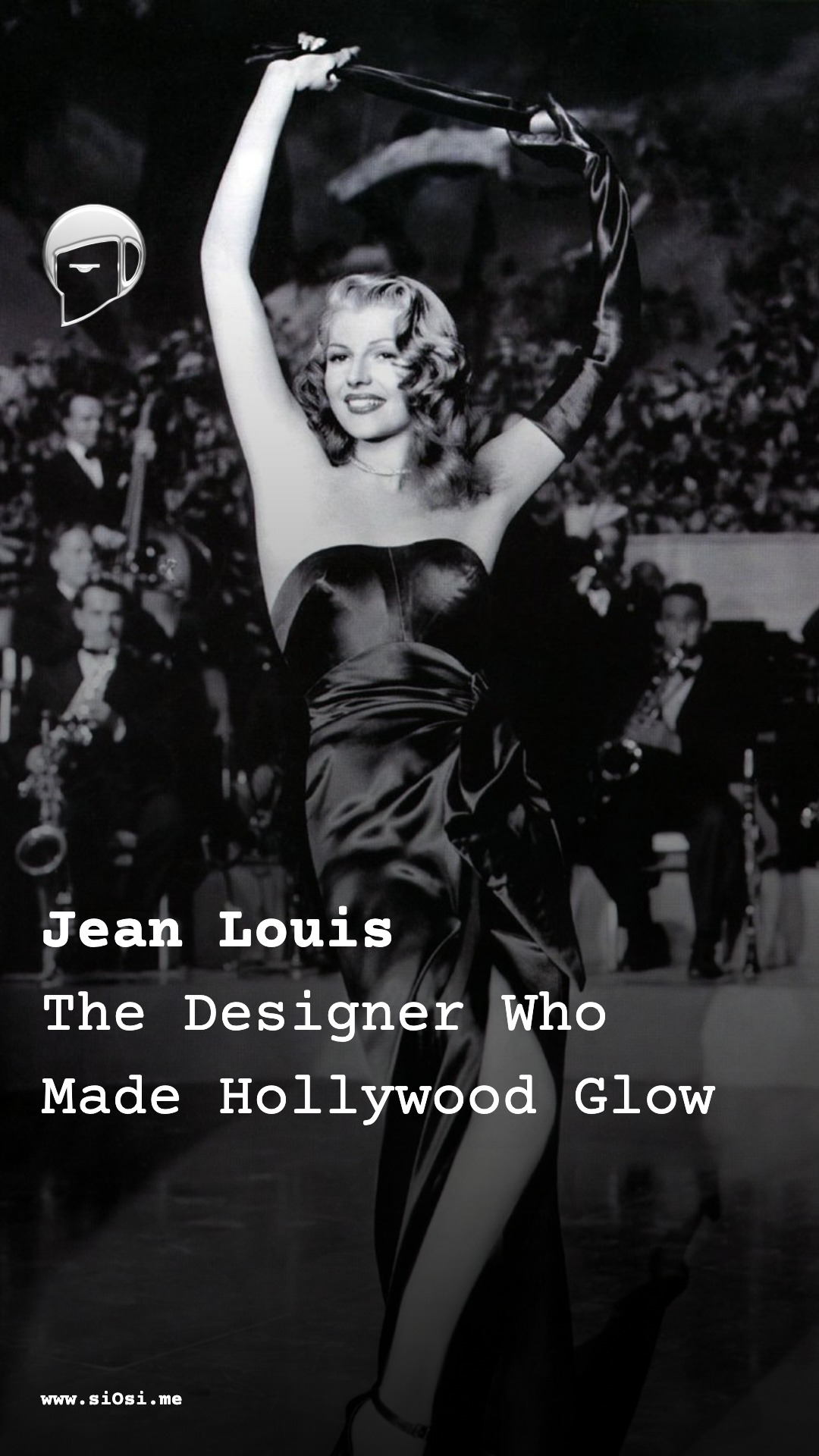
Jean Louis built glamour from light and line. Born in Paris, he brought couture discipline to Columbia Pictures and gave stars their most unforgettable silhouettes. The black satin gown he made for Rita Hayworth in Gilda moves like liquid under studio lights, turning every glove removal into suspense. Crystal beading on nude net later turned Dietrich and Monroe into moving constellations. His secret was never excess, just perfect placement.
Jean Louis, born Jean Louis Berthault in Paris on October 5, 1907, brought the disciplined elegance of French couture into the heightened visual world of Hollywood. Across nearly four decades, he shaped glamour through satin, crystal, controlled exposure, and the precise orchestration of a woman’s entrance, turning the costume into an instrument of light, movement, and emotional authority.
A Parisian eye in Hollywood
Louis studied at Paris’s École des Arts Décoratifs and began as a sketch artist at the couture house of Agnès-Drecoll before moving to New York, where he worked for Hattie Carnegie for seven years. This training gave his work a distinctly architectural foundation. His gowns were not merely ornamental surfaces. They were constructed around posture, proportion, and the changing relationship between the body and the camera.
When he became head designer at Columbia Pictures in the 1940s, he entered a studio system that treated clothing as a central component of star identity. He designed for many of the major actresses of the period, including Rita Hayworth, Rosalind Russell, Ginger Rogers, Lana Turner, and Kim Novak. His particular gift was to make elaborate clothing appear inevitable, as though the garment had emerged from the wearer’s own bearing rather than being placed upon her.
The resulting silhouette was often long, close, and highly legible. The torso might be held in a clean sheath, the shoulders restrained, the neckline lowered or sharpened, and the skirt allowed to fall in a single uninterrupted column. Such shapes gave the body a quiet authority. They did not depend on excessive decoration because the line itself carried the drama.
The black satin gown in Gilda
Louis’s most enduring image is Rita Hayworth’s black satin gown in Gilda (1946), designed for the performance of “Put the Blame on Mame.” The dress is remembered for its strapless construction, dark surface, and tightly controlled exposure, but its effect depends on more than its famous color. Black satin absorbs and returns light unevenly, creating a liquid surface that shifts with every turn of the body. The fabric seems almost wet beneath the studio illumination, alternately revealing and concealing the figure.
Its neckline establishes a severe horizontal boundary across the décolletage. Above it, Hayworth’s bare shoulders and pale skin become part of the composition. Below it, the gown gathers the eye into a long, uninterrupted field of black. The contrast is stark but not violent: ivory flesh, dark satin, red hair, and the deliberate white of the stage environment form a limited palette of exceptional force.
The garment’s emotional temperature is equally important. It does not present sensuality as softness. Instead, it gives sensuality a controlled, almost dangerous composure. Hayworth’s movement, including the famous removal of her long gloves, appears slow because the dress makes every gesture visible. The costume converts delay into suspense. A shoulder turning, a hand drawing away fabric, or a glance held for an instant becomes an event in the silhouette.
The gown therefore belongs to a tradition of Hollywood glamour in which the body is not exposed indiscriminately. It is edited. The covered arm, the long glove, the bare shoulder, and the darkened torso create a sequence of permissions and refusals. Louis understood that mystery is produced not by concealment alone, but by the exact placement of what may be seen.
The body as a field of light
Louis repeatedly worked with the tension between fabric and illumination. His gowns were designed to respond to movement and to the specific demands of Technicolor, black-and-white cinematography, stage lighting, and close-up photography. Satin, metallic embroidery, net, and crystal allowed the body to become a moving surface of reflections.
For Marlene Dietrich’s stage performances, Louis developed costumes made from nude-colored net covered with crystal beads, a technique associated with the illusion of a nearly uncovered body while retaining the elaborate authority of couture. The effect was neither simply naked nor fully clothed. The neutral ground dissolved against the skin, while the beads caught the light like frost, sparks, or a constellation suspended across the figure.
This visual language was especially suited to Dietrich’s performance style. Her body could appear at once distant and intimate, masculine in posture and opulent in surface. The beaded costume did not soften her into decorative femininity. It made her presence harder, brighter, and more deliberate. The garment became a kind of armor made from glimmer.
Louis later used a related effect for Marilyn Monroe’s sheer, crystal-covered gown worn while she sang “Happy Birthday, Mr. President” in 1962. The dress was famous because it seemed to hover between transparency and radiance. Its flesh-colored ground allowed the body to remain visually present beneath the ornament, while thousands of sparkling elements transformed the figure into a concentrated field of light.
The emotional power of the gown lies in this contradiction. The body appears vulnerable because the fabric is sheer, yet the density of the crystals produces protection and distance. Monroe is not simply revealed. She is made luminous, almost untouchable. The garment turns intimacy into spectacle without allowing the spectacle to become ordinary.
Line, restraint, and the choreography of entrance
Louis also understood clothing through movement. The gown was not complete when viewed on a mannequin. It was completed when a woman crossed a room, descended a staircase, turned toward a camera, or paused at the edge of a spotlight.
The costumes he designed for Loretta Young’s television entrances in the 1950s and 1960s emphasized this principle. Her appearances were structured around the dramatic arrival of the gown, often with a sweeping skirt and a pronounced sense of rotation. The clothing expanded the body’s movement into a formal event. A turn became a circular flare of fabric; a step became a change in scale.
This approach depends on a particular understanding of femininity. The woman is not merely dressed to be looked at. She controls the timing of the look. The garment gives her an entrance, a pause, and a departure. In Louis’s hands, volume and train were not passive decoration. They were mechanisms of theatrical command.
His work frequently created a tension between stillness and motion. The bodice could be close and immovable while the skirt moved around it. A rigid neckline might frame a face whose expression remained composed while beads and sequins flickered with each breath. This contrast made the wearer seem calm even when the surrounding image was full of movement.
Color and the emotional register of glamour
Louis’s most famous work is associated with black, nude, silver, and flesh tones, colors that allow the body and the light to become the principal subjects. Black gave his gowns gravity, concealment, and graphic clarity. Nude tones created optical ambiguity, making fabric seem to dissolve into skin. Silver and crystal introduced a colder radiance, closer to moonlight than warmth.
Even when his costumes used brighter colors, the design generally preserved a strong hierarchy. Color served the silhouette rather than overwhelming it. The eye was directed first to the line of the body, then to the surface, then to the details that appeared as the wearer moved.
This restraint distinguished Louis from designers whose glamour depended upon abundance alone. His richness was concentrated. A single black satin surface, a narrow line of rhinestones, or a precisely placed sweep of fabric could produce more emotional force than an accumulation of ornament. His dresses often feel opulent because every element has been given room to register.
Beauty as construction rather than disguise
Louis’s background in couture and studio costume encouraged an exacting attitude toward the body. The garment had to support the performer’s physical presence, but it also had to accommodate the demands of photography, choreography, narrative, and public memory. Beauty was therefore constructed through proportion and control.
The body in his work is shaped, but rarely erased. The waist may be disciplined, the bust line clarified, and the shoulders exposed or covered with intention, yet the wearer remains visibly embodied. The purpose is not to create an abstract fashion plate. It is to make a person appear more concentrated, more legible, and more emotionally charged.
That quality can be seen in the contrast between the sculpted gowns and the women who wore them. The dresses do not impose one universal ideal. They heighten individual presence. Hayworth’s softness becomes dangerous in black satin. Dietrich’s severity becomes electric beneath crystal. Monroe’s vulnerability becomes radiant through transparency and light.
Louis’s philosophy of glamour was consequently less about excess than about transformation through precision. He understood that the most persuasive costume does not compete with the wearer. It organizes the eye around her.
The afterlife of Jean Louis’s visual language
Jean Louis’s work remains recognizable because it established several enduring principles of modern glamour: the dark strapless column, the controlled décolletage, the nude illusion surface, the crystal-encrusted body, and the gown designed as a sequence of movements rather than a static object. His influence belongs not only to fashion history but also to the broader visual history of cinema and performance.
His black satin gown for Gilda continues to evoke a particular emotional atmosphere: midnight, polished wood, cigarette smoke, red lips, and the slight danger of a woman who knows precisely when to remain still. The beaded gowns for Dietrich and Monroe produce a different sensation, one of radiance held at a distance. Their surfaces tremble with light, but the figures beneath remain composed.
Louis died in Palm Springs in 1997 after a career that included work on approximately 188 films and an Academy Award for The Solid Gold Cadillac. Yet his strongest legacy is not a catalogue of garments. It is a way of making clothing carry emotional voltage. In his designs, satin becomes shadow, crystal becomes atmosphere, and the entrance of a woman becomes a controlled release of light.