
Sun in LibraMoon in ScorpioWaxing Crescent
Walasse Ting's Radiant Colors Still Glow Bright
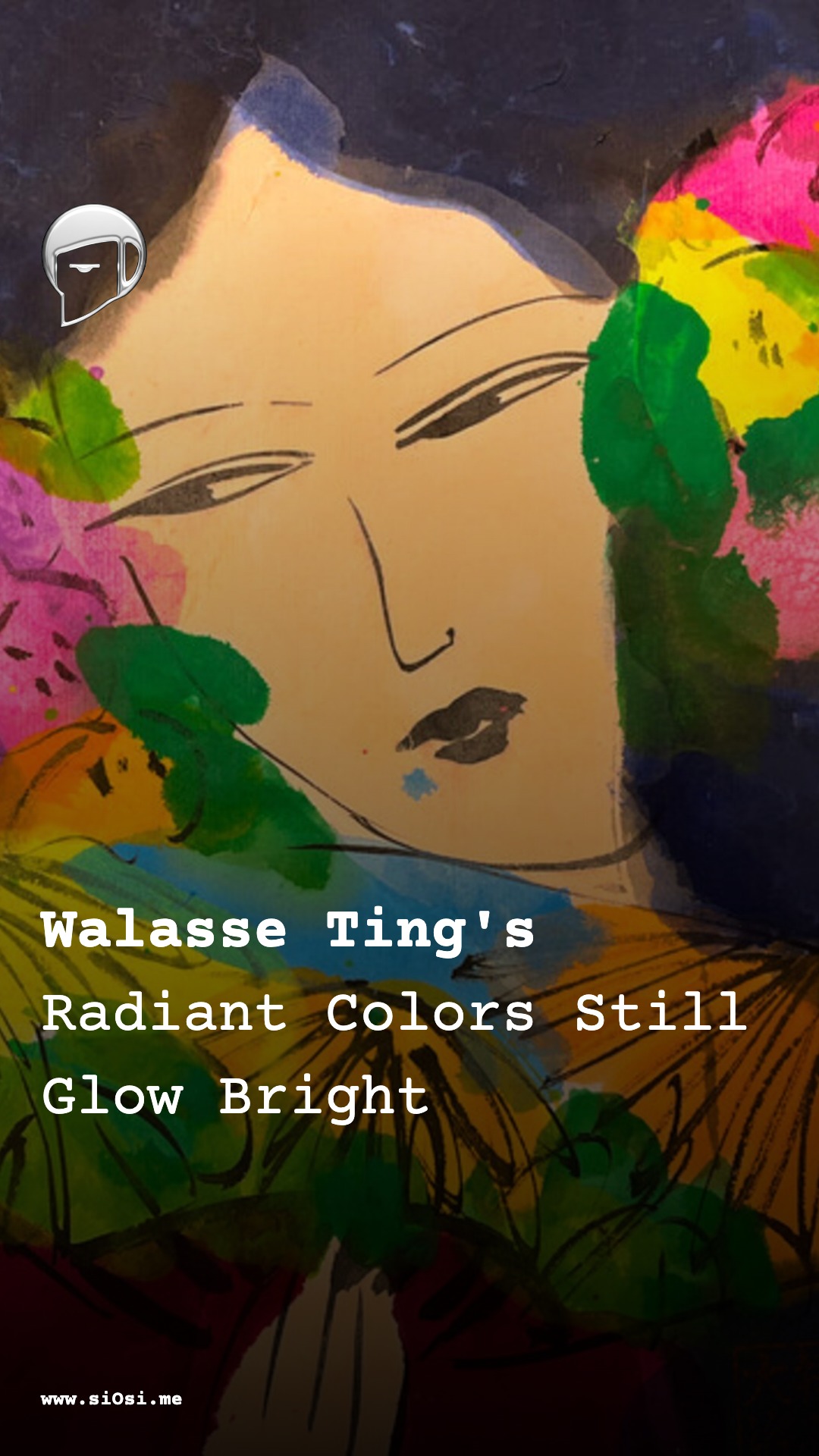
Walasse Ting turned paint into pure vibe. Born in 1929, he blended chinese ink lines with wild acrylic bursts that make flowers and figures feel alive and electric. His women and blooms share the same sweeping energy, all wrapped in magenta, turquoise and lemon yellow that seems to light up from inside. One look and you feel the heat, the motion and that unapologetic joy of color everywhere. It's like stepping into a garden where everything breathes at once.
Walasse Ting was born on 13 October 1929 in Wuxi, China, and became one of the most distinctive transnational artists of the postwar period. His work moved between Chinese ink, European avant-garde painting, American Pop, and Abstract Expressionism, transforming flowers, animals, female figures, and the nude body into fields of saturated color and rhythmic movement.
Walasse Ting: color as atmosphere and physical sensation
Ting’s visual world is immediately recognizable for its radiant chromatic intensity. His paintings often place brilliant acrylic pigments against white or lightly worked grounds, allowing vermilion, magenta, turquoise, lemon yellow, cobalt, and acid green to appear almost illuminated from within. The color does not merely describe a flower, a woman, a parrot, or a cat. It creates an atmosphere around them, a sensuous climate in which bodies and forms seem to breathe.
His later figurative paintings are frequently organized around a tension between calligraphic contour and chromatic abundance. Black or dark gestural lines may enclose a figure, animal, or bloom, while the interior is flooded with pure, high-key color. This relationship recalls the discipline of Chinese brushwork, yet Ting’s surfaces are also loose, splashed, and exuberant, carrying the physical energy of postwar abstraction.
The effect is neither purely decorative nor conventionally descriptive. A flower may become a burst of paint, its petals opened into fan-like planes. A woman’s body may be reduced to a few emphatic curves, surrounded by foliage, birds, or pools of pigment. The image feels less like a fixed scene than a moment of visual pleasure caught in motion.
The body, the flower, and the language of abundance
Ting is especially associated with female figures surrounded by flowers and other decorative elements. In these compositions, the body and the garden often share the same pictorial language. Hair, petals, limbs, stems, and feathers are linked by sweeping lines. The distinction between a woman and her environment becomes fluid, as if the figure were part of a larger floral and animal rhythm.
His women are commonly shown as languid, frontal, reclining, or gently posed, rather than engaged in narrative action. Their presence is ornamental but not inert. The strong outlines give them a graphic authority, while the surrounding color creates an emotional field of heat, pleasure, and repose. The body is treated less as an anatomical study than as a carrier of contour, posture, surface, and mood.
This visual language belongs to a wider modernist history of the nude, but Ting’s approach is distinctive in its fusion of the sensual and the calligraphic. The body becomes a sign of vitality. Its beauty is not built through realistic modeling, flesh tones, or delicate shading. Instead, it emerges through line, interval, color contrast, and compositional rhythm.
From monochrome abstraction to resplendent color
Ting’s career developed through several stylistic phases. His early work included black-and-white abstraction, while his years in Paris brought him into contact with artists associated with the CoBrA movement, including Pierre Alechinsky, Asger Jorn, and Karel Appel. This encounter helped place his work within an international network of experimental painting, where instinctive mark-making, raw pigment, and childlike or primal imagery were valued over academic finish.
By the 1970s, Ting’s painting had moved decisively toward brightly colored figuration. The change was connected in part to the influence of Pop Art, but his imagery remained more fluid and painterly than commercial Pop. Animals, flowers, nudes, and still-life forms were enclosed by expressive lines and saturated acrylic passages.
This transition altered the emotional temperature of his work. The earlier abstractions could feel austere, tense, or concentrated. The later paintings opened outward. Their colors seem to enter the room as sound or perfume, producing an impression of gaiety, sensuality, and visual release. The brightness is not timid. It is flamboyant, sometimes almost neon-like, and it refuses the muted seriousness often associated with canonical modernist painting.
Texture, gesture, and the sensation of movement
Ting’s surfaces are animated by splashes, splatters, quick brushstrokes, and abrupt changes in scale. A contour may be elegant and controlled, then interrupted by a loose spray of pigment. A carefully described flower may sit beside a broad field of acrylic that appears poured, brushed, or released in haste.
This combination gives the work a particular physicality. The paintings record not only what is represented but also the movement of the artist’s hand. Their energy is visible in the sweep of a line, the pressure of a brush, the irregular edge of a colored shape. The result is a style that feels both spontaneous and highly legible.
The eye moves rapidly across these compositions. It follows the curve of a shoulder, then travels into a stem, a wing, a petal, or a fragment of calligraphic line. There is rarely a single quiet center. Instead, the surface is distributed through a succession of visual accents, like percussion, petals, and flashes of light.
Fashion, beauty, and visual attitude
Ting’s importance to fashion and beauty history lies less in a direct fashion movement than in the way his work offers a vocabulary of chromatic confidence, fluid silhouette, and ornament without restraint. His figures are not dressed through elaborate costume. Their visual presence comes from posture, line, color, and the surrounding abundance of flowers and animals.
The paintings suggest a beauty ideal based on radiance rather than concealment. Skin may be rendered in unexpected colors. Hair can become a dark graphic mass or a flowing extension of the surrounding forms. Lips, limbs, and floral shapes may be distinguished by the same saturated pigments, creating a deliberately artificial yet emotionally warm world.
This artificiality is central to Ting’s appeal. He does not seek a naturalistic beauty that imitates flesh, daylight, or botanical accuracy. He creates a beauty of heightened sensation, where the body is permitted to appear as red, blue, violet, or yellow. The image becomes an affirmation of color as emotional truth.
His visual attitude is therefore generous and anti-restrictive. The body is not disciplined into a narrow ideal of proportion. It is enlarged by its setting, surrounded by flowers, birds, cats, and other forms of life. The decorative becomes expansive rather than merely ornamental.
Cultural hybridity and the modern image
Ting’s style reflects a cosmopolitan movement between artistic cultures. Born in China, raised in Shanghai, active in Paris, and later associated with New York, he developed a visual language that cannot be placed within a single national tradition. Chinese ink practice, European gestural abstraction, American Pop, and the chromatic freedom of postwar painting coexist in his work.
This hybridity is visible in the tension between controlled line and liberated pigment. The contour can recall calligraphy, while the color behaves like contemporary acrylic painting. The motifs may belong to a familiar East Asian repertory of birds, flowers, and animals, yet their scale, palette, and treatment are unmistakably international and modern.
Ting’s work thus offers a particularly vivid image of postwar artistic mobility. It does not resolve its influences into a quiet synthesis. Instead, it allows them to remain visible, overlapping and intensifying one another. The paintings feel made from crossings: between ink and acrylic, abstraction and figuration, restraint and exuberance, the intimate body and the overflowing garden.
How the work feels today
Ting’s paintings still carry an immediate glow of pleasure. Their intensity can feel almost physical, like sunlight striking lacquer, tropical petals, dyed silk, or glass. The colors retain their capacity to surprise because they are not subordinated to realism. They announce themselves as color, and in doing so they create an emotional register of openness, warmth, appetite, and delight.
At the same time, the work’s sensuality is not entirely weightless. The repeated presence of women, flowers, and animals creates a world of beauty that is lush but also carefully staged. Its pleasure comes through stylization, not through illusion. The viewer is always aware of the painting as a constructed surface, alive with marks, stains, contours, and chromatic decisions.
What remains most compelling is Ting’s belief in beauty as an active force. His flowers do not simply decorate the body. They amplify it. His colors do not simply fill a shape. They alter the temperature of the entire image. His lines do not merely define figures. They set them into motion.
The lasting emotional presence of the work is therefore one of exuberant release. It feels like entering a room where color has become atmosphere, where the boundary between the human figure and the flowering world has softened, and where painting retains the freshness of a gesture made quickly, vividly, and without apology.