

Sun in LibraMoon in GeminiWaning Gibbous
Shantell Martin Turns One Black Line Into Pure Identity Magic
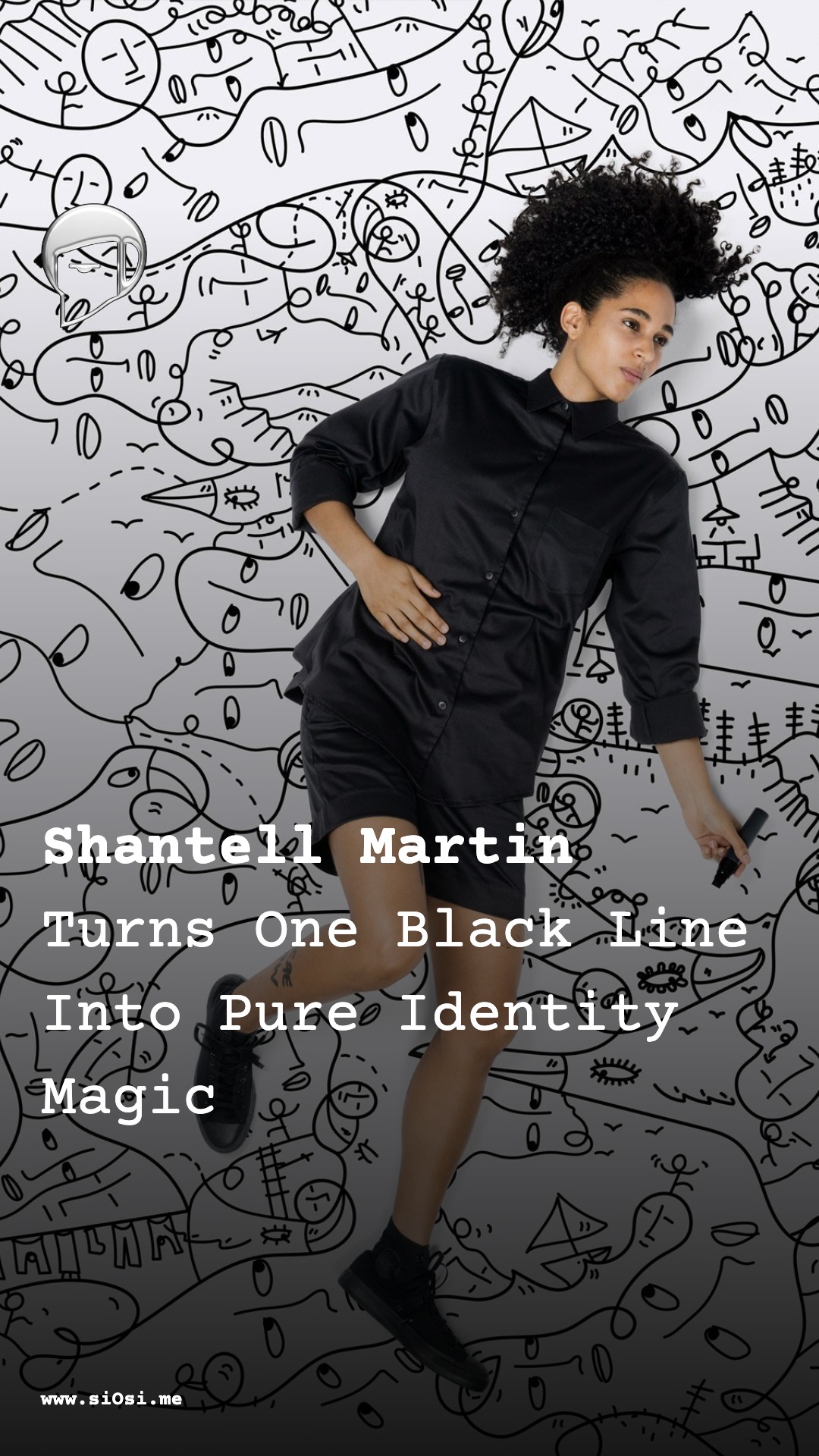
One unbroken black line can ask the biggest questions. Shantell Martin lets it wander across walls, sneakers and skin until faces, birds and quiet words appear like charms. The white space stays open on purpose, a pause that invites you to wonder who you really are. Her live drawings feel like watching thought take shape in real time. That single skeleton line becomes a fingerprint no one else can copy.
Shantell May Martin, born 1 October 1980, has developed one of the most distinct visual languages of the early twenty–first century: a world of black lines on white ground, improvised yet disciplined, playful yet quietly insistent. Her drawings, whether on walls, garments, sneakers or museum installations, form a kind of roaming script in space – a hand–drawn topology of identity, movement, and looking.
Her aesthetic impact unfolds along several intertwined axes: the line, the field of white, the scattered yet intentional words, the faces and small creatures that surface from the flow. Each is deceptively simple, yet together they produce a highly recognizable silhouette in contemporary visual culture.
Signature visual language: the ascetic richness of black and white
Martin describes her practice as a “language of lines, words and recurring characters, mostly black and white leaving space for discovery.” The stark restriction to black ink on white surfaces functions almost like a couture dress code in graphic form: a monochrome wardrobe of marks.
Visually, her drawings tend to begin as a single continuous black line, laid onto an empty ground that may be a canvas, a wall, a floor, furniture, clothing, or a shoe. She has likened this first line to a “skeleton” or “DNA”: a structural thread that dictates the later composition. From this initial line she reads shapes the way one might find forms in clouds or patterns in fabric. A curve that resembles the side of a face becomes nose, mouth, eyes. A horizontal fragment becomes land, then trees, sun, birds. The drawing grows like embroidery guided by intuition rather than a pre–drafted pattern.
The visual effect is a stream of consciousness rendered as wandering filigree. Lines loop and meander, sometimes dense and tangled, sometimes leaving generous, breathing expanses of white. This alternation of fullness and emptiness resembles minimal tailoring where cut and negative space matter as much as material – the body appearing by virtue of what is left unadorned. The white, unmarked surface is not passive background; it is a deliberate silence between phrases, a field of possibility in which the line can ask: Who are you? Are you you?
Her lines often carry faces, creatures, and brief texts: single words or short questions, fragments that feel like annotations on a garment or tattoos on skin. The characters are whimsical rather than heroic: simplified, cartoon–adjacent visages, little boats, birds and abstract forms. They float along the line like charms on a bracelet, each modest yet collectively forming an atmosphere of curiosity and gentle humor. This interplay of text and image suggests fashion’s long romance with slogans and illustrative prints, but filtered through a quieter, more introspective sensibility. The phrases are not declarations of status; they are prompts for reflection.
Emotionally, the black–white palette reads as clarity, even when the nội structure is intricate. It invokes chalk on blackboard, ink on paper, a designer’s first sketch. Martin herself has spoken of stripping down her language, using less color so she can explore “the depth of my process and the questions I ask in it, with simplicity.” This reduction parallels movements in fashion and beauty that reject excess adornment in favor of a single decisive gesture: a precise haircut, a bare face with one graphic element, a sharply cut coat in neutral wool. Her work has similar restraint: the drama lies in the decision to limit, not in flamboyant spectacle.
Movement, performance, and the body as surface
Martin often draws live, in front of audiences, with her improvisational line unfolding in real time. The act of drawing becomes a kind of bodily performance: the motion of her hand across architecture or clothing, the pacing, the pauses, the “STOP feeling” that signals completion. The body – her own and that of the viewer – is implicated in this choreography.
She consistently “draws on everything,” transforming objects and environments into participants in her visual narrative. Walls and furniture receive the same kind of attention as canvases; sneakers, ceramics and garments become carriers of her line. This dispersal of drawing across varied surfaces recalls the way fashion circulates silhouettes throughout daily life. A pattern migrates from dress to upholstery to wallpaper, dissolving boundaries between person and space. Martin’s lines carry this sensibility of all–over patterning, yet they resist repetition: each line is improvised, each composition singular.
When she collaborates with clothing brands, her signature language translates into wearable drawing. In her work with the print–heavy label Suno, limited–edition T–shirts and dresses were “emblazoned with Martin’s signature drawings,” an extension of earlier murals she created for the brand’s studio. The garments function as moving canvases on the body: lines travel across fabric, curving with shoulders, hips and hems. The wearer becomes part of the narrative, a figure literally dressed in questions and faces. The silhouettes of the clothing remain relatively simple; it is the surface drawing that introduces visual rhythm, much like the way handwriting animates a plain sheet of paper.
In collaboration with Puma, her line appears on classic sneaker silhouettes such as the Clyde and Suede, as well as a women’s Platform Strap style. Here, the sculpted form of the shoe – its rubber sole, leather upper, lacing – becomes the three–dimensional structure on which her drawings unfurl. The result is both graphic and tactile: the viewer reads the lines as image, yet also perceives them as part of the shoe’s material skin. This fusion recalls how beauty can be understood as both visual and haptic: the eye sees a stroke of eyeliner, but the wearer feels the weight and texture of pigment.
Her collaboration with The North Face similarly drapes her visual language onto technical pieces: search and rescue jackets, fleece, ripstop pants are overlaid with original prints and yellow–black color blocking. Here the aesthetics of utility – reflective strips, zippers, panels – meet the aesthetics of personal mark–making. The garments symbolize “not only the importance of overcoming challenges, but humanity’s desire to connect, create community and yet still retain individuality,” according to the brand. The printed line becomes metaphor for pathways, routes, connections across bodies and landscapes; its presence on outdoor gear evokes maps sketched on clothing, an emotional cartography of movement.
Philosophy of beauty, identity, and the line
Martin’s conceptual focus is the single line as a vehicle of identity. She has articulated a pivotal question: “What if I make a line, the most accessible element available to all of us, and master that? What if I take a single line and make it look like me? What if I take line and make that my fingerprint, my identity?” Beauty, in this schema, is not tied to symmetry or polish; it is located in the fidelity of the line to the individual hand, the unwavering trace of self.
Her mark–making is described as an extension of herself, “unique to her like a fingerprint or handwriting.” The line does not seek perfection in a conventional sense; it values authenticity, immediacy, and presence. She begins each illustration with a continuous line that becomes the “skeleton” of the drawing, then waits for spaces to call out for faces or words. The process is responsive rather than domineering: she listens to the drawing’s emergent form, allowing the line to guide her rather than imposing a rigid plan. This attitude carries an ethical dimension in relation to the body – a refusal to force a prescribed ideal, a willingness to let form arise from intimate observation.
In interviews, Martin speaks about being “completely present and being informed by my environment and my experience of the moment” when drawing, whether live or alone in the studio. She recognizes her art as a language that exists prior to any particular piece, yet insists that each work is shaped by context: the architecture, the audience, the time of day. Beauty, thus, is situational and relational; it appears as a conversation between the artist’s internal vocabulary and the external world. This carries affinities with contemporary approaches to beauty and style that emphasize personal narrative, cultural background, and emotional state rather than static standards.
Her drawings are often described as “inviting, accessible, and universally relevant,” serving as prompts like “Who are you? Are you you?” for viewers. The visual simplicity of the line allows more conceptual complexity: the work invites introspection about selfhood, belonging, and difference. For a historian of style, this is significant: the image does not merely decorate the body or environment; it asks the wearer or viewer to consider their own contours of identity. The aesthetic pleasure of the line – its loops, crossings, and occasional words – is inseparable from a gentle interrogation of the self.
Emotional presence and atmosphere today
Contemporary responses to Martin’s work often emphasize its combination of freedom and joy with an undercurrent of thoughtfulness. Her drawings are described as “visual musings” driven by intuitive energy and “a sense of true freedom and joy gleaned from sharing her ideas.” Yet this joy is never manic; it feels closer to quiet delight, like the satisfaction of tracing a path without losing oneself.
Her monograph, Lines, is noted for documenting a prolific practice that bridges fine art, commercial art, doodling, and play. That notion of play is central: the line moves with the spontaneity of a child’s drawing, but it inhabits adult spaces – museums, design studios, fashion collaborations – where playful mark–making is often constrained. The continued resonance of her work lies in this tension: a refusal to relinquish the exploratory, improvisational qualities of drawing, even within highly codified visual cultures.
Recent profiles describe her lines on walls as more than “scrawls and squiggles.” They appear simple, but function as “narratives inscribed in codes” along buildings and environments, designed to deepen viewers’ understanding of surroundings. In aesthetic terms, this means her interventions alter the perception of space. A blank wall becomes a conversation partner; architectural surfaces read as pages in a book. The emotional presence is one of gentle animation: spaces feel more alive, more capable of reflecting the inner movement of thought.
Her practice of leaving space for discovery – not filling every area, not resolving every line into a recognizable figure – resonates with current sensibilities around minimalism and mindful attention. Viewers today, often accustomed to dense visual feeds, may experience her work as a pause: an invitation to follow a line slowly, to read words at a humane pace. The glow it evokes is neither glossy nor theatrical; it is the soft radiance of clarity, of seeing how a simple element can carry complexity.
On the level of fashion and beauty aesthetics, Martin’s impact sits in a lineage of graphic minimalism but insists on handmade immediacy. Her collaborations show how her language of lines can be layered onto existing silhouettes without overpowering them, much as subtle makeup enhances bone structure without masking it, or a single piece of jewelry reframes an outfit. The line operates as a signature – unmistakable yet restrained.
Her work today continues to feel both contemporary and timeless because the basic unit – the line – precedes trends. Lines have always defined borders, seams, cuts, and contours. Martin simply isolates the line, lets it wander, and trusts that this most elementary mark can carry questions about who we are. In doing so, she offers an aesthetics of beauty in which the smallest gesture – a stroke of black on white – becomes a record of presence, a visible trace of being fully, calmly, oneself.