
Sun in LibraMoon in LibraNew Moon
Melvin Sokolsky's Bubble Series Still Floats
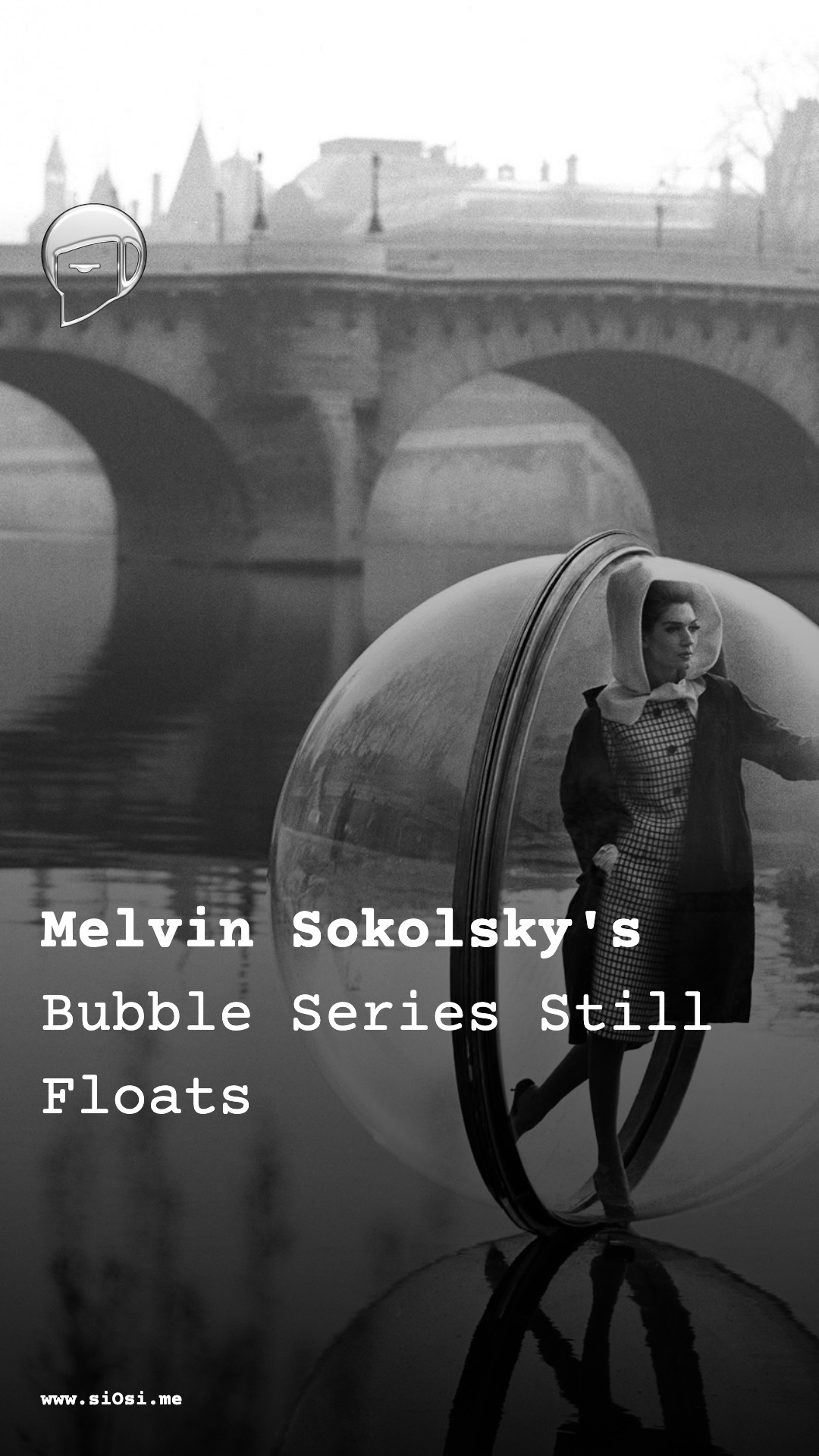
Picture a model hovering over the Seine inside a clear orb, couture intact. Melvin Sokolsky turned that 1963 vision into reality for Harper’s Bazaar with his Plexiglas bubble rig. The transparent shell catches daylight while Paris stays grounded below in stone and river water. His self-taught eye made weightlessness look like the ultimate power move. The result still feels like fashion meeting a quiet dream.
Melvin Sokolsky was born on October 9, 1933, in New York City. His fashion photography transformed the dressed body into a figure of suspension, illusion, and dreamlike composure, bringing an experimental, almost cinematic energy to the pages of Harper’s Bazaar during the 1960s.
Melvin Sokolsky: fashion released from gravity
Raised on Manhattan’s Lower East Side, Sokolsky was self-taught. He began photographing with his father’s box camera and entered professional fashion photography without formal artistic training, relying instead on observation, experimentation, and an instinct for the theatrical possibilities of the camera. That autodidactic beginning mattered to his visual language. His pictures do not treat fashion as a static catalogue of garments. They treat it as an event, a transformation of space, and a temporary suspension of ordinary physical laws.
In Sokolsky’s work, clothing acquires an almost weightless authority. A couture suit is not merely cut, fitted, and worn. It becomes an instrument of posture, a polished architecture around the body. Dresses lengthen into vertical gestures; hats, gloves, and tailored shoulders become signs of composure. The model’s body often appears less like an individual personality than a poised vessel for movement, light, and fantasy. This abstraction gave fashion a new emotional register, one built not on domestic elegance or social realism, but on wonder.
His most celebrated achievement was the “Bubble” series, made for the March 1963 issue of Harper’s Bazaar. The photographs showed Simone D’Aillencourt suspended inside a transparent Plexiglas sphere above Paris, including scenes over the Seine and near the city’s streets. The effect was both technically audacious and visually serene. The bubble’s hard, immaculate circumference enclosed the model in a private atmosphere, while the city continued below in its ordinary density of stone, water, bridges, and traffic.
The images produce a striking opposition between weight and weightlessness. Paris appears tactile and historical: gray façades, dark river water, masonry, and winter or early spring light. Against this material world, the translucent sphere is almost without color, a faintly luminous shell that turns the model into a figure of suspended grace. The eye moves between the geometric clarity of the orb and the soft irregularity of the city. Fashion becomes an apparition above the everyday.
The body within the bubble is not shown as athletic or forceful. It is composed, elongated, and still. The model’s posture preserves the manners of couture, yet the setting removes her from the social ground on which those manners ordinarily operate. She is neither walking nor seated, neither entering a room nor leaving it. She appears to hover between states, with the controlled elegance of a mannequin and the vulnerability of a human being placed in an impossible environment.
This tension gives the photographs their emotional power. They are not simply fantasies of luxury. They contain a subtle estrangement, a sense of being protected and isolated at once. The transparent enclosure suggests freedom from gravity, but also separation from the world below. The model can see the city, yet cannot touch it. Her beauty is elevated, preserved, and made almost untouchable.
The bubble as silhouette and atmosphere
Sokolsky’s bubble was more than a prop. It functioned as a new kind of silhouette, one that expanded beyond the garment and surrounded the entire body with a secondary outline. Traditional fashion photography depends on the contour of the dress, the shoulder, the waist, the hem, or the hat. Sokolsky enlarged that contour into an orb.
The result was a fashion image organized around enclosure rather than exposure. The body was visible, but contained. Transparency allowed the viewer to read the line of the clothing while preserving a veil of distance. The Plexiglas surface caught daylight and reflections, creating a fluctuating border between the model and the surrounding air. Its smoothness contrasted with the textures of wool, satin, fur, or tailored cloth, giving the images a tactile duality: soft fabric inside a hard, polished shell.
The bubble also altered scale. A human figure, ordinarily small against the monumental spaces of Paris, became a floating focal point. The city was transformed into a stage set, not because it lost its reality, but because Sokolsky reorganized its proportions. The river became a horizontal plane; the bridges became graphic bars; the façades became flattened tonal fields. The model, enclosed in a perfect sphere, appeared both miniature and monumental.
This manipulation of scale was central to Sokolsky’s larger practice. He later created images in which models seemed to shrink, float, or occupy impossible architectural situations, helping establish illusion as a legitimate and influential language within fashion photography. Before the widespread use of digital compositing, these effects depended on physical construction, rigging, perspective, careful planning, and the photographer’s ability to make artificial circumstances appear emotionally credible.
Surrealism with couture discipline
Sokolsky’s work is often described as surreal, but its strangeness is moderated by an exacting sense of elegance. The images do not abandon fashion’s codes. They preserve the smoothness of couture, the discipline of styling, and the quiet authority of the well-dressed body. What changes is the world around those codes.
His imagination joined the polished surface of mid-century fashion with the irrational spaces of dreams. The influence of surrealism is visible in the separation of body from ground, the distortion of scale, and the transformation of ordinary urban settings into sites of apparition. One account connects the “Bubble” series to Hieronymus Bosch’s The Garden of Earthly Delights, a source of visual inspiration for its mixture of earthly landscape, fantasy, and impossible movement.
Yet Sokolsky’s surrealism is not dark or grotesque. It is luminous, restrained, and often emotionally buoyant. The images retain the coolness of editorial design: clean planes, controlled contrast, and a deliberate absence of visual clutter. Their fantasy is made credible through discipline. Every improbable element is presented with the calm conviction of a fact.
That calm is essential to their beauty. The model does not appear astonished by her flight. She maintains the composed posture expected of a fashion subject, as though floating above the Seine were simply another condition of being well dressed. This refusal of theatrical surprise gives the images their particular sophistication. The impossible is absorbed into etiquette.
Movement without motion
Sokolsky’s photographs are fascinated by movement, but many of their most memorable figures are completely still. The bubble travels through Paris, cranes lift it above streets, and the model is transported through space, yet the final image often feels suspended in a single breath.
This creates a distinctive kind of visual rhythm. The city suggests movement through perspective, water, traffic, architecture, and changing distance. The model counters that movement with stillness. The result is neither static nor kinetic, but held motion: a moment in which travel becomes posture.
The images therefore extend fashion’s relationship to the body. Clothing is shown not only as something that follows movement, but as something that can define the emotional meaning of movement. A sharply tailored silhouette retains its authority even when removed from the ground. A flowing dress becomes more than fabric in air. It becomes evidence of an altered physical world, its folds and edges registering a motion that the photograph has arrested.
This suspended movement also gives the photographs a musical quality. The orb is a rounded note; the river provides a horizontal staff; the model’s body forms a vertical accent. The image is composed through intervals between line, volume, and emptiness.
Beauty, distance, and the body
Sokolsky’s philosophy of beauty was expressed through imaginative displacement. He did not treat the body as a fixed object to be recorded against a neutral background. He treated it as something capable of inhabiting other scales, other atmospheres, and other laws of gravity.
His models are often idealized, but not in the conventional sense of simply being made more glamorous. They are idealized by being granted a different relationship to the world. Their beauty becomes atmospheric. It lies in the distance between the body and the ground, in the lucid surface of the sphere, and in the composure with which the model occupies an impossible situation.
This approach altered the emotional presence of the fashion photograph. Earlier editorial imagery often emphasized social setting, desirability, refinement, or access to a particular world. Sokolsky added another possibility: fashion as psychological escape. The dressed body could leave the street without losing its elegance. It could become remote, weightless, and inwardly radiant.
The distance is not entirely liberating. The bubble resembles a jewel, a spacecraft, a glass vessel, and a protective womb. It promises safety while making isolation visible. Its transparency allows the viewer to look, but also reminds the viewer that looking does not equal access. Beauty is presented as something luminous and fragile, preserved within a boundary.
Lasting visual impact
Sokolsky helped move fashion photography away from straightforward representation and toward constructed visual fiction. His work demonstrated that an editorial image could be a form of visual art, dependent on invention, engineering, set design, perspective, and narrative rather than merely on the accurate display of clothing.
The cultural significance of this shift lies in the way he expanded the permissible imagination of fashion. The garment no longer had to remain within the recognizable world of rooms, streets, salons, or social occasions. It could travel through the air, hover over water, shrink within architecture, or become part of a visual allegory. Fashion could be photographed as a dream without surrendering its precision.
His work entered major museum collections, including the Victoria and Albert Museum, the Getty, and the Museum of Modern Art, confirming its place not only in editorial history but also within the broader history of photographic invention. The continuing presence of the “Bubble” images is partly explained by their technical ingenuity, but their endurance is more deeply emotional. They still evoke the quiet astonishment of seeing the familiar made weightless.
Viewed today, Sokolsky’s photographs retain a cool, glassy glow. Their transparent surfaces, restrained palette, and immaculate silhouettes belong unmistakably to the modernist imagination of the 1960s, yet the feeling they create is less dated than suspended. They offer a vision of beauty freed from gravity but not from discipline, a beauty that remains elegant precisely because it meets the impossible with composure.