
Sun in LibraMoon in LeoWaning Crescent
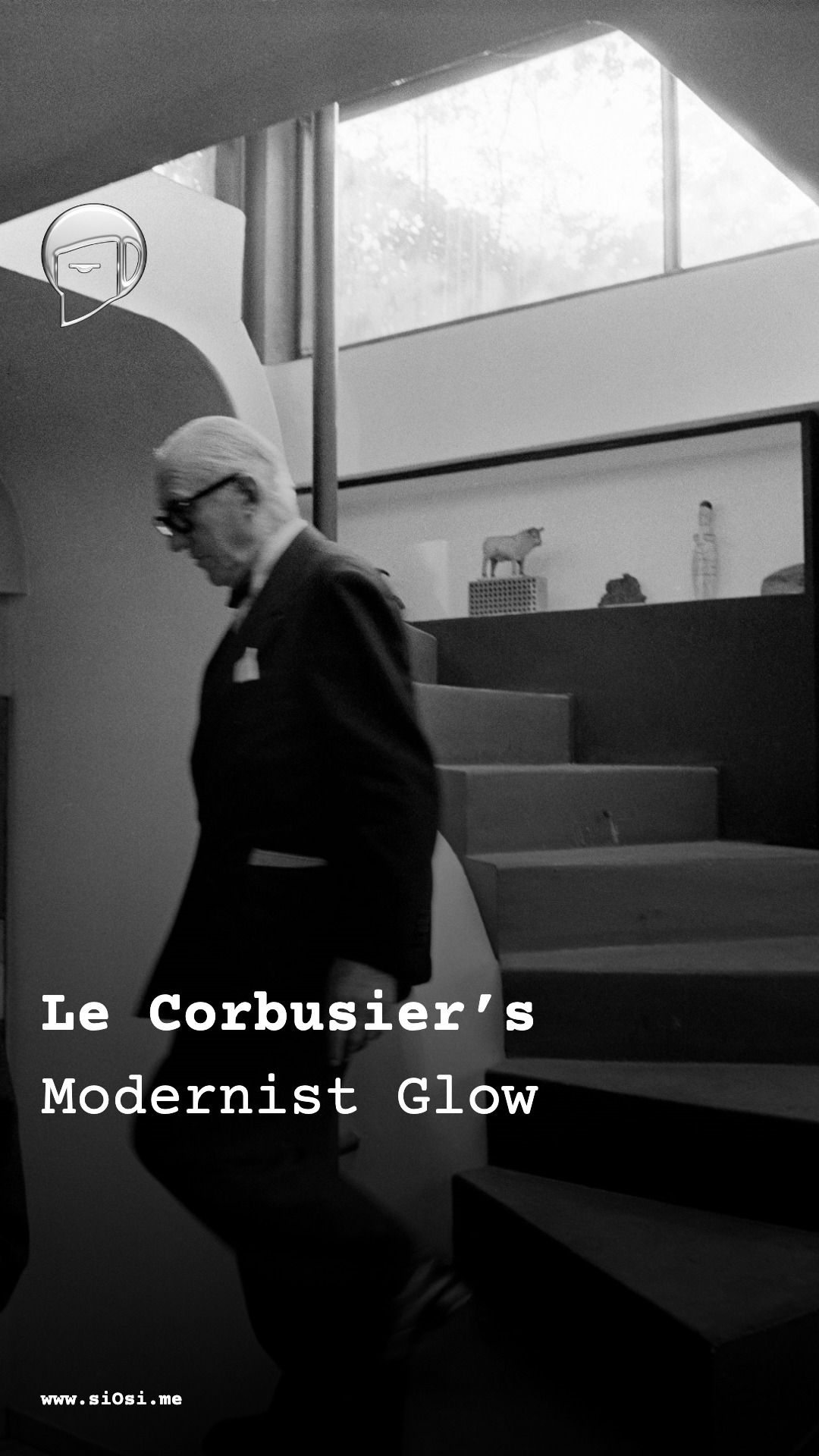
Le Corbusier’s Birthday Sparks a Modernist Glow
Le Corbusier turns the calendar into pure geometry. Born in a Swiss watchmaking town, he carried that precision into every line and plane he touched. His ramps and terraces turn walking into a slow reveal, like a camera dollying through light and shadow. Color isn’t decoration for him, it’s temperature and depth, shifting how a room breathes around you. The result still feels fresh: clean edges that make the body look sharper and more alive.
Le Corbusier was born Charles-Édouard Jeanneret on 6 October 1887 in La Chaux-de-Fonds, Switzerland, a watchmaking town in the Jura. His lasting influence on fashion, beauty, and style lies not in a wardrobe or a cosmetic vocabulary, but in a radically ordered way of seeing: the body moving through space, color acting upon feeling, and form reduced until its essential rhythm became visible.
A watchmaker’s beginning
La Chaux-de-Fonds offers an important visual beginning. Its culture of watchmaking valued precision, calibration, repetition, and the lucid geometry of small mechanisms. Le Corbusier’s later work retained something of that atmosphere: the disciplined interval, the measured plane, the quiet authority of a horizontal line. His architecture often feels less like ornament than like a finely proportioned instrument, with windows, columns, stairs, and voids arranged as parts of a larger visual timepiece.
That sensibility altered the modern image of the body. Instead of the softened, heavily decorated interiors and curving silhouettes associated with earlier decorative traditions, his spaces offered a new poise: upright, clear, economical. The eye encountered white surfaces, strong shadows, exposed structure, and uninterrupted planes. Beauty became associated with order, air, light, and proportion rather than accumulation.
The body in motion
Le Corbusier’s architecture was not intended to be seen from one fixed position. The idea of the architectural promenade made movement part of visual experience. A stair, ramp, terrace, or changing aperture gradually revealed the building, so that the observer’s body became an instrument of perception. The house was understood through walking, turning, ascending, pausing, and looking outward.
This created a distinctly modern choreography. The body did not merely occupy a room. It was drawn through a sequence of compressions and expansions: a low passage opening onto a bright terrace, a narrow stair releasing the gaze toward the sky, a dark interior framing a distant landscape. The emotional effect could be almost cinematic, although it depended on architecture rather than spectacle.
In aesthetic terms, this movement displaced the static portrait. The ideal figure was no longer simply posed against a decorated background. It became a figure in passage, its outline sharpened by architectural edges and its presence altered by sunlight, shadow, and scale. Clothing, gesture, and posture could appear newly graphic against the large planes of modern space.
Lines, silhouettes, and the modern face
Le Corbusier’s visual language depended on a small number of persistent forms: the horizontal ribbon window, the free-standing column, the roof terrace, the rectangular plane, the curved ramp, and the disciplined grid. These forms created a setting in which the human silhouette could be read with unusual clarity.
Against pale walls, a dark coat became almost calligraphic. Against a saturated red or blue plane, the body appeared as a contrasting shape rather than as a collection of decorative details. The architecture supplied a severe but generous frame. It did not soften the figure; it isolated and clarified it.
This clarity influenced the broader modern appetite for streamlined form. In fashion and beauty culture, the period increasingly favored shorter hair, simplified clothing, tubular or geometric silhouettes, and faces presented with graphic definition. Le Corbusier did not design these fashions, and no direct line should be drawn between his buildings and every contemporary garment. Yet his architecture belonged to the same larger modernist transformation, in which ornament gave way to contour, surface, function, and visual economy.
Color as atmosphere and emotional force
Le Corbusier was not an advocate of colorless modernism. His architectural polychromy began early, with colored walls appearing in the Jeanneret-Perret House as early as 1912, and he articulated his relationship to color more fully in 1931. He developed two color collections, in 1931 and 1959, comprising 63 shades.
For him, color was spatial and physiological rather than merely decorative. His system treated color as capable of altering the apparent depth, weight, and emotional temperature of a room. Blue and green could recede, producing distance and atmosphere. Reds, oranges, browns, and related tones could stabilize a wall, affirming its position and presence.
This gives his interiors an almost cosmetic intelligence. Color behaves like rouge, shadow, or reflected light, not as surface embellishment but as an agent that changes the perceived structure of the face or body. A blue wall can make a room breathe outward. A terracotta plane can draw it inward. A white surface can intensify the changing complexion of daylight.
The result is a palette that feels both elemental and cultivated: chalk white, mineral gray, deep ultramarine, ochre, burnt sienna, umber, and muted green. These tones possess the tactile associations of pigment, stone, dust, skin, and weather. Even when applied to concrete or plaster, they retain something handmade and sensuous.
Texture, light, and the unpolished surface
Le Corbusier’s buildings are often associated with smooth white modernism, but his later work also gave concrete a strongly tactile role. Rough surfaces, exposed marks, deep reveals, and heavy shadows resisted the immaculate finish of industrial fantasy. The material could appear porous, weathered, almost geological.
This mattered to the emotional experience of modern space. Smoothness suggests distance and control. Rough concrete introduces touch by implication. Its irregularities invite the eye to imagine pressure, grain, weight, and labor. The surface is no longer a neutral background but a silent record of making.
Light intensifies this physicality. It slides across a wall, catches the edge of a balcony, pools beneath a projecting roof, or cuts a window into a bright geometric aperture. The architecture changes complexion throughout the day. Morning may make it pale and cool; afternoon may bring out ochre, rust, and shadow; evening may reduce it to silhouette.
In this sense, Le Corbusier’s work possesses a beauty regime of its own. It does not conceal age, weather, or material pressure. It allows the building to acquire patina, much as a face gathers expression. The ideal is not perpetual polish, but a legible relationship between surface, light, and time.
Beauty, order, and the body
Le Corbusier’s attitude toward beauty was governed by proportion and relation. He sought systems that could connect the human body to architecture, most notably through the Modulor, a proportional system based on human measurements and mathematical relationships. The body was treated neither as an incidental occupant nor as a purely organic mystery. It became a measure through which space could be organized.
That approach has an emotional ambiguity. On one side, it promises comfort, coherence, and a sense that architecture might meet the body at the scale of the hand, the step, the eye, and the outstretched arm. On the other, its abstraction can feel austere. The human figure is honored as a measure, yet also translated into a system.
This tension gives his work much of its continuing force. The spaces are human in scale but not sentimental. They can feel protective, lucid, and liberating, while also imposing a discipline on movement and attention. Their beauty is not decorative pleasure. It is the pleasure of alignment: the moment when a stair, window, horizon, and body appear to belong to one order.
Emotional presence today
Le Corbusier’s work still evokes a particular modern emotional register: alertness without agitation. Its surfaces can feel cool at first, but the experience often warms through movement and light. A ramp curves with the bodily ease of a shoulder or hip. A roof terrace opens toward weather. A colored wall alters the pulse of a room. Concrete holds the day’s heat, while shadow offers relief.
The resulting atmosphere is neither intimate in the traditional domestic sense nor impersonal in the manner of pure machinery. It is contemplative, sometimes severe, yet capable of unexpected tenderness. The tenderness lies in the invitation to notice: the changing blue of distance, the pressure of a handrail, the frame of a view, the measured pause before a turn.
His enduring glow comes from this union of rigor and sensation. Geometry does not eliminate feeling. It gives feeling a structure through which to move. Color does not decorate form. It changes the emotional distance between the body and its surroundings. Light does not merely reveal architecture. It makes the architecture appear to breathe.
Le Corbusier’s birth on 6 October 1887 therefore marks more than the arrival of an architect later recognized as one of the twentieth century’s central modernists. It marks the beginning of a visual imagination that helped make austerity expressive, proportion sensuous, and the moving body central to the experience of beauty.