
Sun in LeoMoon in PiscesWaning Gibbous
Yves Saint Laurent: Born to Shape Modern Elegance
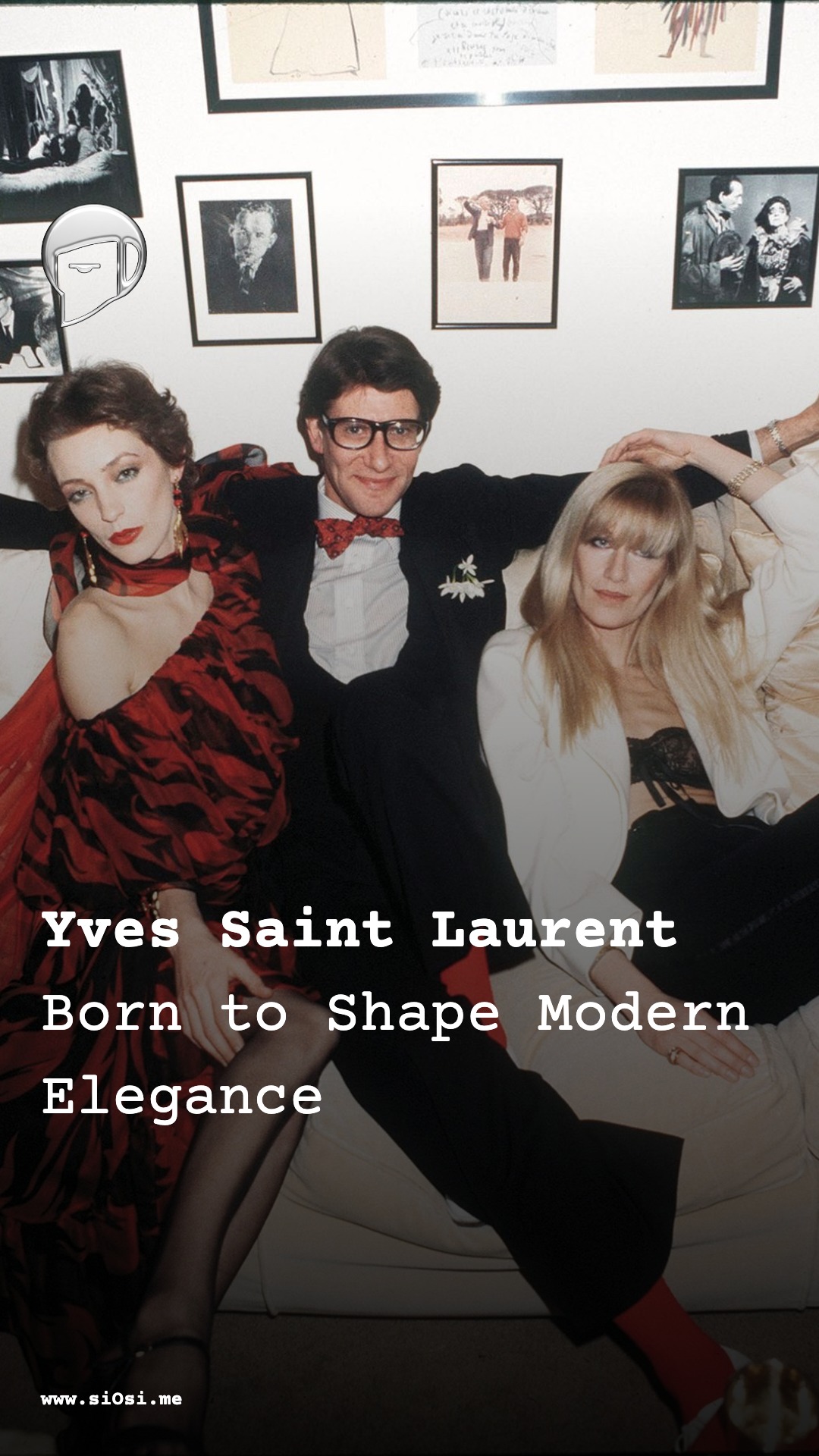
On 1 August 1936, Yves Saint Laurent entered the world in Oran, Algeria, and quietly rewrote the language of beauty. His childhood under the hard Mediterranean light taught him to turn shadow into graphic clarity and black into luminous armor. From the architectural shoulders that frame composure to the fluid trousers that grant stride without spectacle, his silhouettes protected while they liberated. Neutrals like sand and olive met sharp tailoring; vivid accents arrived like controlled sparks against midnight fields. Texture played matte against sheen, intellect against allure. The result was lucid glamour: women dressed with the authority of men yet kept their own sensuality intact. Today his lines still whisper urban twilight—self-possessed, articulate, and quietly free.
Yves Saint Laurent’s birth in Oran on 1 August 1936 is less a biographical fact than the quiet beginning of a new visual grammar of modern beauty: a way of dressing the body that made sharpness tender, darkness luminous, and freedom exquisitely precise.
Origins of an eye: Algerian light, French rigor
Saint Laurent’s childhood in Oran, on Algeria’s Mediterranean coast, imprinted him with a sense of light and shadow that would later migrate into fabric and line. The sun there is hard and white, flattening architecture, bleaching façades, and turning shadows into clear, graphic shapes. One can feel that climate transposed in his later work: black rendered not as heaviness but as brightness against the skin, khaki and sand tones treated as urbane neutrals rather than provincial dust, and color used sparingly, like a precise accent in a glaring field.
Educated within a French cultural framework yet formed in colonial North Africa, his visual world combined French discipline of cut with an instinct for loosely draped ease, as if Parisian tailoring had inhaled warm air and widened its lungs. The result, once he came to Paris, would be a silhouette that always felt both drawn with a ruling pen and softened by heat: shoulders defined but never brutal, waists suggested but not pinched, skirts that move but do not flutter.
The new silhouette: structure as protection, ease as intimacy
From the moment Saint Laurent began designing professionally in the mid‑20th century, he refined a silhouette that protected the wearer while liberating her.
-
The shoulder: His jackets frequently carry a clear, architectural shoulder line—neither the drooping romantic shoulder nor the aggressive, padded bulk of earlier power dressing, but a measured horizontal that frames the head like a plinth. On the body, this reads as composure: the wearer appears self-contained, her gestures edited, her outline legible from across a room.
-
The torso: Rather than cinching a corseted waist, Saint Laurent often drops visual focus to the hip line, creating a vertical flow where the torso becomes a calm surface rather than a site of constriction. This gives his clothes a particular emotional temperature: they are poised but never anxious, aware of sexuality yet unwilling to dramatize it.
-
The leg and hem: He favored hem lengths that maintain dignity while permitting stride, skirts that do not cling but follow, trousers that fall in a straight, fluent line. In movement, this translates to a kind of low-volume drama: fabric whispers around the legs, never shouting, leaving the impression of a life lived in continuous, unhurried motion.
His much‑celebrated androgynous pieces—most famously the woman’s tuxedo—crystallize this silhouette. The smoking jacket’s verticals and sharp lapels lodge the body within geometry, while the taper of trousers and the softness of shirts reintroduce intimacy. The overall effect is of a figure who owns the space around her with minimal gestures; beauty becomes a form of stillness intensified by design.
Color and contrast: nocturnal brightness, disciplined exuberance
Saint Laurent’s use of color is marked by restraint charged with intensity. When he embraces vivid hues, they arrive as controlled detonations against a dark or neutral field.
-
Black as light: In his hands, black becomes luminous, a reflective surface rather than a void. Black wool, satin, or velvet catches gallery light and candle glow, carving the body into planes and edges. Emotional tone: quiet daring, a cultivated mystery that is more urban than gothic.
-
Neutrals as terrain: Tans, olives, and sandy beiges recall Mediterranean soils and stone, but refined into cosmopolitan palettes. These shades soften severe tailoring, making jackets and trench coats feel like extensions of the environment rather than armor.
-
Accented brilliance: When strong color appears—fuchsia, cobalt, crimson—it often comes in concentrated blocks or accents, echoing modern art’s flat, saturated panels. Color is never scattered; it is placed. The emotional register is purposeful joy, never frivolity.
This disciplined chromatic language, grounded in contrast and clarity, helped reposition fashion from romantic prettiness to something closer to graphic design on the body: visual decisions rather than decorative impulses.
Texture and fabric: the tactility of intelligence
Saint Laurent’s fabrics often stage a dialogue between matte and sheen, weight and air.
-
Wool and gabardine frame the body with dry, matte surfaces that support his tailored lines. Touch conveys seriousness, reliability; the garments feel like companions in work and thought.
-
Silk, satin, and chiffon appear as counterpoints: slips of gleam beneath structured jackets, flowing sleeves emerging from rigid shoulders. Movement here is liquid: the wearer leaves small trails of light as she walks.
-
Velvet and brocade, when used, bring depth rather than opulence. They catch and hold shadow, lending clothes an introspective, evening quiet rather than mere baroque excess.
Texture, in his vocabulary, is a way of modulating emotional atmosphere: matte for thought and clarity, sheen for allure, pile for mystery. The body becomes the site where these emotional textures meet and reconcile.
Lines, shapes, and posture: a geometry of presence
Saint Laurent’s signature visual language is graphic and architectural, yet intimately aware of how a person stands and moves.
-
Lines: He relies heavily on clean verticals—lapels, trouser legs, long scarves—balanced by discreet horizontals at the shoulder and, occasionally, the belt. This yields a sense of internal order: the wearer seems to inhabit a quiet set of rules, self-imposed and elegant.
-
Shapes: His recurring shape families include the rectangle (box jacket, shift dress), the column (straight skirt, evening dress), and the soft trapezoid (slightly flaring coats). Rounded forms are present but subordinated; curves appear in the drape of fabric rather than in overt contouring of the body.
-
Posture: Clothes are cut to encourage a upright, calm posture, shoulders back but not rigid, head clearly framed. A Saint Laurent figure looks neither coquettish nor submissive; she seems to occupy the vertical line of her spine as a chosen stance.
In photographs and runway images from his career, one sees models who do not flutter or simper but advance with measured steps, often with hands in pockets or lightly resting on hips—gestures of quiet self-possession amplified by the clothes.
Face, hair, and the aura of intellect
Although known primarily for garments, the environments around his clothes—hair, makeup, jewellery—extend his philosophy of beauty.
-
Makeup: The typical Saint Laurent face, especially in archival runway imagery, leans toward defined eyes, sculpted cheekbones, and controlled lips—a balance of drama and clarity. This produces an impression of sharpened awareness rather than artificial doll‑like prettiness; beauty is aligned with alertness.
-
Hair: Hair is often worn in sleek bobs, controlled waves, or disciplined volume, styles that hold their shape rather than unravel. Against the sharp lines of jackets and dresses, this hair creates a sealed, complete contour around the head—another assertion of self.
Together, this face-and-hair language contributes to an aura in which intelligence becomes a visible feature. The person appears lit from within by thought, their clothes operating as clear frames.
Philosophy of the body: liberation through seriousness
According to biographical accounts, Saint Laurent articulated a desire to modernize and liberate women’s wardrobes, allowing them to dress with the same authority as men while maintaining their own sensuality. This philosophy manifests aesthetically in several key ways:
-
The body as subject, not ornament: Clothes do not compete with the body; they give it structure and privacy, enabling the wearer to move through public space without being overexposed or erased.
-
Androgyny as equilibrium: By importing traditionally masculine codes—tuxedos, safari jackets, trench coats—into women’s fashion, he creates an androgyny that feels like balance rather than conflict. Emotionally, this reads as composure: beauty becomes the quiet confidence of one who chooses her form.
-
Sensuality without spectacle: His designs can be deeply sensual—low backs, sheer panels, narrow cuts—but the sensuality is tempered by formality, a tension that keeps desire and dignity in constant conversation.
The body in a Saint Laurent garment is invited to be fully present yet not fully disclosed, a modern condition rendered visually.
The feeling today: a glow of lucid glamour
Viewed now, long after his death and decades after his most groundbreaking collections, Saint Laurent’s work still projects a distinct emotional glow: lucid glamour.
-
There is glamour, certainly, in the depth of black, the fall of a satin lapel, the glint of a jewelled cuff—but it is glamour that has read books, walked city streets alone at night, and learned to value silence.
-
His clothes evoke urban twilight: the hour when offices empty, lights come on in galleries and bars, and people move from labor to self-expression. The mood is neither escapist nor nostalgic; it feels like reality intensified.
-
The visual presence of his silhouettes today still suggests self-authored identity. To inhabit those lines, one does not vanish into costume; one becomes more sharply oneself.
In the ongoing history of style, the birth of Yves Saint Laurent in 1936 marks the arrival of a sensibility in which fashion becomes a language of clear thought, controlled desire, and poised freedom expressed through cut, color, and light. His aesthetic continues to offer a way of seeing beauty as a form of articulate quiet—a body drawn in strong lines, moving through the world with measured grace.