
Sun in LeoMoon in GeminiThird Quarter
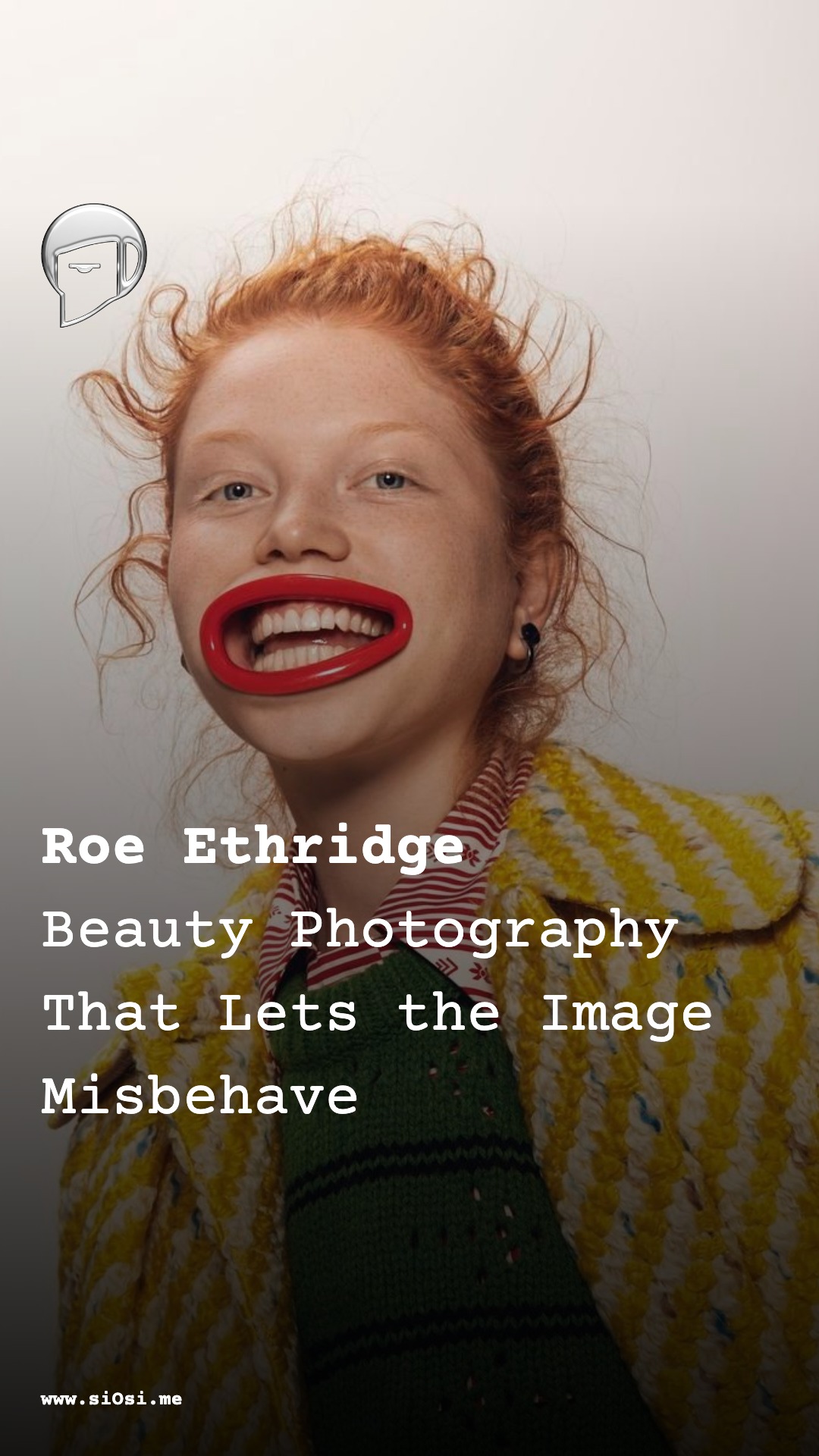
Roe Ethridge: Beauty Photography That Lets the Image Misbehave
At siOsi we love images that refuse to stay perfect. Roe Ethridge, born in 1969, built his career by letting high-gloss fashion lighting slip into awkward crops, stray textures and flat suburban daylight. His frames keep the commercial sheen but add bruised fruit, fingerprints on plastic and a model whose expression has already drifted. The result feels both over-lit and slightly off, exactly the restless beauty we chase in every siOsi campaign. Instead of flawless ideals, Ethridge shows beauty as a temporary alignment that can fall apart at any moment. We invite you to embrace the same friction: clean lines interrupted by real life, glamour that still carries the room it was shot in. Step into the beautiful chaos with us.
Roe Ethridge’s work has rewired the visual grammar of contemporary fashion and beauty photography, replacing seamless fantasy with a restless, luminous friction between polish and disruption. His images feel like surfaces that have begun to misbehave, a language of commercial sheen interrupted by stray textures, awkward crops, and emotional noise that never quite resolves.
Visual language: the misbehavior of the image
Ethridge’s signature aesthetic arises from a deliberate collision between high-production gloss and errant detail. He works with the lighting, framing, and retouching conventions of advertising and editorial photography, then allows them to slip, glitch, or fray.
-
Light and sheen The light in his images is often clean, frontal, and studio‑bright, a kind of persuasive commercial clarity that makes skin look lacquered, fabric crisp, and objects almost overreal. Yet this clarity is frequently compromised: reflections flare, shadows flatten or turn muddy, highlights edge toward overexposure, so that the scene feels both professionally lit and faintly disturbed, like a product shot taken at the wrong moment or from a slightly wrong angle.
-
Color and tonal atmosphere Ethridge’s color is saturated yet unromantic, closer to catalogue printing and supermarket packaging than to the carefully harmonized palettes of traditional fashion editorials. Plastics and synthetics gleam, fruits and flowers verge on garish, suburban lawns and highways sit in a hard daylight that denies nostalgia. At times the palette is sugary, almost kitsch; at others it is metallic and cool. Across this range, his color suggests a reality tuned to the frequency of advertising, then pushed slightly off station, producing a faintly nauseous, yet compelling, beauty.
-
Lines, structure, and composition Many images are built on the blunt, functional compositions of commercial photography: centered objects, simple planes, direct gazes. Into this order he threads compositional irritants, such as skewed angles, cropped limbs, intrusive backgrounds, or minor clutter that refuses to be styled away. The result is a visual rhythm that feels efficient but unstable. Everything appears “correct” at first glance, then slowly reveals its own imbalance.
-
Texture and surface Ethridge is acutely attuned to surface textures – the knurled plastic of packaging, the sticky gloss of fruits, the slickness of hair product, the sharp weave of denim or polyester shirting. In still lifes, these textures are amplified: droplets on a glass, bruises on a peach, fingerprints on a bottle. The surfaces that advertising would smooth out are left visible, even celebrated, so that the fantasy of perfection comes to rest on a visibly imperfect material world.
-
Movement and stillness While some fashion work captures bodies in kinetic motion, Ethridge often favors a kind of arrested movement – poses that look caught between test shot and final image. Hands hover indecisively, expressions are halfway to a smile or a grimace, garments sit slightly wrong on the body. The photographs feel paused rather than posed, as if we are looking at the moment when the model or object forgot to perform, and the camera recorded that lapse.
Fashion, beauty, and the “failure of good taste”
Ethridge’s impact on fashion and beauty imagery lies in his persistent refusal of the smooth, aspirational elegance that dominated late‑20th‑century editorial and campaign photography. Instead, he cultivates what critics have called a “failure of good taste” – images that borrow the codes of refinement only to let them come apart.
-
Elegance disturbed In many works, the styling feels almost conventionally chic – clean lines, sharp tailoring, controlled hair and makeup – yet the frame introduces an element of disruption: a cheap prop, a banal backdrop, a stray cable, a minor stain. This friction makes beauty appear contingent rather than absolute, something that flickers within the everyday rather than floating above it.
-
Generic vs intimate Ethridge repeatedly explores the boundary between the generic and the personal: stock‑photo blandness pressed up against private moments and idiosyncratic details. A face styled for luxury branding is lit like a DMV portrait; a domestic kitchen or suburban street is photographed with the crisp ruthlessness of an advertising shoot. Fashion and beauty here feel embedded in ordinary life, subject to its mess and boredom, not protected from them.
-
Flirting with bad taste According to interviews, Ethridge is drawn to images that feel “rude in the good way,” allowing elements of tackiness, cliché, or visual overstatement to enter the frame. High‑octane campaigns coexist with pictures that recall stock photos, tourism brochures, or amateur snapshots. This interplay unsettles the hierarchy between high and low fashion, suggesting that style can emerge from any visual register, including those typically dismissed as vulgar or dull.
-
Beauty as an awkward presence Beauty in Ethridge’s work rarely arrives as a stable ideal. It feels more like a fleeting pressure in the image: a precise highlight on a cheekbone, a fold of fabric catching the light, a glint on a plastic surface, suspended within an otherwise uncomfortable composition. The viewer senses that the image is not trying to flatter so much as to expose how much effort, artifice, and accident go into making things appear beautiful at all.
Silhouette, body, and posture
Although Ethridge is not a designer, his images subtly reshape how the fashion silhouette is perceived, particularly in a photographic context.
-
Bodies as objects, objects as bodies Commercial fashion imagery typically turns the body into a seamless vector for clothes. Ethridge complicates this by treating bodies a bit like still life objects and objects a bit like bodies. A model may be photographed with the same detached clarity as a cereal box, and a sneaker or handbag may be lit with a near‑portrait intensity. This cross‑treatment collapses the distinction between living flesh and commodity, making the silhouette feel both animate and strangely inert.
-
Posture and emotional misalignment There is often a disjunction between the posture demanded by fashion styling and the emotional tenor of the face or setting. A bold stance may be paired with a tired or distracted gaze; immaculate makeup appears in a room that feels provisional or slightly chaotic. The viewer experiences an emotional double exposure: confidence laid over boredom, glamour laid over mild absurdity.
-
The unheroic body Ethridge’s fashion images rarely monumentalize the body. Instead, the figure sits in the frame as one element among many – as exposed to bad lighting, cheap flooring, and ambient clutter as any other object. This unheroic presentation alters the emotional relationship to beauty: the body is no longer a perfect vessel for style, but a participant in a broader scene of cultural and visual noise.
Emotional climate: beauty and perversity of Americana
Ethridge’s work has frequently been described in relation to Americana – not as nostalgic celebration, but as a cool, sometimes perverse inspection of American image culture.
-
Flat affect, underlying unease Many photographs carry a deadpan, almost affectless tone: a neutral gaze, a straightforward angle, a calm surface. Under this flatness runs a strain of unease or mild perversity, produced by small visual wrongnesses – the bruise on a fruit, the slightly dirty floor, the off‑kilter crop of a face. Emotion is not signaled loudly, but accumulates quietly as the viewer notices how the ideal never quite materializes.
-
Beautiful chaos Recent work has been described as capturing the “beautiful chaos” of American life – a layering of commercial signage, suburban architecture, fashion styling, and casual domestic scenes in a single visual field. There is a sense of too much information: competing patterns, overlapping textures, mixed signals of class and taste. Beauty appears as a kind of shimmer within this excess, both seductive and slightly exhausting.
-
Perversity and tenderness Even in his most clinically lit images, there is a faint tenderness for the flawed things he photographs: dented cars, wilted flowers, cheap clothes, unremarkable interiors. The perversity lies not in cruelty but in the decision to show these things with the same care and clarity normally reserved for luxury goods. This democratization of attention alters the emotional presence of beauty, granting a quiet dignity to what might otherwise be visually discarded.
Philosophies of beauty and the body
Across interviews and critical writing, Ethridge’s attitude toward beauty is marked by skepticism toward ideals and fascination with slippage – the moment when an image reveals its own construction.
-
The image as unreliable narrator Ethridge speaks of building a practice that “thrives on slippage: between the real and the ideal, the generic and the intimate, the applied and the autonomous.” Beauty, in this framework, is not a stable property, but a temporary alignment of elements in an image that can easily fall apart. His work repeatedly stages that falling apart.
-
Disrupting the ideal with the real As his gallery biography notes, Ethridge “uses the real to suggest – or disrupt – the ideal,” merging art‑historical genres with the pervasive images of contemporary advertising and media. This is not simply a critique of commercial beauty, but a recognition that the ideal cannot exist without the real materials, bodies, and environments that support and compromise it.
-
Collaboration and polyphony Ethridge often emphasizes collaboration and a “chorus of voices” in his practice, acknowledging stylists, editors, brands, and subjects as co‑authors of the image. This multi‑voiced process aligns with his visual language: beauty becomes a negotiated, unstable result, never wholly controlled by a single aesthetic will.
-
Attitude toward the body The body in his photographs is not sanctified or demonized. Instead, it is treated as another site where cultural pressures and commercial aesthetics converge. Skin is lit like product surface, posture is styled for the camera, yet small bodily details – stray hairs, minor blemishes, unflattering folds – leak into the frame. The body appears as a lived thing inside an economy of images, neither purely glamorous nor purely vulnerable, but continuously reconfigured by visual expectation.
How his work feels today
Seen today, Roe Ethridge’s photography carries a peculiar emotional glow: cool, lucid, and slightly disenchanted, yet suffused with a quiet affection for the flawed world it depicts.
- There is a sense of standing inside the machinery of fashion and visual culture, watching it work from within: the lights, the retouching, the aspiration, and the boredom.
- His images feel prescient of an era in which advertising, editorial, and personal snapshots blend together on screens, their hierarchies dissolved. The tension between generic and intimate that he foregrounds now reads as a faithful portrait of contemporary visual life.
- Emotionally, the photographs radiate a soft, analytic melancholy. They acknowledge the seductions of beauty – the pleasure of clean color, good light, sleek surfaces – while quietly showing how those seductions rest on ordinary, sometimes indifferent reality.
The glow they leave is not the halo of idealized glamour, but the more complex light of recognition: the feeling of seeing the stylish world one inhabits with unusual clarity, its textures sharpened, its poses interrupted, its beauty rendered at once fragile and inescapable.