
Sun in LeoMoon in LeoNew Moon
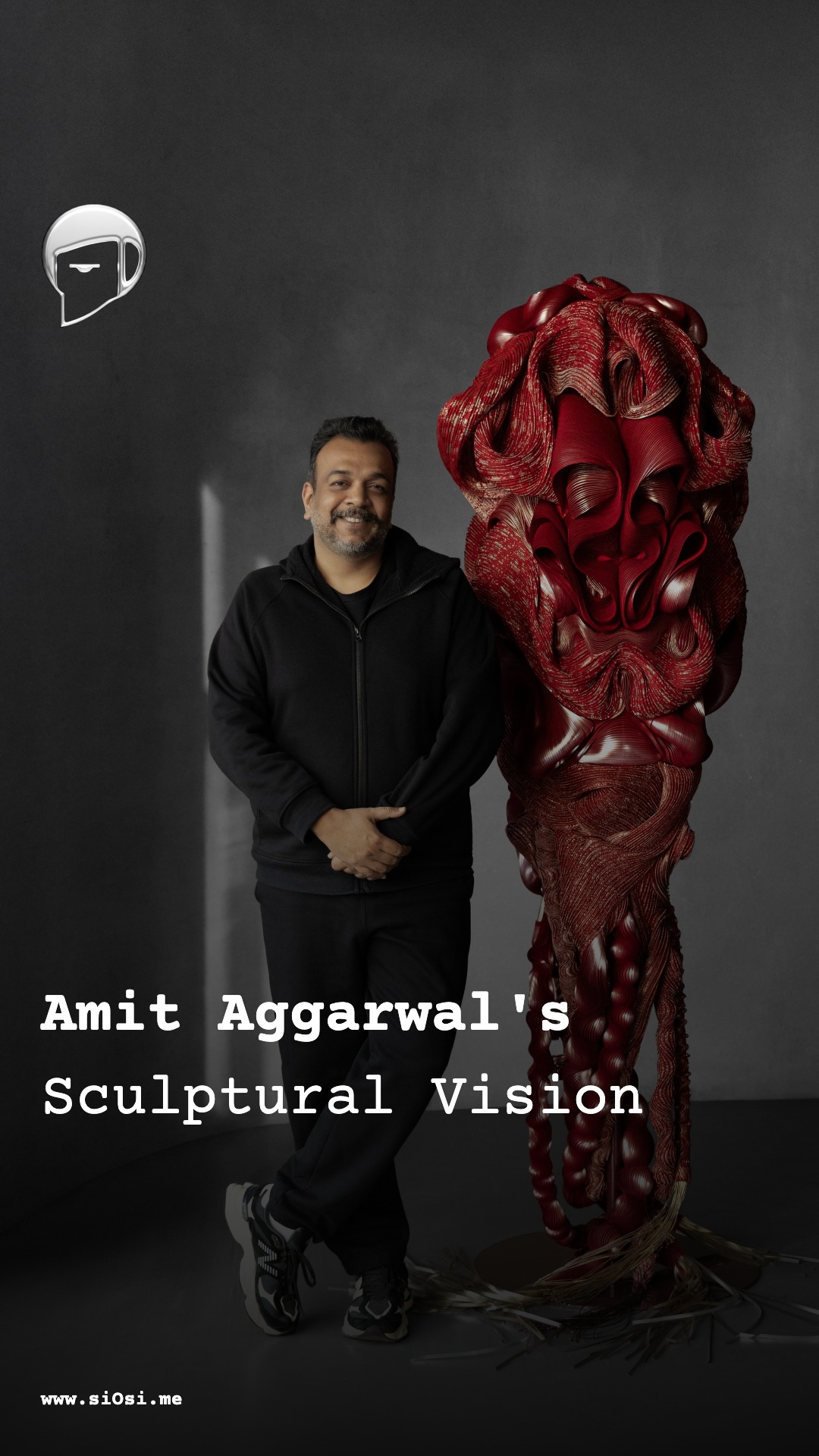
Amit Aggarwal's Sculptural Vision Shines on His Birthday with siOsi
Born on 11 August 1980, Amit Aggarwal redefines beauty through luminous architecture and recycled memory. His sculptural silhouettes fuse moulded polymers with hand-woven heritage weaves, turning the body into a living organism of light and engineered rhythm. Deep jewel tones meet chrome iridescence, while fan-like panels and ribbed textures move like petals or wings. At siOsi we celebrate this visionary who treats garments as evolving shells, balancing structured chaos with refined simplicity. From upcycled patola encased in futuristic films to menswear that flows like draped saris, his work invites us to wear both ancestral craft and bold tomorrow. Today we honour the designer who makes recycled plastics devotional, the body a site of dynamic evolution, and couture a luminous dialogue between nature, industry and the self.
Amit Aggarwal, born 11 August 1980, brought into Indian fashion a vision in which the body becomes a luminous architecture, clothed not in softness alone but in sculpted light, engineered rhythm and recycled memory. His work reshapes ideas of beauty through structure, sheen and movement, treating garments as living organisms that fuse science, nature and craft.
Silhouette and the engineered body
Aggarwal’s signature contribution to contemporary style is his sculptural silhouette – garments that appear part exoskeleton, part flowering shell, holding the body in a precise yet fluid frame.
Instead of allowing fabric to simply drape, he uses moulded polymers, hand‑woven recycled strips and heat‑formed materials to build contoured forms around the torso and hips, often resembling fossilized waves, ribcages or spiralling leaves. These silhouettes do not merely flatter, they redefine the outline of the wearer, adding projected curves, arcs and spines that extend beyond natural anatomy, so the person becomes a moving sculpture in space.
His couture often balances structured volume with sharp linearity:
- Fitted corset‑like bases that trace the rib and waist, then burst into fan‑like pleats or sculpted peplums.
- Long column skirts interrupted by sweeping plissé panels or shell forms over the hip, suggesting both protection and bloom.
- Menswear drapes that treat the male body with the fluid respect usually reserved for saris, wrapping it in swathes and pleats that soften traditional masculine rigidity.
Critics have described his aesthetic as “structured chaos and refined simplicity” – a tension between discipline and release. The garments often look as if frozen at the climax of a movement, an inward explosion held in precise equilibrium.
Color, light and contrast
Aggarwal’s color language is inseparable from his fascination with industrial material and organic form. His palette often moves between deep jewel tones and metallic iridescence, so that fabric seems to emit light rather than merely reflect it.
Common chromatic signatures include:
- Petrol blues, emerald greens and wine reds, often laminated or overlaid with transparent films that create a chromatic halo around the body.
- Chrome, graphite and liquid gold surfaces, produced through polymer coatings, that catch stage lighting and fracture it into sharp highlights and long glancing reflections.
- Unexpected combinations, such as earthy mustard under laser‑cut plumes of holographic plastic, which read as both futuristic and strangely botanical.
Light is central to his work. Under runway illumination, his pieces behave like moving prisms: ribbed panels create bands of brightness and shadow across the torso, while layered transparent strips generate moiré effects as the wearer walks, a subtle shifting between opacity and glow. Textures are often glazed or iridescent, making the garment appear wet or freshly hatched, as if beauty has just emerged from a metallic chrysalis.
Texture, material and touch
Aggarwal is best known for making recycled plastics and industrial materials part of the mainstream fashion conversation in India. He approaches these materials with an almost devotional respect for their tactile possibilities, transforming them into surfaces that feel half‑mineral, half‑floral.
Key material gestures:
- Recycled polymer strips, cut into fine ribs or leaves, then hand‑woven over traditional textiles so that each movement causes a faint, brittle rustle.
- Laminated organza and tulle, structurally reinforced so pleats hold a permanent, architectural edge, yet remain transparent enough to reveal skin and underlayers.
- Upcycled saris – particularly patola and other heritage weaves – encased or overlaid with futuristic films, creating a dialogue between ancestral softness and industrial crispness.
The emotional sensation of his textures is paradoxical: at a distance, the garments read as armour, chrome‑bright and protective. Up close, the eye discovers delicate, almost cellular detail – fine pleating, micro‑folds, hand‑stitched lattices – suggesting vulnerability and care. According to his own brand narrative, he seeks to “transform traditional Indian textiles into modern sculpted forms,” using polymers and unusual weaves to celebrate both nature and technology.
Touch, in his work, is more imagined than literal. Many surfaces look cool, slick, slightly resistant, as if the garment might hum under the fingers. This slight alienation from expected softness is central to his aesthetic, redirecting beauty away from comfort toward alertness and sensory curiosity.
Movement and emotional presence
Although his materials are often rigid, Aggarwal thinks choreographically. He designs garments to move like organisms rather than fabrics.
- Fan‑like panels attached at the waist or shoulder open and close with each step, echoing petals, wings or shell hinges.
- Fine vertical ribbing along the skirt and bodice creates a visual vibration when in motion, similar to the flicker of insect wings or the ripple of deep water.
- Draped menswear, cut to follow the lines of the knee and hip, allows the male body to stride in elongated arcs, restoring a certain classical grace to contemporary menswear silhouettes.
At Lakmé Fashion Week X FDCI, his collection “Orizon” was described as a “meditation on Indian heritage in motion,” with garments that seemed to flow between architectural stiffness and fluid drape, rendering tradition as something in continuous transit rather than fixed nostalgia. The runway atmosphere often feels contemplative, almost cinematic: models move through pools of light that sharpen the metallic surfaces, while the folds and ribs respond like quiet machinery, soft mechanical echoes of breath and heartbeat.
Emotionally, his clothes project controlled intensity. They do not aim for romantic softness but for a kind of luminous poise – the wearer appears centered, encased yet radiant, an axis around which the garment’s curves orbit. The effect is at once futuristic and devotional, as if beauty is a ritual of alignment between inner rhythm and external form.
Signature visual language
Aggarwal’s work can be read as a coherent visual language built on a few recurring signs:
-
Lines:
-
Strong vertical and diagonal lines across the torso, often created through polymer ribs or pleats, suggest both growth and scaffolding.
-
Circular or spiral lines around the shoulders and hips, evoking shells, galaxies or botanical whorls, inscribe the body within natural geometries.
-
Shapes:
-
Shells, pods, carapaces, petals – usually symmetric but slightly offset, giving the impression of evolution in progress.
-
Crescent forms hovering over the hip or breastbone, tracing lunar arcs across the body.
-
Fabrics and surfaces:
-
Traditional weaves such as patola, chanderi or brocade, used as internal strata beneath semi‑rigid outer skins.
-
Experimental polymer fabrics, often translucent, cut into fringes or ribs, used as outer exoskeletons that articulate the garment’s structure.
-
Hair and makeup: While specific runway details vary, the beauty styling around his work tends toward polished restraint that amplifies the garments’ sculptural focus. Shows often feature sleek, pulled‑back hair, minimal yet gleaming skin, and defined, architectural brows or eyes to echo the clothing’s clean lines. The face becomes another smooth surface in the composition, allowing the clothes’ engineered drama to dominate without competition.
-
Posture and presence: His silhouettes encourage upright, grounded posture. The slight armour‑like weight around shoulders and hips naturally draws the spine long, so models appear to stand as if holding a quiet charge of electricity. The body reads not as passive mannequin but as central engine, powering the garment’s geometry.
Philosophy of beauty and the body
Aggarwal speaks frequently of innovation, sustainability and upcycling, but beneath these terms lies a deeper philosophy: beauty as the convergence of memory and future, nature and industry, craft and technology.
He was raised in a family of engineers and scientists, a background that shaped his interest in structural design and systems. Trained at NIFT in Delhi, he internalized classical pattern‑making yet chose to push beyond conventional couture toward what he has described as “redefined India,” a vision of Indian aesthetics as fluid, adaptive and technologically conversant.
Key attitudes toward beauty and the body:
- The body is a site of evolution, not a fixed ideal. His exoskeletal forms suggest that beauty is a dynamic state, in which the body might continually grow new shells, leaves or wings.
- Recycled materials are not merely ethical choices but aesthetic provocations, asking viewers to reconsider what surfaces can be considered desirable, luxurious, worthy of ceremony.
- Indian heritage is treated as living pattern, capable of being remixed, laminated, restructured, rather than preserved in nostalgic purity.
He has articulated couture as a medium that should reflect “the changing realities of our lives,” emphasizing that garments must resonate with both personal emotion and environmental responsibility. This produces a beauty ideal in which luminosity and sharpness coexist with conscience, where glamour carries traces of former lives – plastic reborn as sculpture, sari reborn as sheath.
How his work feels today
Seen today, Aggarwal’s work still radiates the cool heat of near‑future memory. The pieces look contemporary yet slightly ahead of the present, as if glimpsed from a time when industrial waste has been fully absorbed into new ecosystems of form and meaning.
Emotionally, his garments evoke:
- Awe, in the precision of their structure and the way they capture light on invented curves.
- Serenity, through their refined symmetry and disciplined lines, which calm rather than agitate the gaze.
- Curiosity, provoked by unfamiliar materials that ask the viewer to imagine their previous existence in factories, packaging, wires, and then their transformation into couture.
There is also a quiet tenderness embedded in the work. Beneath the metallic gleam, one senses the hands that pleated, stitched and assembled each piece, and the ancestral threads preserved under polymer skins. In this layered presence, Aggarwal’s aesthetic impact lies not only in visual spectacle, but in the emotional proposition that beauty can be reconstructed, that the body can wear both its past and its possible futures at once.