
Sun in LeoMoon in PiscesWaning Gibbous
Estevan Oriol's Enduring Vision of LA Street Style
Estevan Oriol sculpts light and shadow into a tactile grammar of Chicano Los Angeles—chrome glinting on lowriders, starched khakis draping with defensive elegance, and the precise geometry of the “L.A. Fingers” hand sign. His high-contrast portraits turn skin, fabric, and concrete into living textures, revealing a silhouette of coiled presence rather than softness. From prison tiers to cruising boulevards, Oriol documents beauty as endurance: manicured nails flashing against asphalt grit, tattoos mapping time on the body, and cars passed from generation to generation. For síOsí, his archive is a masterclass in authentic style—where adornment meets resistance and every crease, glint, and stance tells a story of self-possession.
Estevan Oriol’s work gives Los Angeles a distinct visual temperature: a chiaroscuro of chrome and concrete, low-slung cars and long shadows, jewelry-flash and asphalt grit. His images do not merely record Chicano street culture; they fix a style of being in the world—how a body occupies a car seat, a sidewalk, a prison tier—and turn it into an enduring aesthetic grammar.
1. Visual and stylistic language
Oriol’s signature is a high-contrast, almost tactile black-and-white that makes skin, concrete, chrome, and fabric read like different weights of metal and dust. Faces emerge out of deep shadow; whites of the eyes, polished rims, manicured fingernails and jewelry become points of light that puncture the darkness. This is less reportage than sculpting with contrast: he carves figures out of their environment, allowing the city to cling to them like a second skin.
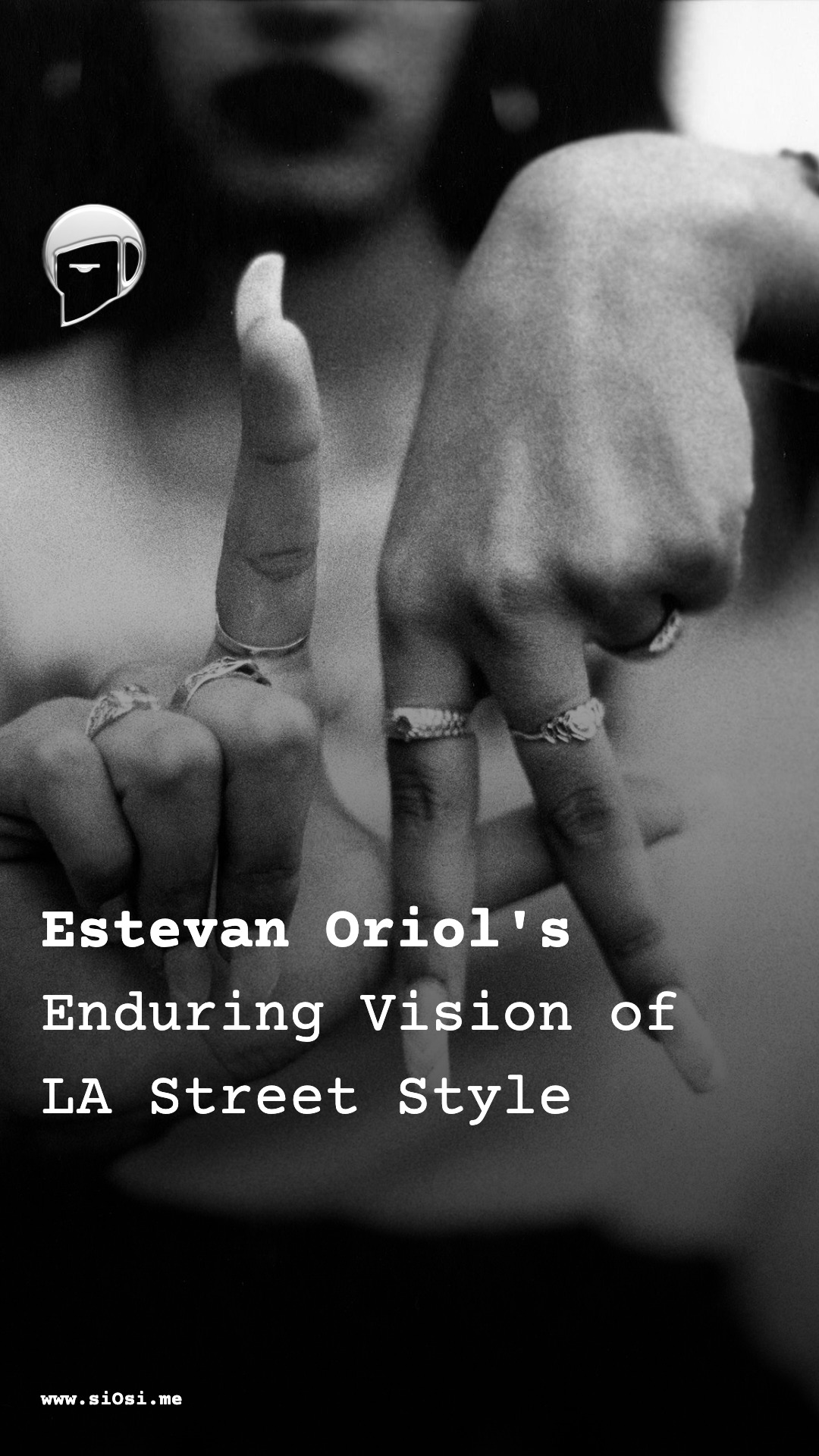
His iconic “L.A. Fingers” photograph shows this language distilled: a woman’s hands, nails immaculate and rings heavy, spelling out “L.A.” with her fingers. The image rests entirely on line, gesture, and adornment—the curve of the wrists, the sharp geometry of the hand-sign, the glint of metal on skin. The city is reduced to a sign made of a body, ornamented and deliberate, turning a casual street gesture into a kind of calligraphic logo.
Beyond that single image, Oriol’s archive—spanning lowrider shows, gang neighborhoods, hip-hop stages, prisons, and Japanese bosozoku—shares a consistent aesthetic: frontal, intimate, unflinching. He often places the viewer at close range, so that tattoos, fabrics, and facial lines are legible, almost readable, as text. His compositions are deceptively simple; what looks like a straightforward street shot is quietly controlled in terms of geometry—straight sightlines down streets, car bodies forming horizontal bands, figures centered like icons in a shrine of urban infrastructure.
Color, when he uses it, tends to be saturated but not glossy—more enamel than neon. Lowriders gleam with candy apple reds and metallic blues, but photographed in a way that preserves their connection to dust, oil, and hands, not to the detached sheen of showroom culture. The palette feels sun-bleached and heat-struck rather than commercial; the colors imply afternoon heat on painted hoods and the smell of gasoline, rather than a spotless studio.
2. Silhouette, body, and movement
Oriol’s work documents a very specific silhouette of Chicano street style: the long, roomier drape of khaki pants; oversized T‑shirts and crisp white tank tops; hair slicked back or shaved close; the lean-forward pose of men in lowrider interiors; the straight-backed stance of women in tight skirts and high heels. These bodies are rarely relaxed in the sense of softness; they are relaxed in the sense of alertness—coiled, aware, never fully surrendered to the frame.
Lowriders, central to his visual universe, dictate an entire kinetic vocabulary. A car with a lifted nose or dropped tail alters how a body sits, leans, or poses—elbows resting on door frames, legs stretched along seats, torsos twisted to meet the camera through an open window. The machines—chrome, paint, hydraulics—become extensions of the body’s gesture. His images often freeze cars in stillness, but you feel the ghost of their movement: the slow cruise, the bounce, the procession down a boulevard lined with spectators.
Within spaces of confinement—prisons, tight alleys, small apartments—movement becomes minimal, almost ritualized posture. Men stand shoulder to shoulder, gaze directly at the camera, arms crossed or hands clasped in front, as though the pose itself is a claim to visibility. Women may be seated on car hoods or steps, one knee bent, one foot grounded, a choreography that signals both readiness and rootedness.
In all of this, Oriol captures what might be called a defensive elegance: a style of self-presentation that is beautiful but never purely decorative, always carrying the trace of risk, surveillance, and resistance. Clothes hang a certain way not only because of fashion but because of the need for mobility; hands rest in particular configurations that are as much about signaling and safety as they are about aesthetics.
3. Texture: skin, fabric, metal, city
Oriol’s photographs are unusually sensory in their textural layering. The eye moves across:
- The smooth, polished surfaces of lowrider paint and chrome, often photographed close enough that reflections bend across the curvature of a hood or fender.
- The grain of tattooed skin, rendered in high contrast so that ink and flesh form a unified, patterned surface.
- The weave and stiffness of fabrics—Dickies, flannels, bandanas—showing creases, starch, and the way garments hang from shoulders and hips.
- The rough textures of cinderblock walls, chain-link fences, cracked sidewalks, all of which anchor the styling in a lived, not theoretical, environment.
Los Angeles itself appears as texture rather than skyline. Instead of sweeping panoramas, there are glimpses: telephone wires slicing the sky, stucco facades, graffiti, shadows of palm trees falling across asphalt. The city is not a backdrop but a material, like fabric or metal, wrapped around its inhabitants.
This attention to tactility is echoed in his collaboration with the visual language of Teen Angels Magazine, an underground Chicano periodical that chronicled lowrider and gang culture. The magazine’s drawn lettering, tattoo flash art, and prison-style illustrations embody a handmade aesthetic—ink pressed into cheap paper, art sent from cells and barrios. Oriol’s images, when shown alongside this artwork, dramatize a continuum of texture: from pen lines on paper to ink in skin, from sketched lowriders to the actual cars glinting in sun.
4. Philosophy of beauty and representation
Oriol has described his practice as documenting primarily for himself, rather than explicitly to “shed light” or educate outsiders. This stance produces a distinct philosophy of beauty: beauty is not constructed for an external gaze but recognized and preserved as it appears within the community. The images do not ask for permission for their subjects to be seen; they assume that beauty already exists in these faces, cars, and corners of the city, regardless of whether mainstream culture acknowledges it.
His photographs counter a long history of distorted, sensationalist portrayals of Chicano and gang culture. Instead of reducing bodies to threats, he offers complex, dignified portraits—sometimes tender, sometimes severe, always unflinching. Beauty, in this context, is inseparable from vulnerability and danger: the immaculate crease of a pant leg beside the knowledge of police harassment; a languid pose beside the specter of incarceration.
By repeatedly photographing the same subcultures—lowriders, cholos, incarcerated men, barrio families—over decades, Oriol articulates beauty as endurance and continuity. Tattoos document time on the body. Cars pass from one generation to another, repainted, re-chromed, but still on the same streets. Seen through his lens, style is not disposable; it is archival, a record of survival.
In exhibitions such as his collaboration with the Teen Angel estate at BEYOND THE STREETS, this philosophy grows more explicit: the show is framed as a celebration and a “positive” propulsion of Chicano culture. Yet the positivity is not sanitized; it is built from the frank depiction of poverty, gang life, and prison, and from the insistence that even within those contexts, there is creativity, community, and visual splendor.
5. Emotional presence and mood
Emotionally, Oriol’s images occupy a space between melancholy and pride. They rarely depict overt joy; smiles, when they appear, are controlled, half-lidded, never naïve. Instead there is a powerful sense of self-possession: people look directly into the camera, often unsmiling, as though meeting the viewer on equal terms.
For viewers inside the culture, his work functions as recognition—a mirror that neither romanticizes nor pathologizes. For viewers outside it, there is a palpable sense of being allowed into an intimate zone on the condition of respect. The emotional temperature is steady, unhurried; even in scenes of crowds, protests, or shows, Oriol tends to freeze time at a calm point, emphasizing presence over spectacle.
The result is an atmosphere of dense stillness: cars parked but tense with potential, bodies posed but suggesting constant motion just before or after the shutter. This stillness gives his photographs a long afterglow. They feel like memories, not snapshots—moments that have already accepted their fate as archival documents.
6. Contemporary resonance: how the work feels now
Seen today, Oriol’s images radiate a deep, steady glow of authenticity in an era saturated with curated, algorithm-friendly visuals. Their power lies in an almost stubborn refusal of trend; the clothes, cars, and hair may shift over decades, but his framing, his affection for shadow, his commitment to the same neighborhoods and communities remain remarkably constant.
In a cultural moment where Chicano aesthetics—lowrider graphics, script lettering, tattoo styles, oversized silhouettes—circulate widely across fashion and design, Oriol’s archive feels like a primary source of that visual vocabulary. His photographs carry the weight of origin: they remind us that these styles emerged from specific histories of migration, policing, poverty, and resistance, not from mood boards.
Emotionally, the work still feels intimate, unsmoothed, and alive. The faces hold their privacy even as they are photographed; the streets remain particular, never flattened into generic “urban” imagery. There is a dignity in how he lets people and objects remain exactly themselves—the slight scuff on a pristine sneaker, the chipped paint on a wall behind an immaculate car.
Ultimately, Oriol’s visual legacy is a poetics of presence: a way of looking at bodies, clothes, and machines that acknowledges their scars and their shine with equal respect. His Los Angeles is neither utopia nor hellscape, but a vast, layered stage on which Chicano style has written its own enduring script in metal flake, black ink, and the clean line of a hand spelling out three letters in the air.