

Sun in VirgoMoon in AquariusFull Moon · Sturgeon Moon
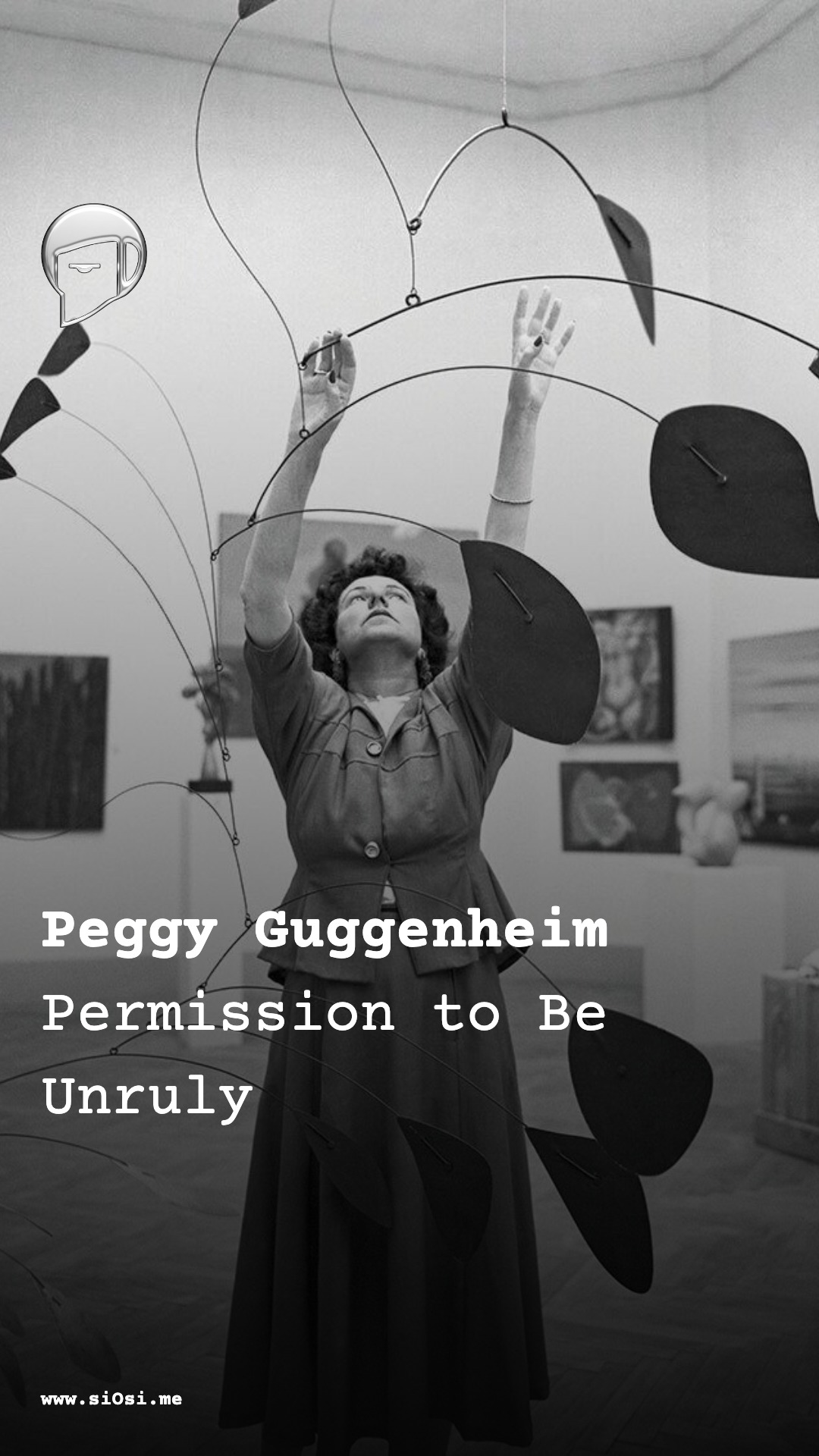
siOsi Salutes Peggy Guggenheim: Permission to Be Unruly
On August 26, 1898, Peggy Guggenheim entered the world in New York and later turned her privilege into a platform for visual risk, collecting Cubist, Surrealist, and Abstract Expressionist works when they were still unsettled. Her taste favored contrast, tactility, and sensory force, creating immersive galleries like Art of This Century where art seemed to breathe and beckon. siOsi draws from her anti-static philosophy of beauty, embracing modernity's rough edges and electric restlessness rather than polish or symmetry. Today her legacy reads as starkly contemporary: black-and-white contrast, metallic coolness, and a lucid glow that invites intensity over sentimentality. Step into that charged field where form is still becoming itself and let siOsi help you claim the same permission for unconventional elegance.
Peggy Guggenheim’s aesthetic impact was the impact of permission: permission for modern art to look unruly, tactile, asymmetrical, and emotionally immediate, and permission for a woman patron to present herself as visibly unconventional rather than decorous. Her legacy feels less like polish than voltage, with a cold shimmer of glamour crossed by bohemian roughness, as if elegance had been interrupted by avant-garde force.
Born in New York on August 26, 1898, into wealth, she turned privilege into a platform for visual risk, collecting Cubist, Surrealist, and Abstract Expressionist work when these languages were still unsettled and, in many circles, not yet respectable. That choice mattered aesthetically because it helped normalize the look of modernism: fractured planes, dream imagery, vigorous brushwork, and the emotional drama of nontraditional form.
Her signature visual language was one of contrast. Her collection brought together European avant-garde precursors and the emerging American abstractions, creating a charged field where sharp geometry, automatic invention, and painterly gesture could coexist. In the galleries she founded, especially Art of This Century, exhibition design became part of the artwork’s emotional atmosphere, shaping how viewers moved, paused, and felt in front of the objects. The result was not a neutral white cube but an immersive experience in which art seemed to breathe, glare, and beckon.
A key part of her aesthetic influence lay in her attraction to tactility. She wrote of responding to Bernard Berenson’s idea of “tactile value,” and to her, that meant the visual world should feel physically alive, not remote or overly refined. This appetite for texture, material presence, and sensory force aligned her with artists whose works emphasized surface, impulse, and bodily energy. In that sense, her taste favored paintings that did not merely depict emotion, but carried it in their paint, line, and rhythm.
Her philosophy of beauty was anti-bourgeois and anti-static. Rather than treating beauty as polish, symmetry, or social propriety, she embraced modernity’s rough edges, its strangeness, and its instability. She was drawn to the new not because it was pretty, but because it was alive. That attitude helped shift the cultural meaning of beauty toward intensity, experimentation, and risk.
Visually, the world associated with Peggy Guggenheim still reads as starkly contemporary: black-and-white contrast, metallic coolness, Surrealist wit, and a restlessness that resists sentimentality. What it evokes today is a particular emotional glow, not soft or nostalgic, but lucid and electric, the feeling of entering a room where form is still becoming itself.