
Sun in LeoMoon in AriesWaning Gibbous
Marlene Dumas: Bruised Beauty & Fragile Silhouettes
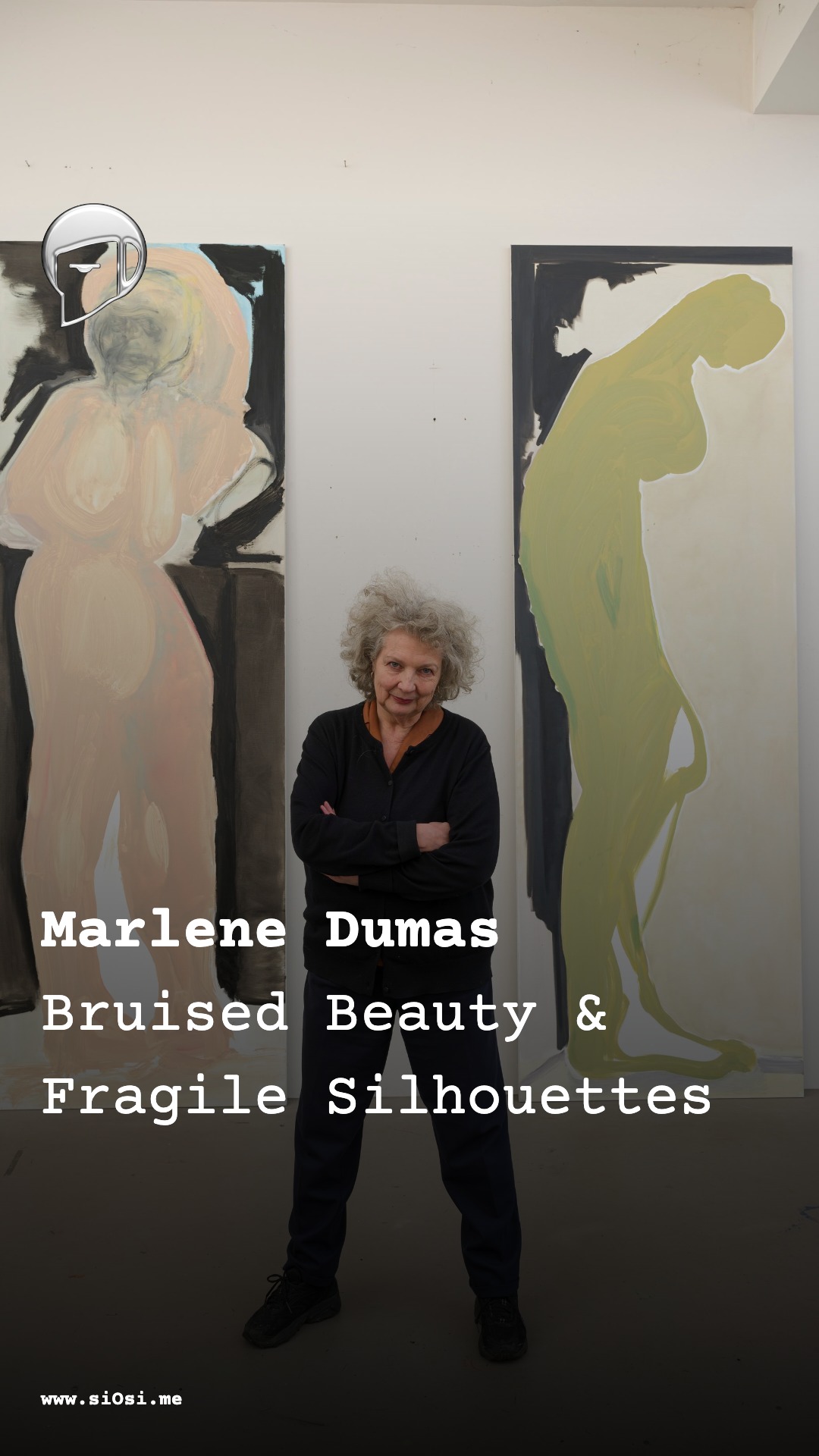
Born on this day in 1953 near Cape Town, Marlene Dumas has redefined contemporary beauty and style through her haunting portraits. Her figures emerge with blurred edges, sallow skin tones, and stained surfaces that speak of vulnerability, desire, and psychic weight. Working from photographs, she transforms media images into emotionally charged silhouettes where makeup reads as bruise and hair falls like shadow. Installed in the Louvre, her Liaisons series brings this troubled glamour into the heart of art history, reminding us that true beauty is never perfect—it is porous, conflicted, and alive with history. At síOsí we celebrate this poetic imperfection as the essence of modern allure.
Marlene Dumas, born 3 August 1953 near Cape Town, has fashioned a visual language in which the human face and body become fragile vessels for psychic weather: beauty bruised by history, desire shadowed by guilt, tenderness edged with cruelty. Her work’s impact on contemporary ideas of beauty and style lies in how she remakes the figure—blurring it, staining it, troubling it—until it flickers between allure and unease.
1. The body as a volatile silhouette
Dumas’s paintings are, at their core, studies of the socially constructed body: the body as rumor, as stereotype, as political evidence, as erotic surface. She tends to work from photographs—press images, pornography, family snapshots, art-historical reproductions—translating them into paint so that the original sharpness collapses into unstable silhouettes.
Her figures rarely possess clean, classical outlines. Limbs blur into ground; torsos dissolve at the edges; faces are softened to the brink of anonymity. This creates a peculiar silhouette-style: bodies appear both emphatic and indistinct, as if emerging from memory rather than from life. The line is hesitant, wavering, sometimes incomplete, and this incompleteness is central to the work’s emotional charge—identity is never fully secured, beauty never fully resolved.
The posture of her figures is crucial. Many stand or sit at slight angles, with shoulders drooping, heads tilted, hands hanging, a quiet slackness that suggests exhaustion, vulnerability, or moral ambiguity. Others confront the viewer directly, but even then their stance is wary, their gaze ambivalent. Beauty, in Dumas, is almost never triumphant; it is defensive, compromised, aware of its own precariousness.
2. Color as psychology: stain, pallor, and fever
Color is perhaps Dumas’s most distinctive aesthetic instrument. Critics frequently describe her palette as sallow, bruised, or corpse-like, with grey-greens, mauves, diluted blues, chalky beiges and yellows dominating the flesh. The skin tones often appear diseased or spectral rather than healthy, aligning beauty with fragility and mortality rather than with perfection.
She works with thinned paint, allowing washes to pool and bleed, creating stained surfaces that recall both water damage and emotional fallout. In portraits and head studies, cheeks may bloom with exaggerated blush, or eyes ringed with indigo shadow, but these accents feel less like cosmetics and more like eruptions of inner strain. A single streak of red can suggest both lipstick and wound; a patch of dark under the eye reads simultaneously as makeup, bruise, or insomnia.
Her series Liaisons at the Louvre—nine site-specific paintings of faces responding to contemporary horrors—extends this chromatic psychology into monumental scale. The faces are not rendered in naturalistic tones; instead, they are haunted by grays, greens, and subdued violets, so that the color itself seems to bear the weight of global anxiety. Installed in the Porte des Lions atrium, the works inject a cool, troubled chromatic mood into the classical museum space, unsettling the polished stone and historical grandeur with an atmosphere of unease.
3. Texture and the physicality of paint
In an era dominated by digital images, Dumas insists on the tactility of painting, on surfaces that record the hand, the pause, the error. Her brushwork oscillates between fluid and abrupt: broad, diluted passages of wash meet abrupt, more opaque strokes that mark eyes, nostrils, lips. This textual contrast—soft flood versus sharp accent—creates a tension between dissolution and definition, mirroring the instability of the identities she paints.
The paint often looks soaked into the paper or canvas, especially in works on paper, where pigment seeps and feathers along the fibers. This gives her images a damp, almost clammy feeling; bodies appear as if emerging from fog or water, or from the submerged zone of unconscious thought. The resulting texture is neither glossy nor decorative—there is little of the lacquered finish associated with commercial beauty—but rather porous, absorptive, and slightly abraded.
In works such as Miss January, which achieved record auction prices, the physical handling of paint is integral to the image’s sensual impact. The surface bears streaks, drips, and tonal shifts that behave like emotional noise: attraction accompanied by a grain of discomfort, seduction interrupted by stain. Dumas’s textures rewrite conventional glamour as something unstable and contingent, always on the verge of smearing.
4. The photographic gaze, re-styled in paint
Dumas’s key innovation in the visual culture of beauty lies in how she appropriates the photographic gaze—especially from mass media and pornography—and then distorts it through painting. Rather than treat photographs as neutral sources, she exposes their manipulative framing: the way they fix bodies into roles of victim, object, suspect, or fetish.
By softening focus, altering color, or cropping unexpectedly, she transforms familiar media images into ambiguous tableaux where desire and violence coexist. Her figures, often drawn from erotic or sensational imagery, lose their crisp photographic “truth” and instead gain a painterly doubt. This shift in visual style has had wide influence, prompting a generation of artists and viewers to question how beauty is constructed by lenses and screens.
Her compositions frequently center the face, but rarely as a site of idealization. Eyes may be overlarge or slightly misaligned; mouths appear slack, asymmetrical, caught between speaking and withholding. The photographic expectation of a “perfect” portrait is replaced by an image in which recognition is troubled—we see the person, but we also see the distortions of culture, trauma, and desire that cling to them.
5. Hair, makeup, and the refusal of polished glamour
Although Dumas rarely paints fashion in the conventional sense—garments, accessories, styled environments—she continuously engages with beauty codes at the level of hair, makeup, and facial presentation. Hair is often rendered as dark, amorphous mass: a block of color, a halo of shadow, sometimes bleeding into the background. It rarely gleams or flows; instead, it hangs, clumps, or crowds the face, more weight than ornament.
Makeup appears in her work as smudged shadow, exaggerated blush, or heavy contouring, but never as the clean, perfected surface of commercial imagery. A ring of dark paint may simultaneously suggest eyeliner and fatigue; rouge-like marks on cheeks convey both cosmetic effort and emotional flush. This double reading of makeup—beautification and concealment, glamour and damage—echoes her broader philosophy that beauty is inseparable from vulnerability.
There is little of the stylistic bravura associated with high fashion photography: no crisp highlights, no gleaming lips, no meticulously rendered fabric textures. Instead, she presents a beauty that is undone, already in process of fading or smearing. The overall aesthetic is one of after-beauty—the moment when style has been lived in, slept in, cried in, and is now inseparable from psychic life.
6. Emotional presence: attraction, repulsion, and the quiet horror of the ordinary
Institutions and critics repeatedly emphasize the psychological intensity of Dumas’s work—its capacity to stir “raw emotion — attraction, repulsion, fear.” This emotional presence is not theatrical; it tends to be quiet, slow-burning, lodged in the slight misalignment of features, the pallor of skin, the droop of a shoulder.
Her paintings often expose what one critic called “the evil in the ordinary”: the way everyday-looking faces can carry traces of complicity, shame, or suppressed cruelty. This has profound implications for contemporary ideas of style and character. Beauty, in Dumas’s hands, does not signal innocence or goodness; it is a surface onto which history, politics, and personal guilt are projected.
The emotional palette of her work ranges from melancholic tenderness to icy detachment. Some portraits feel like vigil candles for unknown or forgotten subjects, their soft edges and muted tones evoking grief. Others confront the viewer with a chilling blankness, an absence of readable feeling that becomes unsettling in itself. The style thus trains viewers to read faces not as simple messages of personality, but as complex sites of conflict.
7. Philosophy of the body: between intimacy and history
Over nearly fifty years, Dumas has devoted herself to translating the inner tensions of the human psyche into images, distilling them into “poetic tableaux” that awaken our darker sides. Her philosophy of the body is neither purely personal nor purely political; instead, it inhabits the intersection where intimate experience and historical trauma meet.
She works from both lived encounters and found images, making “little distinction in her work between subjects she knows from lived experience and those she ‘knows’ through pictures.” This attitude destabilizes conventional hierarchies of authenticity: the body in a news photograph, the body in pornography, the body of a friend or child—all are equally subject to the distortions of representation.
Her recurring themes—sexuality, love, death, shame—are not framed as moral lessons but as conditions under which bodies must exist. The stylistic choices—blurred outline, bruised color, damp texture—become visual metaphors for this existence: the body is always in negotiation with external images, expectations, and fears. Beauty, therefore, is not a stable ideal but a site of conflict where attraction and danger cohabit.
8. Light, contrast, and atmosphere
Dumas’s handling of light is subtle but decisive. Rather than sharp chiaroscuro, she often employs soft, ambient illumination, with faces emerging from pale grounds or shallow tonal fields. This creates the sense of images happening in mental rather than physical space—like recollections or dreams, lit from within rather than from an external source.
Contrast tends to be concentrated in the features: dark eyes against pallid skin, a deep mouth against a nearly white cheek. These zones of intensity act as emotional focal points, while the rest of the image remains softly modulated. The atmosphere is frequently fogged, with edges merging into background; the lack of crisp contrast contributes to the feeling of indeterminacy and moral ambiguity.
In Liaisons, installed within the Louvre’s historic architecture, this atmospheric style clashes gently with the museum’s clarity and order. The faces’ muted contrasts and diffused light complicate the surrounding marble and canonical paintings, introducing a contemporary visual mood in which the viewer’s gaze is drawn into uncertainty rather than clarity.
9. How the work feels today
Today, Dumas’s work exerts a powerful influence on how the visual culture of portraiture and beauty is understood. As the first contemporary woman artist in the Louvre’s permanent collection, with her nine-part series Liaisons permanently on display, she occupies a symbolic position at the heart of Western art history. Her presence there is not decorative; it introduces a critical, uneasy beauty into one of the most codified spaces of artistic grandeur.
Her paintings feel uncannily contemporary precisely because they refuse slickness. In a world saturated with high-resolution imagery, her soft-focus, stained, emotionally dense figures seem to speak more directly to the anxiety and overexposure of the present. The emotional “glow” they emit is not radiant but troubled—a low, persistent luminescence of doubt, grief, and ambivalent desire.
Viewers encountering her work today often describe being simultaneously drawn in and pushed away: the faces invite empathy while their distortions suggest complicity or hidden cruelty. This tension has reshaped expectations of what a portrait can be, moving it away from celebration and toward introspection, ethical questioning, and psychic excavation.
In terms of style, Dumas has helped legitimize a poetics of imperfection—a way of painting the body that embraces blur, stain, and asymmetry as carriers of meaning. Her influence can be traced in the broader acceptance of emotionally charged, loosely handled figuration across the art world, and in the growing understanding that beauty, far from being a simple ideal, is a negotiation between desire, history, and harm.