
Sun in LeoMoon in TaurusThird Quarter
Naum Gabo: Sculpting Beauty from Void, Light & Line
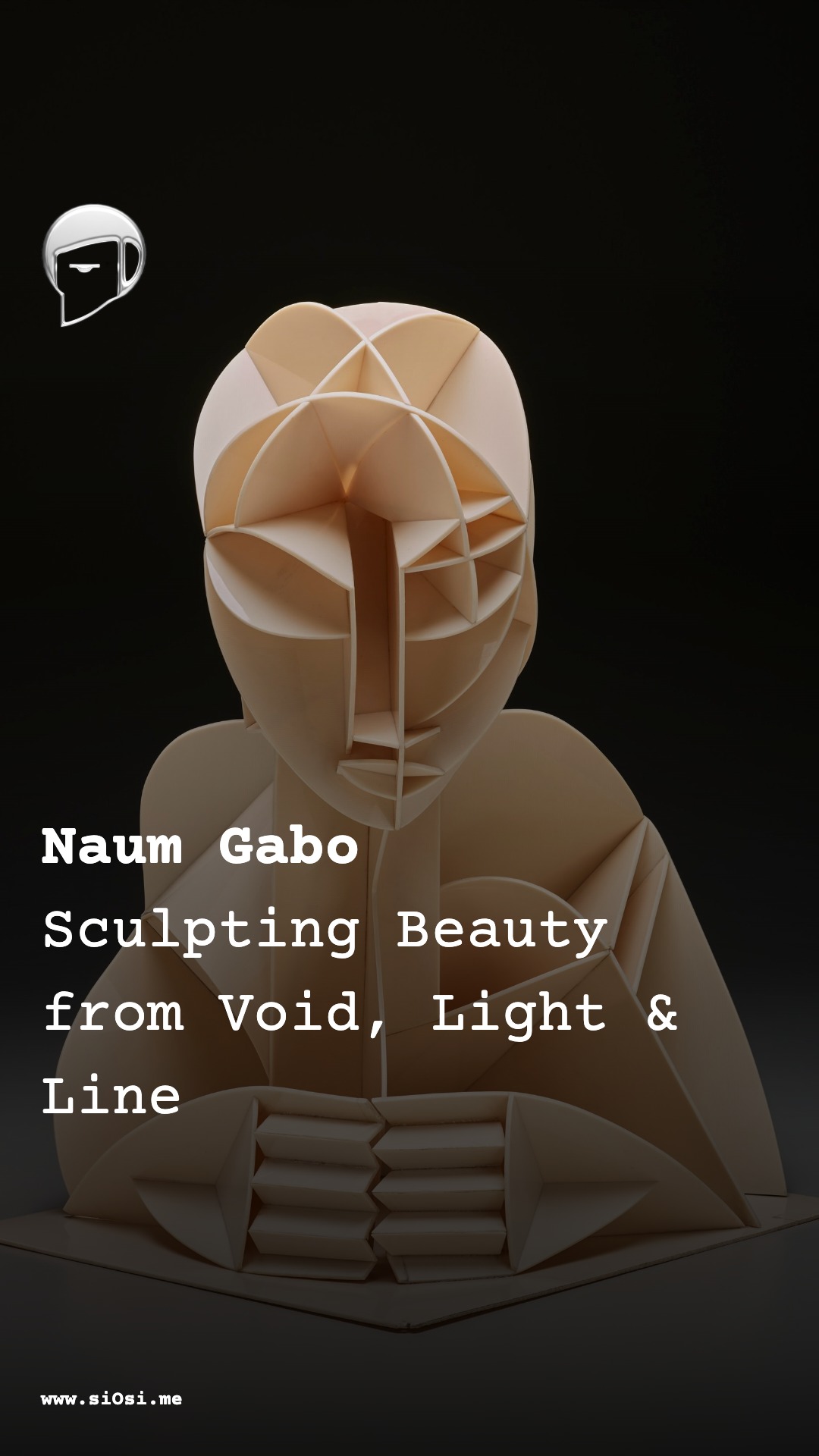
Born 5 August 1890, Naum Gabo replaced sculptural mass with air, weight with transparent line, and ornament with engineered grace. His open lattices of lucite, glass and taut wire turned negative space into the hero of form—silhouettes that breathe, structures that vibrate with implied motion. Today his vision shapes modern beauty: layered translucent skin, airy hairstyles that release volume instead of filling it, fashion silhouettes built on tension and light rather than bulk. Gabo’s industrial materials and kinetic rhythms remind us that true elegance is structural clarity—cool, lucid, and profoundly modern. Step into his world and let the voids between the lines become your new definition of glamour.
Naum Gabo’s birth on 5 August 1890 marks the arrival of a sculptor who would redraw the very outline of beauty: replacing weight with air, mass with line, and ornament with a lucid, engineering-like grace.
Gabo’s aesthetic belongs to that rare category of vision in which form seems less made than calculated—not coldly, but with an almost spiritual clarity. His sculptures and reliefs appear as diagrams of space itself: transparent planes, taut wires, curving ribs, and calibrated voids that give the viewer the sensation of walking through a thought rendered visible.
Silhouette, Space, and the Beauty of the Void
The central visual drama of Gabo’s work lies in his refusal of traditional sculptural bulk. Instead of carved blocks or modeled figures, he constructs lattices and frameworks in which negative space is the principal actor.
- His sculptures are often built from interlocking components—struts, planes, arcs—assembled so that the air between them feels as structured as the material itself.
- This creates silhouettes that are open, almost permeable: not a contour enclosing weight, but a kind of spatial notation in which the void is “released from any closed volume or mass,” a preoccupation explicitly associated with Gabo.
Visually, these works stand like architectural ghosts: the outline of a possible building, instrument, or organism, rendered as a skeletal, airy presence. From a distance, one sees a coherent, abstract figure; up close, one sees a web of lines and planes in delicate equilibrium.
The effect is a new kind of beauty—neither ideal body nor decorative flourish, but an appreciation of structural clarity itself. The viewer’s eye traces the paths of force and tension through the curves and intersections; their pleasure lies in watching stability emerge from near-weightlessness.
Materials, Texture, and the Industrial Sublime
Gabo’s choice of materials is crucial to the emotional tenor of his work. He turns to glass, plastic (lucite), metal, wire, nylon and semi-transparent industrial substances—materials associated with engineering, optics, and modern manufacture rather than with the studio or the atelier.
- Lucite and glass introduce transparency: the sculpture does not obstruct vision but refracts and filters it, so that surfaces are seen in layers, like overlapping diagrams.
- Wire and nylon supply line: taut, shimmering, almost musical in their suggestion of vibration and tension.
- Metal elements provide a measured density, anchoring the composition yet maintaining an overall sense of lightness.
The textures are not lush in a traditional, tactile sense; they are refined, cool, and precise—the aesthetics of instruments, lenses, bridges. Yet their arrangements produce a quiet sensuality: light skims across polished metal, passes through plastic planes, catches on filaments, and draws soft shadows in the voids.
This is the industrial sublime: beauty located in the language of rational construction, the gleam of modern materials, the smooth convergence of engineering and art. Gabo’s surfaces do not invite caress so much as contemplation; their tactility is felt as a tension between hardness and immateriality, between the coolness of plastic and the warmth of the light that inhabits it.
Line, Movement, and the Presence of Time
Central to Gabo’s visual language is an obsession with movement and time. The works often include either:
- actual kinetic elements (as in his pioneering Kinetic Construction of 1920, frequently cited as one of the first true works of kinetic art), or
- static structures that strongly imply motion through rhythmically repeated lines, spirals, and intersecting curves.
His Realistic Manifesto declared that “kinetic rhythms” were the basic form of our perception of real time, insisting that space and time are the fundamental “forms on which life is built and hence art must be constructed.” This is not a theoretical aside—it is visible in the sculptures’ very posture.
Lines in Gabo’s constructions rarely sit inert. They sweep, twist, arc, mapping trajectories through space. Curvilinear members, as engineering analyses have noted, follow internal stress paths, allowing material efficiency and lending a palpable sense of dynamic balance. The viewer feels the forms as frozen motion: a moment in a continuous transformation, like a captured oscillation.
- Visually, the works seem to vibrate between solidity and dematerialization;
- Emotionally, they evoke a kind of poised tension, as if time had been momentarily arrested at a particularly elegant configuration.
To stand before a Gabo piece is to feel the body subtly attuned to rhythm: one’s gaze moves along the lines much as it would follow music, and the sculpture becomes an instrument of spatial tempo.
Color, Light, and Emotional Atmosphere
Color in Gabo’s work is sparing, subdued, often subordinate to light. Many pieces rely on the natural tones of their materials—clear, smoky, metallic—allowing illumination to become the true chromatic event.
- Semi-transparent components invite light to enter and linger, creating internal glows and quiet halos.
- Shadows become part of the design, doubling and offsetting lines, so that the sculpture extends as an immaterial drawing on the surfaces around it.
The emotional atmosphere is therefore one of lucid calm. Even when forms are complex, they are not chaotic; the rhythm is measured, the geometry deliberate. The mood is contemplative, almost meditative: a feeling of being inside a diagram of forces that govern the modern world—industrial, scientific, architectural—yet rendered with tenderness and a sense of order.
Unlike the explosive color fields of other avant-gardes, Gabo’s palette of transparency and reflection suggests clarity rather than intensity, an aspiration to a universal language of form. His belief that art should be “grounded by the present” and express actual experience rather than illusion aligns with this lucid, unsentimental chromatic restraint.
The Body and a New Attitude to Beauty
Gabo’s sculptural vocabulary effectively repositions the human body within art. Instead of sculpting the figure directly, he reshapes the environment of space, time, and movement in which bodies exist.
His Realistic Manifesto advocated for art that was non-representational, dynamic, and interactive, insisting that it should be genuinely connected to the modern age and constructed for modern life. Beauty, for Gabo, ceases to be a matter of idealized muscles or classical proportions; it becomes:
- the elegance of a functional structure,
- the grace of material efficiency,
- the poetry of abstract relations—line to plane, void to volume, motion to stillness.
This is a profoundly modern reimagining of the aesthetic value of the body. The viewer’s own body is involved—moving around the piece, experiencing shifts in perspective, feeling the tilt and balance of forms—but the focus has shifted from representation to participation. Beauty lies in how a body moves through and perceives the sculpted field, not in a mirror of its appearance.
The attitude toward beauty, then, is both ascetic and generous: ascetic in its refusal of decorative excess, generous in its invitation to inhabit a clarified world of relations and rhythms.
Emotional and Sensory Impact Today
Encountered today, Gabo’s work retains an uncanny freshness. The forms feel contemporaneous with current digital and architectural aesthetics—parametric curves, skeletal frameworks, transparent skins—yet they were conceived with the tools and materials of the early to mid‑20th century.
The emotional impact is multifold:
- A feeling of weightless serenity: the works appear to hover between presence and absence, offering a quiet respite from visual noise.
- A sense of intellectual exhilaration: one recognizes in their precise geometries an early expression of ideas about space and time that have since become part of physics, architecture, and design.
- A muted melancholy of exile and modernity: Gabo’s life as an émigré, moving from Russia to Germany, France, Britain, and the United States in flight from war and repression, shadows the work with the impression of a mind perpetually seeking a stable context, finding instead stability in form.
The sculptures’ glow today is not the glow of nostalgia but of ongoing relevance. Their transparent shells and interlaced lines feel like prototypes for how beauty can exist in an age of data, engineering, and global systems: abstract, lucid, structurally honest, yet still capable of deep, quiet emotion.
When light passes through a Gabo construction in a museum or public space now, it seems to confirm his conviction that art could be “a universal form of communication that transcends social, political and cultural barriers.” The language is pure form—space, time, movement—and it continues to speak with remarkable clarity.
Signature Visual Language, Summarized
To distill Naum Gabo’s stylistic impact into a brief visual lexicon:
- Lines: taut, engineered, often in wire or nylon; rhythmic, directional, suggesting force and motion.
- Shapes: abstract, geometric, curvilinear frameworks; shells, spirals, and intersecting planes that imply potential architecture or instruments.
- Silhouette: open, airy, non-massive; the void is integral, not residual.
- Textures: industrial smoothness, transparency, fine filaments; a union of hardness and immaterial luminosity.
- Movement: kinetic or strongly implied; forms conceived as events unfolding in time rather than static objects.
- Light and contrast: light as structural medium, generating internal radiance and shadow-drawings; contrast between material and void.
- Emotional presence: contemplative, lucid, quietly utopian—a disciplined optimism that sees beauty in the precise ordering of modern space.
Gabo’s birth in 1890 thus marks more than the advent of a sculptor; it signals the emergence of a new, constructivist idea of beauty in which the world’s invisible frameworks—its tensions, trajectories, and temporal flows—are given delicate, crystalline form.