
Sun in LeoMoon in AriesThird Quarter
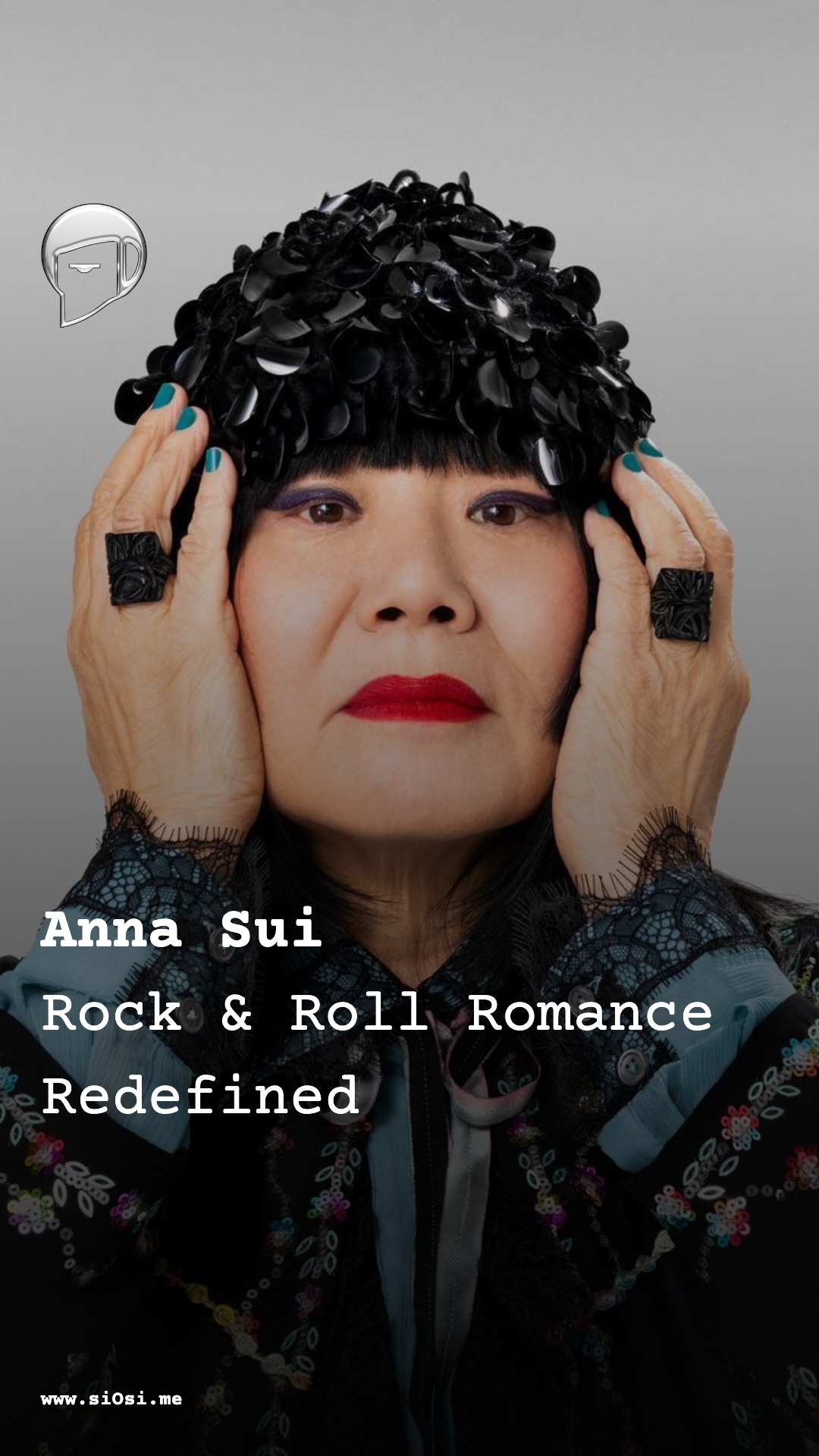
Anna Sui Born: Rock & Roll Romance Redefined
On this day in 1964, Anna Sui arrived to gift the world her signature romantic rock-and-roll universe. Her collections unfold like chapters in a visual novel—psychedelic reveries, Victorian fairy tales, and desert-punk idylls where flowing chiffons meet leather jackets and jewel-toned florals collide with graphic pop motifs. Sui favors ease and swagger over rigid structure, letting bodies move, dance, and tell stories through tiered skirts, bell sleeves, and luminous makeup that feels like storybook heroines stepping out of a downtown club. She championed beauty as narrative and eclectic, turning vintage flea-market finds into high-fashion fantasy while proving that style thrives in sweet subversion and lived-in glamour. Today her influence still glows: an invitation to curate your own myth, layer your references, and dress like the protagonist of your favorite record.
Anna Sui’s birth marks the arrival of a designer whose work would crystallize a distinctly romantic, rock‑and‑roll visual universe: a world of saturated color, nostalgic prints, talismanic accessories, and beauty looks that feel like storybook heroines drifting through a downtown club.
1. Atmosphere and emotional presence
Anna Sui’s aesthetic lives in the tension between sweetness and subversion. Critics and curators repeatedly describe her work as a fusion of romantic nostalgia with rock‑and‑roll glam, a language that has become her enduring signature.
Her collections read less as seasonal statements than as chapters in a visual novel: each show is conceived as a journey—Western road trip, Victorian fairy tale, psychedelic ‘60s reverie, desert punk idyll—so that clothes, makeup, hair, and set design merge into a single, immersive mood. The emotional register is buoyant, imaginative, and deeply cinematic: there is always a sense of play, of dressing as an act of storytelling rather than status.
Even critics who summarize her for encyclopedic entries reach for words like “rock‑and‑roll romantic,” “hip and exuberantly original,” emphasizing that her clothes do not merely follow trends but construct entire fantasy worlds that feel both intimate and performative. The effect on the viewer is a specific kind of glow: a mix of girlish daydream, music‑scene grit, and flea‑market treasure‑hunt joy.
2. Silhouette, movement, and the body
Anna Sui’s silhouettes favor ease, swing, and swagger over rigid architectural structure. Her design language consistently draws from:
- Hippie and bohemian forms: flowing chiffon dresses, tiered skirts, smocks, peasant blouses, caftans, and baby‑doll shapes that allow the body to move with unstudied lightness.
- Punk and rock references: slim trousers, bias‑cut slips, motorcycle jackets, and lean coats that frame the body with an insouciant, streetwise edge.
- Sportswear heritage: influenced by mid‑century American designers like Claire McCardell, she has long explored sportswear’s relaxed, practical lines—wraps, separates, day dresses—transformed by eccentric prints and color.
Her garments often hover between girlish and tough, using soft shapes but assertive styling—boots with diaphanous dresses, lace with leather—to position the body not as a static ideal but as a character in motion, walking, dancing, roaming. There is a refusal of rigid perfection: Sui’s clothes invite slouch, spontaneity, and layering, suggesting a body that is curious and active, not posed as a classical sculpture.
This approach has had a subtle cultural impact: she helped normalize a look in the 1990s and 2000s in which high fashion embraced vintage‑like ease, encouraging a more personal, narrative relationship to dressing, rather than strictly polished minimalism.
3. Color, print, and texture: the Sui palette
Color and pattern are perhaps Anna Sui’s most recognizable tools. Curators of The World of Anna Sui describe how she “reinvented pop culture fashion” through her rock‑and‑roll romantic label, with garments and textiles acting as the backbone of her universe.
Her characteristic palette favors:
- Deep jewel tones—amethyst purple, sapphire blue, emerald, garnet—often contrasted with inky black or shadowy browns.
- Vivid brights—acid green, hot pink, electric turquoise—especially in ‘60s‑inspired collections, recalling psychedelic posters and record covers.
- Vintage florals and ditsies—small, scattered flowers, Liberty‑style prints, and Victorian motifs that soften the boldness of cut and styling.
- Graphic motifs drawn from pop culture: Minnie Mouse iconography, ‘60s Op Art, army surplus camouflage, Japanese hankies, and other found patterns that she reworks into fashion textiles.
Texture in her work operates like a soundtrack. Curators list materials and inspirations that range from papier‑mâché mannequin heads to wood‑soled platforms, army jackets, linens, and qipao fabrics. This eclectic sourcing translates into clothing that juxtaposes:
- Sheer chiffons against rough denim.
- Velvet devoré against cotton jerseys.
- Crocheted lace against utilitarian twill.
The overall tactile experience is that of a curated wardrobe of memories—each fabric feels like it has lived a prior life in a trunk, a market, or a stage costume, now reassembled into something new. Visually, this gives her work an immediate sense of depth and narrative, as though each surface carries a fragment of culture.
4. Signature visual language: lines, shapes, hair, makeup
Anna Sui’s visual system extends far beyond garments into beauty, accessories, and environments.
Lines and shapes
Her lines are seldom severe. Instead:
- Necklines: often scooped, sweetheart, or Victorian high collars softened with ruffles and lace.
- Sleeves: bell sleeves, puffed shoulders, bishop sleeves—shapes with historical references to 1930s, 1960s, and Edwardian dress.
- Hemlines: mini to midi, frequently flounced or tiered, encouraging movement that catches the light and reveals layers.
These lines draw the eye into ornamented detail—piping, contrast trims, embroidery—rather than pure minimal contour. Visually, this reinforces her world as decorative, layered, and story‑rich.
Hair
Her beauty aesthetic, as expressed in her fashion imagery and cosmetics branding, leans toward romantic, slightly disheveled hair:
- Long, loose waves and curls, echoing ‘60s and ‘70s rock muses and hippie style.
- Heavy fringes and mod bangs in more ‘60s‑centric collections, referencing British Invasion culture.
- Occasionally, high Victorian or fairy‑tale updos, but rarely the pristine chignons of strict couture; there is always an element of softness, as if hair has been touched by wind or music.
This hair language positions beauty as lived‑in fantasy—the wearer looks like she has just left a concert or a dream, rather than a formal salon.
Makeup
As a perfumer and cosmetics designer, Sui’s branding reveals her beauty philosophy: ornate bottles, carved roses, gothic flourishes, and rich pigments, all suggesting baroque romance filtered through pop sensibility.
The faces in her orbit often feature:
- Strong eyeliner or shadow, sometimes in deep plums and charcoals, giving a slightly nocturnal, club‑ready gaze.
- Lips in berried reds, vampy purples, or playful pinks, never entirely neutral, asserting the mouth as a site of drama.
- Complexion kept luminous rather than sculpted into harsh planes, reinforcing the dreamlike quality.
The overall impression is not of “natural” bare‑faced beauty, nor of hard, hyper‑contoured glamour, but of storybook intensity—beauty as a kind of illustration.
5. Philosophies of beauty, style, and the body
Anna Sui’s work, exhibitions, and interviews suggest a consistent philosophy: beauty is narrative, eclectic, and democratic.
Curators note that she is a “self‑taught historian of culture, art, and fashion,” sampling music, books, exhibitions, movies, photography, and art movements as source material. The body in her clothes becomes a curator of references—wearing her designs is participating in a collage of eras and images rather than submitting to a singular, rigid ideal.
Several elements support this reading:
- Pop culture reverence: She draws from Minnie Mouse as readily as from Jane Holzer or Zandra Rhodes, placing high art, subculture, and childhood iconography on equal aesthetic footing.
- Non‑luxury emphasis: German‑language sources note that she does not place particular value on “luxus und kostbare Stoffe,” but instead focuses on imaginative styling and cultural references. This de‑emphasis on pure material luxury aligns her work with a more accessible, boutique sensibility—beauty through idea and attitude, not price alone.
- Boutique fashion look: The Museum of Arts and Design describes how she helped popularize the “boutique fashion look,” a language of personal, curated spaces and wardrobes rather than anonymous global luxury. In aesthetic terms, this reaffirmed the importance of character, quirk, and individuality.
Emotionally, her philosophy suggests that the body is a protagonist. Fashion is not armor against the world, but a means of inhabiting one’s own favorite myths—rock star, fairy‑tale wanderer, psychedelic traveler, downtown romantic.
6. Cultural impact on fashion and beauty
By the 1990s, Anna Sui had become a recognized force in New York and global fashion, debuting her first runway show in 1991 and quickly gaining international acclaim. Her influence can be traced along several aesthetic currents:
- Mainstreaming vintage‑inspired eclecticism: She helped ratify a look in which high fashion embraced thrift‑store codes—florals, lace, faded prints, surplus jackets—styled with the polish of runway presentation.
- Rock‑and‑roll romanticism: Her consistent combination of rock references with girlish silhouettes and Victorian or bohemian detail has become a template for later designers and stylists exploring “indie” or “festival” aesthetics.
- Narrative runway shows: By structuring collections around clear thematic journeys, she contributed to an expectation that a show could be immersive storytelling, not solely a product display.
- Beauty as extension of fashion fantasy: Her fragrances and cosmetics, with their elaborate packaging and gothic‑romantic branding, reinforced the idea that makeup and scent are integral chapters in a fashion narrative, not merely functional additions.
Recognitions such as being named among the “Top 5 Fashion Icons of the Decade” (2000–2010) and receiving the CFDA Geoffrey Beene Lifetime Achievement Award in 2009 indicate that her peers see this narrative, pop‑cultural approach as historically significant.
7. How her work feels today
Encountering Anna Sui’s work now—whether in the World of Anna Sui exhibition, archival imagery, or current collections—one feels a warm, imaginative nostalgia that never quite resolves into retro. Her references are overt, but the combinations are idiosyncratic enough to feel fresh: army surplus with fairy‑tale florals, qipao echoes with punk boots, Victorian lace with psychedelic color.
The emotional glow is that of a beloved record collection or a well‑worn bookcase: layers of culture condensed into garments that invite touch, movement, and play. There is comfort in the familiarity of her motifs, but also a quiet daring in how they are reassembled.
Her impact on beauty and style, therefore, is less about a single “look” and more about an attitude toward looking:
- That style can be encyclopedic and deeply personal.
- That beauty thrives in contrast—hard with soft, sweet with dark, nostalgic with futuristic.
- That the body is a site of ongoing storytelling, not final perfection.
Viewed from the present, Anna Sui’s birth on August 4—whether rendered as 1955 in English‑language sources or 1964 in others—marks the origin of an enduring aesthetic world: one in which fashion, beauty, and culture swirl together in a romantic, rock‑and‑roll haze, still shimmering on runways, in boutiques, and in the collective visual memory of late‑20th‑ and early‑21st‑century style.