
Sun in LeoMoon in LeoNew Moon
Hussein Chalayan: Born This Day, Redefining Fashion as Thought
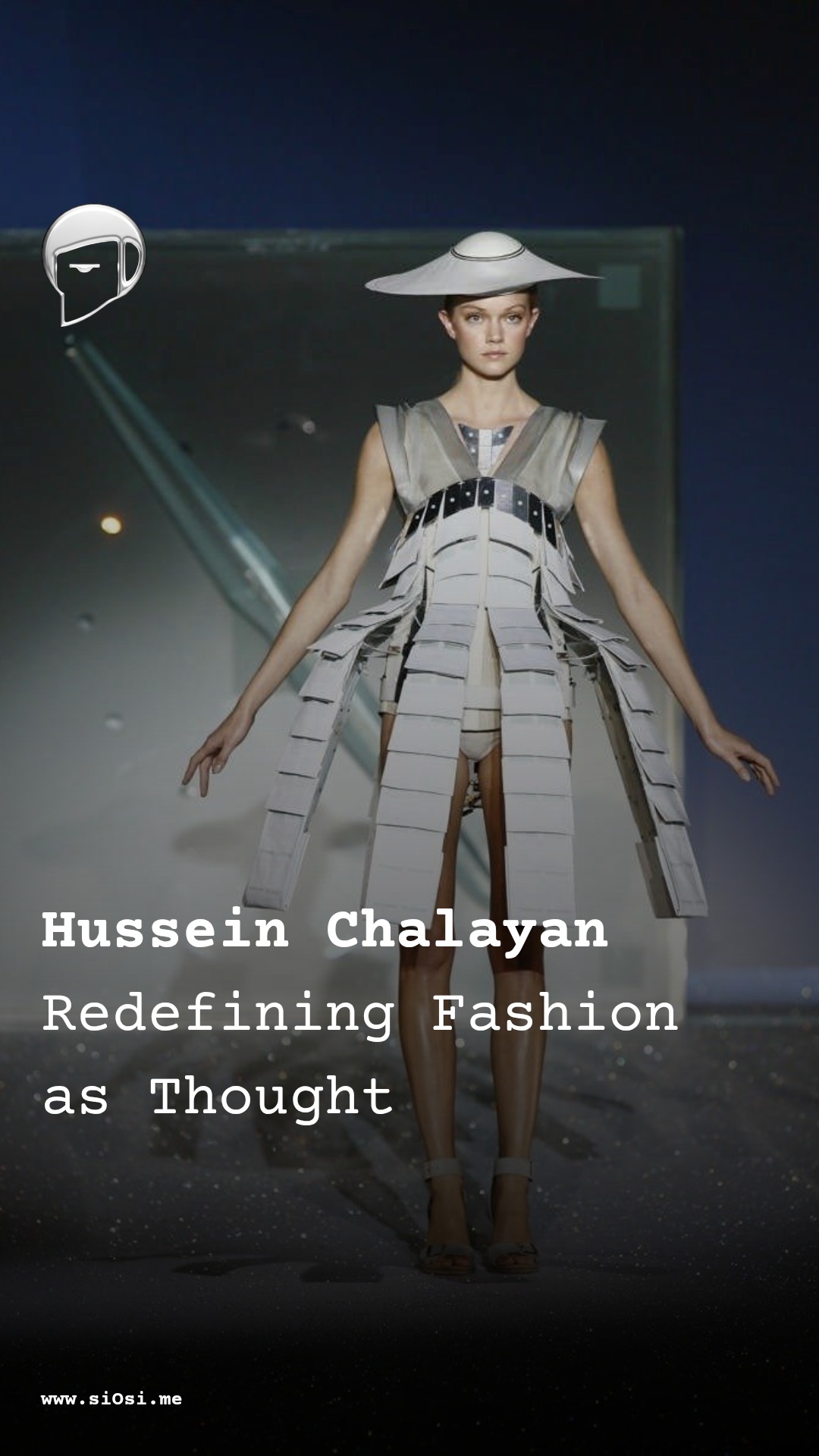
On 12 August 1970, Hussein Chalayan arrived with a vision that would transform garments into living ideas. His kinetic silhouettes unfold like quiet rituals: wooden tables blooming into bell skirts, dresses dissolving in time, Tyvek forms collapsing into envelopes then expanding again. Hard shells meet soft light, motors hum beneath pale fabrics, and the body becomes both shelter and story. siOsi celebrates this cerebral elegance, where technology, migration and memory meet precise lines and composed grace. Chalayan's work invites us to wear not just cloth, but narratives of displacement and possibility, proving beauty can be engineered, meditative and profoundly human.
Hussein Chalayan’s birth on 12 August 1970 feels, in retrospect, like the quiet arrival of a designer who would turn clothing into a thinking medium – garments becoming vehicles for memory, politics, technology, and displacement rather than mere adornment. His impact is aesthetic and emotional: he stretched fashion toward architecture and engineering, yet kept an unmistakable, almost fragile beauty at its core.
1. Visual language: silhouette, movement, and transformation
Chalayan’s signature contribution is a kinetic silhouette: clothing that does not simply sit on the body but mutates, retracts, unfolds, dissolves, or lifts away, revealing another state beneath.
- In his famous “table dress” from 2000, a wooden coffee table is lifted and unfolded into a skirt, the body becoming the central pillar of domestic furniture, the silhouette shifting from rectilinear object to bell-like volume around the hips. The movement is deliberate and almost ritualistic – a slow mechanical blooming that turns an everyday object into a protective shell.
- His “dissolving dress” experiments, using materials that melt or transform, generate silhouettes that are not fixed but time-based, like sculptures that remember each moment of change. The line of the dress is not a contour but a trajectory.
- Earlier “kite dresses” from 1997 exaggerated the relationship between fabric and air, letting panels lift and drag, so that the garments seemed connected to the weather itself. The silhouette hovers between clothing and apparatus, both fragile and aerodynamic.
- The Tyvek garments that fold into envelopes flatten the silhouette completely, collapsing volume into a plane, then back into a wearable form. The body negotiates between two-dimensional storage and three-dimensional presence.
Across these works the visual language of line and shape is clean, often geometric: stark planes, sharp angles, controlled curves that suggest engineering diagrams rather than soft drapery. Yet the experience on the body feels surprisingly intimate – as if one is wearing not just a dress, but a story about movement, migration, or technological change.
2. Materials, texture, and light
Chalayan is renowned for an innovative use of materials and a meticulous, almost surgical approach to pattern cutting. His textiles and surfaces carry an emotional charge:
- Hard–soft contrasts: wood, plastics, metal and technical textiles appear alongside traditional fabric, so that the body is surrounded by shells, housings, and casings rather than conventional cloth. Wearing these pieces evokes the sensation of inhabiting a device, a vehicle, or a portable architecture.
- Tyvek and technical papers: garments that resemble packaging or industrial sheeting, with a dry, fibrous hand and a faint crackle when they move, give the wearer a sense of being archived, folded away, then reactivated.
- Embedded technology: light, motors, and moving airplane-like components are integrated into dresses, turning the surface into an illuminated skin or animated fuselage. Light traces edges, highlights joints and seams, and creates halos around shoulders and hips. The effect is both futuristic and tender – technology not as spectacle but as quiet articulation of the garment’s internal logic.
- Minimal color, maximal concept: many key works are held in neutral palettes – whites, greys, wood tones – that shift attention away from decorative color toward form, mechanics and meaning. When color does appear, it often functions as a signal, marking zones of transformation or emphasising political references such as camouflage or national flags.
Textures in Chalayan’s work frequently feel non-sartorial: the grain of furniture, the sleek resistance of plastic, the matte surface of engineered paper. This estrangement from traditional fabric produces a poignant emotional distance, as if the body is negotiating with the built environment instead of merely being clothed.
3. Attitude toward beauty and the body
According to the Design Museum and other accounts, Chalayan approaches fashion as “one of the most visionary” forms of design, insisting on an intellectual and conceptual framework for each collection. Industry profiles describe him as cerebral, even “the engineer”, underlining his unusual position in fashion as thinker–architect rather than stylist.
His philosophy of beauty and the body can be traced through recurring themes:
- Fashion as thinking, not styling: contemporary commentary notes that Chalayan treated fashion “as a way of thinking, not just styling”, using movement and transformation to question what clothing can represent. Beauty, in this sense, is not surface but thought made visible.
- Body as site of migration and national identity: many works reference displacement, borders, and identity, drawing on his own Turkish Cypriot background and family history. Garments become portable homes, temporary shelters, or vessels for memory. To wear them is to carry a narrative of departure and arrival on the skin.
- Elegance amid disruption: despite their experimental nature, his collections “consistently challenge familiar notions of fashion while still succeeding in being elegant and beautiful”. Beauty is articulated through precision, proportion, and composure rather than conventional glamour. His models often stand or move with architectural restraint, their posture more akin to occupants or guardians of structures than to traditional catwalk personas.
- The body as interface with technology: by integrating aviation, aerodynamics, and lighting, Chalayan explores how the human figure can mediate between organic life and technological systems. The body is not erased by machines, but becomes the central axis around which mechanical parts orbit or unfold.
In emotional terms, Chalayan’s attitude to beauty feels meditative and slightly melancholic. His works often evoke a quiet sadness about displacement and modernity, tempered by a disciplined serenity in line and cut. Beauty arrives as a moment of stillness inside complex machinery.
4. Performance, staging, and emotional presence
From the mid‑1990s onward, Chalayan preferred performances rather than conventional shows, turning the runway into a space of unfolding narratives. This choice deepens the emotional impact of his work:
- Temporal beauty: garments are activated over time – tables become skirts, masks or hijabs appear and disappear, dresses dissolve. Beauty lies in the instant of change, in the viewer’s shock of recognition as the familiar object is re-coded as clothing.
- Spatial tension: models often occupy carefully controlled environments where domestic objects, furniture, or architectural forms surround them. The visual tension between body and object generates a contemplative mood, inviting the audience to consider where “home” or “identity” resides.
- Reserved affect: the emotional presence is rarely exuberant. Instead, Chalayan’s staging cultivates an atmosphere of composed quietness, where each gesture – lifting a table, unfolding a structure – feels ceremonial. This restraint intensifies the viewer’s attention to silhouette and detail.
His work has subsequently been exhibited in major museums such as the Design Museum, the Louvre, the Met, and the Museum of Contemporary Art Tokyo, where curators foreground its hybrid status as fashion, installation, and conceptual art. In a museum context the garments read almost like moving reliquaries of late twentieth‑ and early twenty‑first‑century anxieties: technology, migration, and the fragility of home.
5. Influence on fashion’s visual and emotional vocabulary
Industry analyses describe Chalayan as a leading designer who challenges traditional perceptions of fashion, creating a realm where design, innovation, and technology converge. His influence is not mainly about trend or branding; it is about expanding what clothing can mean.
Visually, his work helped legitimise:
- Architectural and engineered silhouettes in mainstream fashion, encouraging other designers to experiment with rigid structures, collapsible forms, and integrated hardware.
- Techno‑futurist aesthetics that are reflective rather than merely spectacular, framing technology as a poetic medium.
- Narrative garments that explicitly reference political themes such as migration, national identity, and cultural memory, using clothing as visual essay.
Emotionally, Chalayan contributed a distinctive tone to fashion: a blend of intellectual distance and personal vulnerability. His garments rarely flatter the body in a conventional sense, yet they honour it as a carrier of stories, systems, and histories. This attitude continues to echo in contemporary conceptual fashion and in art–fashion collaborations that treat clothing as a philosophical instrument.
6. How his work feels today
Seen today, Hussein Chalayan’s oeuvre radiates a cool, lucid glow: the clarity of diagrams, the hush of museum vitrines, the gentle hum of motors inside fabric. It feels futuristic yet curiously nostalgic, tied to a moment when optimism about technology coexisted with acute awareness of displacement and political fracture.
- There is a sensory quiet: smooth surfaces, pale tones, neat seams, controlled volumes. His garments often appear weightless even when constructed from hard materials, as if gravity itself has been reconsidered.
- At the same time, an undercurrent of emotional unease persists. Furniture turning into clothing, envelopes opening into garments, airplane parts attached to dresses – these are images of lives packed, unfolded, in transit. The viewer feels both admiration and a subtle ache.
- In fashion’s current landscape, saturated with spectacle and speed, Chalayan’s work retains the aura of slow thought. Each piece seems to ask for sustained attention, inviting the eye to trace lines, joints, and transitions, and the mind to follow the implied narrative.
To encounter Chalayan’s designs now is to feel the body situated at the intersection of personal memory and global systems, sheltered by garments that function as diagrams of movement and change. Beauty emerges not as decoration but as precision, dignity, and the fragile poise of a body negotiating the future.