
Sun in LeoMoon in SagittariusWaxing Gibbous
siOsi Captures the Decisive Moment: Henri Cartier-Bresson at 118
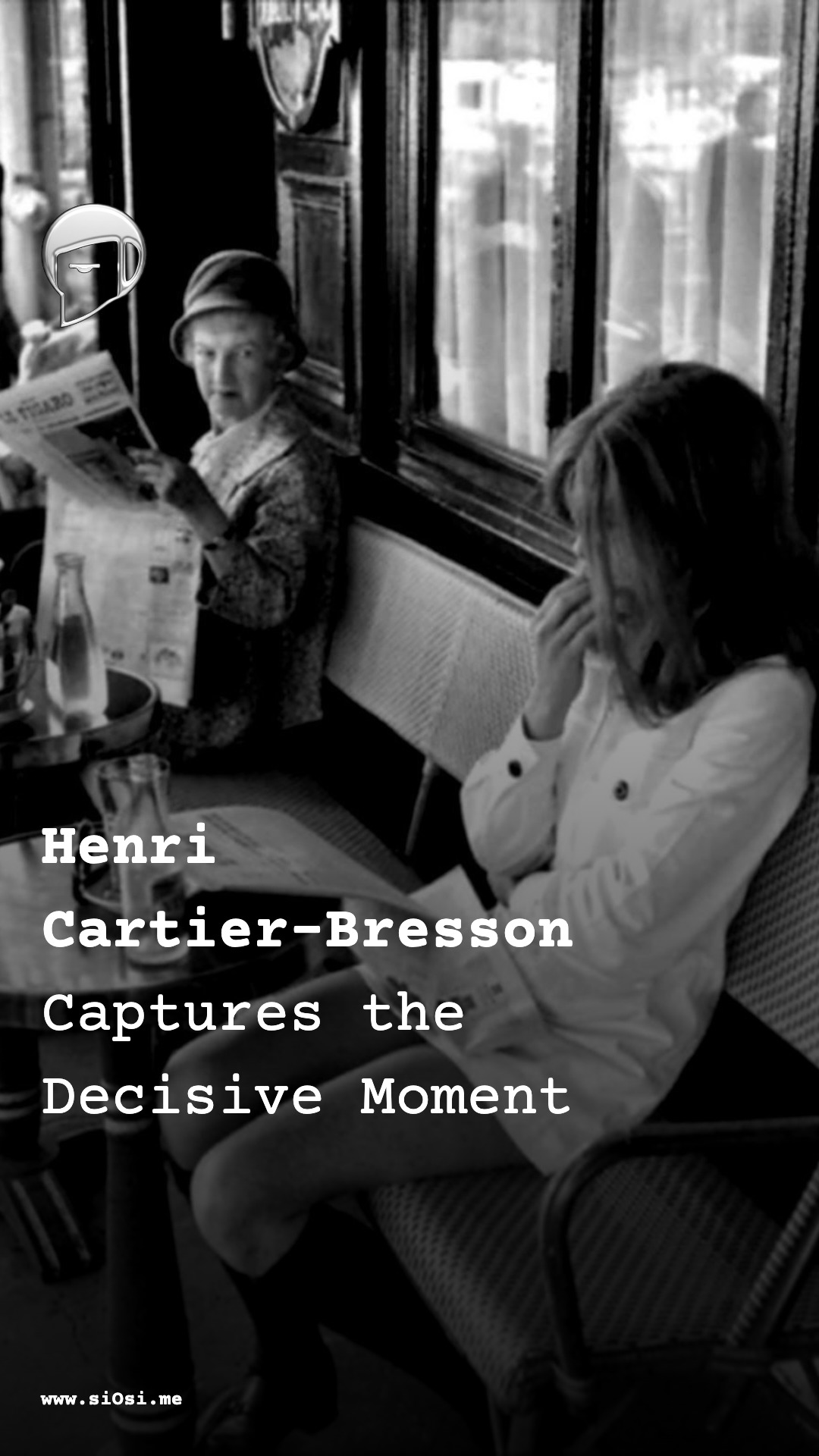
On this day in 1908, Henri Cartier-Bresson entered the world and forever changed how we see beauty in motion. His instinct for geometry and humanity turned fleeting gestures, a turning head or a skirt in the wind, into poised compositions that feel as precise as a tailored garment. At siOsi we celebrate that same alert elegance, where structure meets spontaneity and the unguarded instant reveals true character. Cartier-Bresson showed us that beauty lives in balance and timing, not ornament, and his candid eye still pulses through our collections today. From sharp diagonals to the hush before motion, his work reminds us that style is lived, not staged. Join siOsi in honoring the man who made everyday life feel inevitable and electric.
Henri Cartier-Bresson’s aesthetic impact lies in making instinct, geometry, and humanity look inseparable. His photographs turned everyday life into a study of poised motion, where a bent elbow, a turning head, a skirt caught by wind, or a figure aligned with a stair rail could feel as exact and inevitable as a well-cut garment.
He is most strongly associated with candid photography and the idea of the decisive moment, which he defined as the instant when the significance of an event and the organization of forms meet in a single fraction of a second. Visually, this gave his work a language of sharp diagonals, framing edges, reflected surfaces, open thresholds, and elegant interruptions. The eye moves through his images the way it moves across a tailored coat or a carefully arranged room, noticing tension between structure and spontaneity.
Cartier-Bresson’s early photographs show the influence of Cubism and Surrealism in their bold planes, collage-like composition, and spatial ambiguity. That matters aesthetically because his pictures rarely feel merely documentary. They have the polish of composition and the nervous pulse of life. Flesh, stone, fabric, and shadow are held together by a severe but delicate visual grammar, one in which black and white becomes almost tactile, with bright light, deep shade, and crisp outlines sharpening the emotional climate.
His relation to beauty was unsentimental but deeply exacting. He was interested in the body not as display, but as gesture, balance, and timing, and he favored the unguarded instant when posture reveals character. In that sense, his work often treats beauty as something accidental and fleeting, found in the angle of a shoulder, the poise of a hand, or the suspension of movement just before it resolves. The result is a beauty that feels lived-in rather than staged, elegant without ornament, intimate without softness.
The emotional presence of his photographs is marked by alertness, restraint, and tenderness. His images of public life, back alleys, streets, and political upheaval carry a sense of witness rather than spectacle. Even when the subject is dramatic, the tone is rarely theatrical. Instead, the feeling is lucid, quietly charged, and humane, as if the world has briefly arranged itself into a perfect but fragile order.
His signature visual language also has a strong relationship to silhouette and movement. Working with the small 35mm Leica allowed him to move quickly and unobtrusively, which helped him preserve gestures at their most exact. That mobility shaped an aesthetic of lightness, where figures seem to drift, pivot, leap, or pause at the edge of change. This gives his work a dancerly quality, even in scenes of ordinary street life.
Cartier-Bresson’s attitude toward the body and style was closer to discipline than decoration. The body in his photographs is often unposed but never slack. It becomes legible through line, rhythm, and interruption, much as a garment is understood through how it falls, folds, and moves on the body. His pictures prefer the moment when form is alive, not frozen, which is one reason they still feel modern.
Today, his work still evokes a clean, electric stillness. It can feel at once old and immediate, like silvered air or a glance caught at the edge of memory. What survives is not only historical information, but an atmosphere: urban grace under pressure, the hush before motion, the poise of chance made visible. That is why his images continue to read as emotionally contemporary, with a visual calm that still contains tension, tenderness, and sudden light.