
Sun in VirgoMoon in TaurusWaning Gibbous
Dain Yoon Turns Faces Into Flickering Illusions
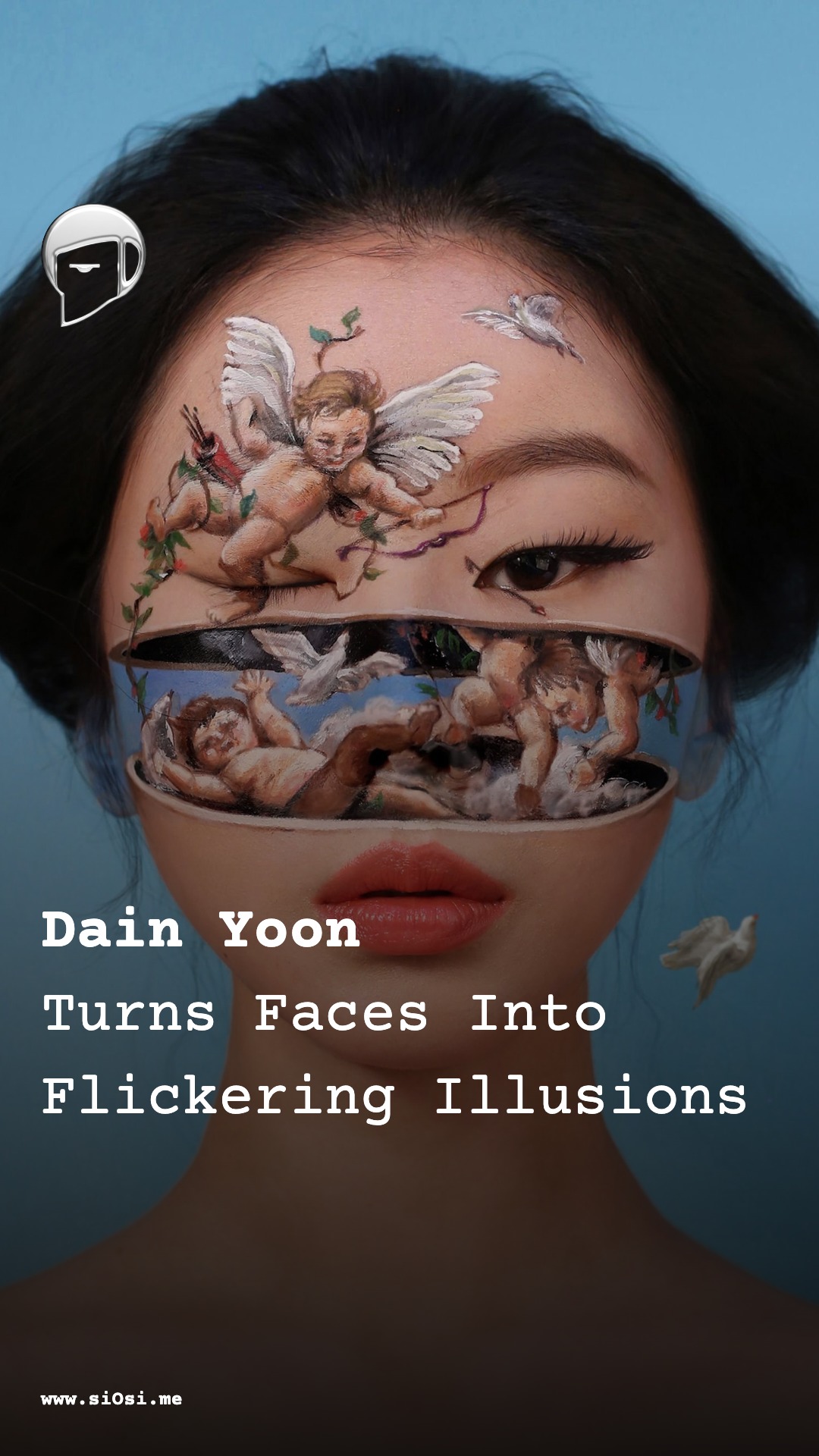
Dain Yoon makes a single face feel like it is splitting into several possible selves. She spends three to twelve hours layering extra eyes and mouths until the outline starts to tremble. The colors stay close to real skin tones so the trick lands with quiet force. What looks like flawless beauty at first glance quickly turns into something that questions what you are even seeing. The whole thing leaves you staring longer than you planned.
Dain Yoon’s work occupies a rare place between beauty ritual and perceptual disturbance, turning the face into a site where identity, glamour and doubt coexist in the same painted surface. Her illusions do not simply decorate the body, they unsettle it, bending conventional ideas of makeup, portraiture and self‑presentation into fluid, sometimes vertiginous configurations that feel as contemporary as they are quietly uncanny.
The face as mutable silhouette
Trained as a fine artist in classical painting before studying at Korea National University of Arts in Seoul, Dain Yoon repeatedly emphasises that she does not see herself as a makeup artist but as an illusion artist who happens to use her own skin as canvas. This distinction is crucial to the visual language she has developed: in her work, the face ceases to be a fixed outline and becomes a mutable silhouette, stretched, repeated, dissolved or layered until it reads more as atmosphere than as stable identity.
Much of her early viral work involves doubling or multiplying facial features, creating compositions where several sets of eyes, noses and mouths are painted with meticulous realism slightly offset from her actual features. The result is a silhouette that seems to tremble in space: the viewer cannot immediately locate a single “true” face, and the edges of the head blur into a flicker of possible selves. Instead of the crisp contour prized in traditional beauty photography, Yoon cultivates a silhouette of instability, a figure that feels in motion even when the image is still.
She often extends the outline of the face into the hands, neck or hair, painting these surfaces so that they visually merge, as in compositions where the hands are layered over the face yet painted to appear continuous with it. In these works the silhouette is no longer a clean border between body and environment; it becomes a continuous, transparent field where limbs and features dissolve into each other. This visual logic disrupts the idea that beauty should sharpen and define the body’s limits. Instead, beauty becomes a technique of blending, of visual ambiguity.
Color and light: from flesh to mirage
Yoon’s palette inhabits a tension between naturalistic flesh tones and high‑key color associated with cosmetic fantasy. She regularly uses body paint, acrylics and an array of cosmetic products – blush, eye shadow, lip color – to achieve an optical realism so persuasive that many viewers assume her images are digitally manipulated. The colors of the painted features mimic the slight variations of human skin: the rosiness around the nose, the coolness of under‑eye shadows, the glazed surface of glossed lips. By reproducing these tones, she can insert additional eyes or mouths into the face without rupturing the overall color harmony, which makes the illusions feel disturbingly plausible.
At the same time, she frequently lets cosmetic color drift into the surreal. In works where the face appears to merge with sky or water, blues, whites and soft gradients replace flesh tones, giving the skin an atmospheric quality. In others, theatrical crimson or midnight black ring the eyes or mouth, emphasising the artifice of the image and recalling both avant‑garde beauty editorials and the history of stage makeup. The chromatic mood oscillates between intimacy and spectacle, between the close warmth of skin and the cool, graphic abstraction of painted pattern.
Light functions as a quiet collaborator in these illusions. Yoon paints with the awareness that highlights and shadows must support the deception: the glint in each painted pupil, the gloss on multiple rendered lips, the directional shading around duplicated noses. When photographed, the lighting is typically soft, frontal or slightly diffused, minimising harsh contrast so that real and painted surfaces receive similar illumination. This creates an enveloping glow in which it becomes difficult to distinguish where light touches actual flesh and where it touches pigment. In aesthetic terms, the light grants the work a muted, dreamlike clarity, the kind of luminosity associated with high‑end beauty imagery, yet used here to intensify the perceptual confusion.
Texture, surface and the feeling of proximity
Yoon’s illusions are built on an intimate knowledge of facial texture. She works directly on her skin for hours – sources report that each piece may require three to twelve hours of painting – adjusting the micro‑scale of pores, fine lines and hair so that pigmented areas sit convincingly on the body’s surface. The viewer, encountering these images, experiences a subtle disorientation of touch. One feels that, if the painted face were present in the room, reaching out to trace an extra eye or mouth might reveal nothing but smooth skin. Texture is present and absent at once.
In many works the paint itself is rendered to resemble photographic clarity rather than painterly brushwork, minimising visible strokes. This decision brings the aesthetic closer to the textureless perfection of digital retouching that dominates beauty advertising, yet the knowledge that everything is hand‑painted restores a sense of artisanal labor and bodily vulnerability. Occasionally, visible strokes or slightly rougher blending remain at the edges, reminding the viewer of the underlying material condition of the illusion. The surface is never entirely immaterial; it carries subtle evidence of work.
Hair is frequently integrated into the texture composition. She may straighten, shape or partially conceal it, using it as another linear element around which paint flows. In some images, strands of hair are painted upon, thickened visually or replicated, contributing to the sense that every aspect of grooming – hairdressing, makeup, even the impression of costume – has been subsumed into a single painterly system. The tactile associations of hair, skin, pigment and fabric converge into a dense but controlled sensory field.
Line, pattern and the choreography of movement
Though Yoon’s images are static, their internal structure suggests movement: the repeated features seem to vibrate, the overlapping hands imply coming together and drifting apart. This is achieved through careful linear composition. She frequently aligns duplicated eyes along a gentle curve, or staggers them diagonally so the viewer’s gaze travels across the face as if tracing a sequence of motion. Lines in her work – the curve of a painted eyelid, the contour of the jaw, the edge of a hand – function as choreographic marks, directing awareness through time as well as space.
Patterns emerge in series: faces multiplied into grids, features echoed several times, or surfaces divided into alternating bands of real and painted skin. These repetitions recall both Surrealist explorations of fragmented identity and fashion’s use of print to organise the body visually. Yet Yoon’s patterning is not purely decorative. By repeating facial units, she neutralises the hierarchy that typically privileges a single, central face in beauty imagery. The viewer is forced to consider each iteration as equally valid and simultaneously unstable.
She sometimes merges her body into surrounding objects or environments, painting clothing or background elements onto the skin so that they appear continuous. This technique resembles camouflage but is more philosophically inflected: the body appears to dissolve into context, suggesting that identity is constructed through environment, costume and gaze. The sense of movement here is not literal but conceptual – a sliding of self into world, of the personal into the collective.
Philosophy of beauty and the body
Yoon has stated that she began painting on herself after initially working on other people’s bodies, turning to her own face because she considers it “the most powerful and sensitive area of the body.” This conviction underlies her entire aesthetic: the face is not merely an index of beauty norms but a site where philosophical questions about selfhood, perception and reality can be visualised.
In interviews, she explains that layering body parts or creating transparent, unified appearances is a way to express that “initial perceptions may not truly reflect reality.” The illusions therefore operate as critiques of surface reading, including the rapid visual assessments that structure contemporary beauty culture. By using makeup – a tool historically associated with enhancing attractiveness or concealing flaws – to destabilise recognition, she redirects the function of beauty labor from socially legible improvement to introspective inquiry.
Her refusal to identify as a makeup artist also speaks to a broader philosophy of the body as medium rather than object. Cosmetics are not used to conform the body to external ideals but to articulate internal ideas about multiplicity, anxiety and fluid identity. Viewers often report feelings of unease or fascination, responses that mirror the emotional ambivalence many people experience toward their own appearance. Yoon lets this ambivalence occupy the image without resolution.
The Surrealist resonances are frequently noted in commentary: she paints “mind‑bending, reality‑defying scenes that evoke the works of surrealist painters – on herself.” Historically, Surrealism used fragmented bodies, doubled faces and dream logic to question social and psychic norms. Yoon’s work translates this lineage into the language of contemporary beauty, fusing the meticulous techniques of editorial makeup with the conceptual ambitions of art history. Beauty becomes not the endpoint of styling but a corridor through which questions about what a face is, and how it is seen, can pass.
Emotional presence and contemporary resonance
Viewed today, Dain Yoon’s illusions carry a distinctly contemporary emotional tone: they feel like portraits of a self dispersed across platforms, mirrors and glances, a psyche aware of being constantly seen. The multiplied faces and overlapping features can be read as visual analogues for the multiple profiles and images a person inhabits online, each slightly different yet tied to the same body. The work’s emotional presence is therefore both intimate and collective, touching private anxieties about self‑image while echoing broader cultural experiences.
There is a quiet sadness in some of the pieces where the real face seems on the verge of disappearing beneath painted repetitions. The gaze can feel lost among the many eyes, the mouth diffused among several mouths, suggesting a kind of visual fatigue. Yet there is also resilience: the underlying body persists, and the labor invested in each piece – hours of careful painting, self‑observation in the mirror – signals a commitment to articulating rather than suppressing complexity.
The glow her work evokes is not the straightforward radiance prized in beauty campaigns, but a more introspective luminosity: an awareness of how fragile our sense of self can be, and how exquisitely it can be rendered. The images leave a lingering sensation of having looked too closely at a face, of seeing it fracture into possibilities without quite breaking. In cultural terms, this aesthetic of delicate disturbance has influenced how audiences imagine the possibilities of makeup and body art, expanding the accepted range of beauty’s emotional states from confidence and allure to ambiguity, estrangement and curiosity.
Within the broader landscape of fashion and visual culture, Yoon’s contribution lies in her insistence that style is not only about choice of color or cut but about the deeper question of how a self appears at all. By turning the most familiar surface – the human face – into a site of gentle, persistent doubt, she has given contemporary beauty a new, subtly haunting register that continues to feel aligned with the fragmented, reflective mood of the present.