
Sun in VirgoMoon in ScorpioWaxing Crescent
Ink Lines That Defined a Century's Beauty Ideal
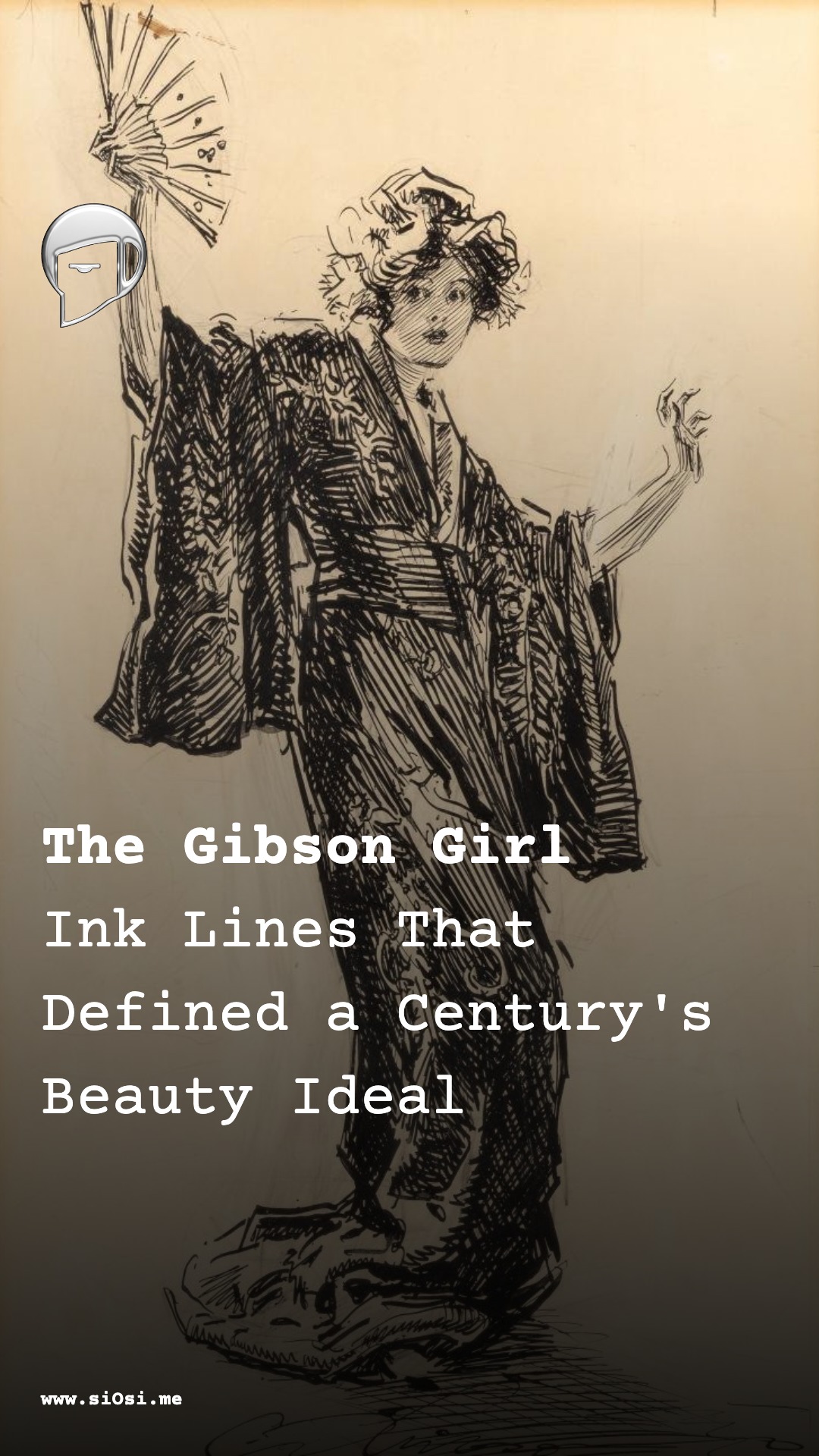
She stepped out of pen strokes and straight into legend. The Gibson Girl's S-curve silhouette turned corsets into something buoyant, with that cloud-like pompadour piled high like a soft halo. Her crisp shirtwaists and A-line skirts moved with quiet confidence, never weighed down by fuss. Posture said it all: shoulders back, gaze steady, ready for whatever the new century brought. One vivid detail sticks: those escaped tendrils curling at the nape, softening the whole look into pure poise.
Charles Dana Gibson, born 14 September 1867, entered the world at a moment when the late Victorian silhouette was still heavy with drapery and moral weight, yet his drawing hand would quietly refine that mass into line, air and attitude. His greatest creation, the Gibson Girl, became a visual aria on paper – the distilled ideal of turn‑of‑the‑century American femininity, rendered not in oil and fabric but in ink, white space and a controlled, almost musical rhythm of curves.
The Gibson line: silhouette as temperament
The Gibson Girl took shape as a figure at once statuesque and fluid, her body organised around the S‑curve that entered fashion through the swan‑bill corset. The waist is cinched to a narrow pivot, the bust projected forward and the hips gently swept back, creating a sinuous profile that feels less like anatomy than calligraphy – a drawn gesture of confidence and poise.
Above this corseted fulcrum, Gibson favoured a relatively tailored upper body: shirtwaists with stiff collars, lightly puffed sleeves, and blouses that balloon just enough to balance the small waist without obscuring it. Skirts fall in an A‑line, gliding from narrow waist to modest flare, often floor‑length but without the exaggerated bustle of earlier decades. The result is a silhouette that is simultaneously upright and relaxed, athletic yet impeccably composed – a body that looks able to move, to walk briskly through a city or swing a tennis racquet, even while it adheres to the dictates of corsetry.
Motion in these images is often implied rather than overt: a turn of the head, a slight forward lean of the torso, the flex of an arm resting on a parasol. Gibson’s lines make the figure appear buoyant, as if the corset does not imprison but lifts, giving the woman a kind of sculptural lightness that matched the new ideal of the “New Woman” – independent, employed, sometimes athletic, yet serenely elegant.
Hair as architecture: the upswept halo
The most immediate and sensorial aspect of the Gibson Girl is her hair, a voluminous upswept style that reads as both architecture and atmosphere. Piled high in a pompadour or chignon, often enhanced with hair “rats” to build width, the hair creates a soft, cloud‑like mass that crowns the face and amplifies the proportions of the neck and shoulders.
Descriptions from the period speak of a “soft pompadour, puffed for a cloud effect, rolled from temple to temple over a horsehair rat”. This gives the impression of hair as a textural aura: airy yet dense, controlled yet suggestively tousled at the edges. A few tendrils escape, curling at the nape or near the ear, introducing an emotional softness that offsets the structural discipline of the corset and collar.
In Gibson’s drawings the hair is rendered through dense cross‑hatching and sinuous contour lines, which catch imaginary light like polished waves. The contrasting black of the coiffure against the white of the paper frames the face with an almost theatrical intensity: the hairstyle is both a fashion statement and a compositional device, anchoring the image and directing the viewer’s gaze.
The face: eyes, mouth, and the discipline of light
The Gibson face is a study in controlled brightness. Contemporary accounts emphasise that she possessed a “flawlessly beautiful face” and “bedroom eyes”, yet Gibson’s handling is restrained – no melodrama, but a cool, luminous self‑possession.
Eyes are large but not exaggerated, often half‑lidded, with the suggestion of a calm, amused intelligence. Gibson achieves this with fine, almost whisper‑like lines around the lids and a modest deepening of shadow under the brows. Brows are arched but not pencilled in the later cosmetic sense; they appear natural, a clear sweep that balances the broad forehead created by the pompadour. The mouth is usually small, with full lips articulated by a single firm line and minimal shading, poised between smile and reserve.
Light in these portraits is stark yet delicate. The high contrast of black ink against white paper means that highlights are not painted but left untouched; the face seems illuminated from within by the whiteness of the ground. Cheeks, nose and chin are modelled with sparse hatching, so that the skin reads as smooth and cool, the complexion always even and luminous. There is no explicit makeup depicted, but the effect is equivalent to a carefully powdered face, subtly defined eyes and lips – an understated cosmetic ideal that anticipates the early twentieth century preference for natural yet perfected beauty.
Clothing and fabric: texture in monochrome
Despite working almost exclusively in pen‑and‑ink, Gibson conveys a surprising richness of textile and surface. Shirtwaists appear crisp, rendered with straight, vertical hatching that suggests starch and fine cotton; collars are stiff, sometimes fastening with a small dark dot that implies a stud or button. Sleeves billow with gentle shading, offering the sensation of light material – lawn, voile, or muslin – filled with air and movement.
Skirts are treated in longer, curved strokes that follow the line of the body and the fall of the fabric, hinting at wool, silk or heavy cotton without the need for colour. Lace, when it appears, is indicated by delicate, broken lines and tiny dots, a visual murmur rather than an explicit pattern. The absence of colour becomes part of the style: the monochrome palette intensifies attention to form, contrast and rhythm, making posture and silhouette more important than ornament.
Accessories – hats, parasols, gloves – are carefully integrated into the composition. Large hats sit lightly atop the hair, often trimmed with feathers or ribbons implied by sweeping lines, extending the figure’s verticality and adding a theatrical dimension. Parasols and walking sticks introduce linear counterpoints, vertical or diagonal strokes that balance the curves of the body, reinforcing an image of control and poise rather than frivolity.
Posture and emotional presence
Perhaps the most enduring aspect of Gibson’s aesthetic is posture. The Gibson Girl “modeled how to dress, stand, sit, present oneself, and interact with others”, becoming a template for feminine comportment. In image after image she stands tall, shoulders back, head held high, the neck long and graceful. Even when seated, she rarely slumps; the spine appears tensile, imbued with a quiet tension that suggests self‑respect and alertness.
Emotionally, these drawings rarely show overt sentiment. The Gibson Girl is neither coy nor melodramatic; she is self‑assured, independent, “sporty”, and casually elegant. She might be reading, sketching, cycling, or conversing, often engaging in modern leisure or professional activities. Her expression tends toward a restrained amusement or mild curiosity, a look that can be interpreted as ironic detachment or serene confidence.
This emotional presence aligned visually with the culture’s emerging figure of the “New Woman” – educated, occasionally employed, and more physically active than her Victorian predecessors. Gibson’s ideal is thus not only a body shaped by corsets and collars, but a psychological silhouette, a mood of control, intelligence and autonomy, conveyed entirely through line, posture and facial nuance.
Philosophies of beauty and the body, implicit in ink
Gibson described his creation as a composite of “thousands of American girls”, suggesting that the Gibson Girl was less a portrait than an idealised type. As an ideal she combined older images of the “fragile lady” with the “voluptuous woman”, synthesising delicacy and sensuality into one figure. The narrow waist, long neck and fine hands speak of fragility and refinement; the full bust, rounded hips and confident stance convey physical presence and vitality.
The underlying philosophy of beauty appears to value:
- Youthfulness and transience: sources note that the Gibson Girl epitomised a late nineteenth‑ and early twentieth‑century preoccupation with “youthful features and ephemeral beauty”. The smooth skin, bright eyes and unlined face are always young, unmarked by age or labor.
- Athleticism within constraint: she is “independent, athletic, and confident”, yet also tightly corseted and impeccably dressed. The body is disciplined, its potential energy contained within elegant posture.
- Elegance as ease: the Gibson Girl is consistently described as “easy” and stylish, “at ease and stylish”, never strained or anxious. Beauty is presented as something worn lightly, a natural extension of one’s bearing and clothing rather than an effortful display.
These values are visually encoded in the interplay of rigid and soft elements: the corset versus the flowing skirt, the stiff collar versus the cloud‑like hair, the cool expression versus the implied warmth of curves and movement. The body is aestheticised as a well‑tuned instrument, controlled yet capable, delicate yet robust.
The first modern standard of style
Gibson’s images were widely reproduced in magazines and prints, making the Gibson Girl “the first 20th century standard of female beauty and style” and “the century’s first pin up”. Her look quickly moved from drawing to lived fashion: women adopted the pompadour hairstyle, the tailored shirtwaist and A‑line skirt, and the swan‑bill corset to approximate the S‑curve figure.
Fashion historians note that she supplanted the mid‑ to late nineteenth‑century bustle silhouette, guiding taste toward more casual, streamlined clothing while still holding to the formalities of high society dress. In this sense Gibson’s work did not merely reflect contemporary style; it actively shaped it, providing a visual grammar of how modern women might look, move and occupy space.
Her hair alone became a cultural touchstone: the upswept, voluminous style “cut across class and ethnic boundaries”, with both upper‑class and working‑class women finding in her image something aspirational and relatable – charm, unconventionality, and a refusal to “put on airs”. Beauty here is aspirational yet attainable: a matter of posture, hairstyle and clothing more than inaccessible luxury.
How the work feels today
Viewed now, Gibson’s drawings retain a cool radiance. The monochrome ink, the spacious white grounds and the precise, musical line give the images a graphic modernity that still feels fresh. The Gibson Girl’s composure can read as both emancipating and constraining: her upright posture and confident gaze suggest autonomy, yet the narrow waist and strict clothing remind us of the physical disciplines imposed on women’s bodies at the time.
Emotionally, the images often evoke:
- Serene poise – a calm, almost architectural elegance.
- Gentle irony – the slight tilt of the head, the subtle set of the mouth hint at intelligence and wit.
- Nostalgic light – the white spaces feel like bright daylight, recalling verandas, city streets, studios, and parlors of a vanished world.
In contemporary eyes, the Gibson Girl has a kind of ghostly glow: she is at once familiar and distant, her idealised body and hairstyle echoing later fashion archetypes yet bound to a specific historical moment. The drawings carry the quiet thrill of seeing an ideal being invented, line by line, at the point where Victorian mass and ornament give way to twentieth‑century clarity and style.
Charles Dana Gibson’s enduring aesthetic imprint
Charles Dana Gibson’s birth in 1867 situates him at the hinge of these transformations: an artist formed in the late nineteenth century who would articulate the first widely disseminated vision of twentieth‑century American feminine style. His visual language – black ink, disciplined contour, luminous white space – became a template for fashion illustration itself, influencing how clothing, hair and bodies were pictured long after the Gibson Girl’s specific silhouette faded from everyday dress.
Today, his work feels like an archive of attitudes: each line recording not just a hairstyle or corset shape, but a way of inhabiting the body, of managing the interplay between public poise and private emotion. The Gibson Girl continues to glow in cultural memory as a figure of poised independence, her ink‑drawn presence still quietly shaping how elegance, confidence and femininity are imagined.