
Sun in VirgoMoon in ScorpioWaxing Crescent
Margaret Keane's Big Eyes Still Pull You In
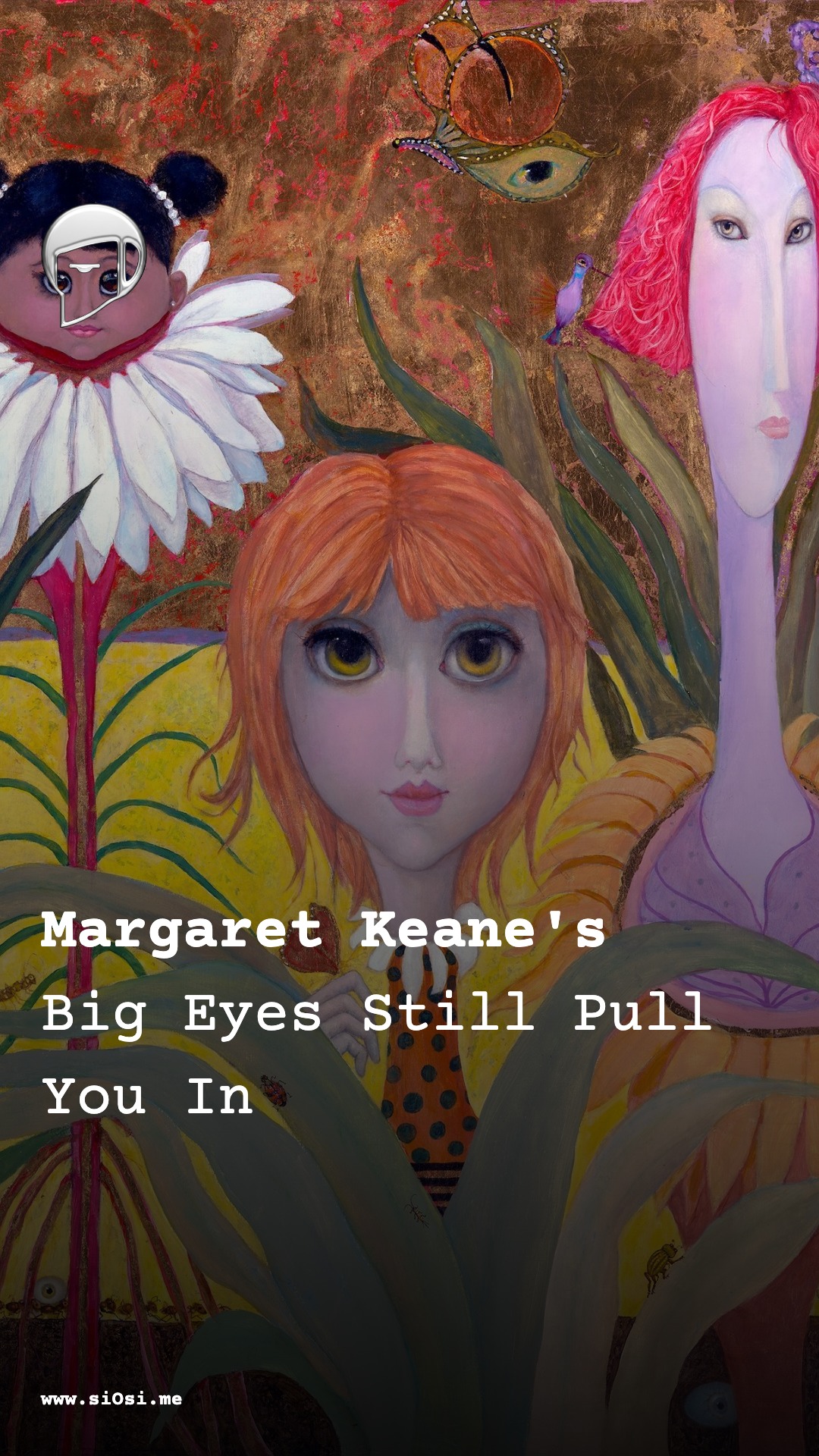
Those giant, liquid eyes hit different. Margaret Keane turned quiet stares into full-on emotional statements back in the 1950s. She kept the palettes soft and misty so the dark irises could glow like little moons. Her waifs in simple dresses feel like they are carrying the whole mood of the room. One look and you know the sadness is the point, not the accessory.
Margaret Keane, born Margaret Doris Hawkins on 15 September 1927, entered the visual culture of the twentieth century as a quiet yet insistent presence: a painter of faces in which the eyes swell to occupy nearly the entire emotional field. Her work did not reshape silhouette in the conventional fashion sense, yet it profoundly altered the way sentiment, vulnerability, and psychic atmosphere were pictured and circulated in popular imagery. Through her big–eyed children, women, and animals she created a vernacular language of beauty in which emotional exposure was the primary ornament.
Signature visual language: the architecture of the eyes
The defining element of Keane’s style is the oversized, doe–like eye – round or slightly almond, often liquid with highlight, disproportionately large in relation to the rest of the face. She herself remarked that eyes were “the most expressive part of the face” and that in her portraits “they just got bigger and bigger and bigger”, a visual escalation of feeling.
Formally, this eye becomes the central compositional device:
-
Lines and shapes
-
Heads are typically modest ovals or gently rounded forms, subordinated to the eyes that dominate the upper half of the face.
-
Eyebrows and noses are rendered with economical line, often faint, allowing the large circular or elliptical eyes to appear almost suspended in a pale field of skin.
-
Limbs are slender, sometimes attenuated in the manner of Amedeo Modigliani – whose influence she acknowledged in her approach to painting women from 1959 – but without his irony; the elongated proportion serves to throw the eyes further into relief.
-
Color and contrast
-
Keane frequently used soft, muted palettes: hazy blues, gentle browns, mossy greens, and pastel flesh tones that create a subdued atmospheric wash.
-
Against these tender grounds, the eyes are deepened with darker pigments – near–black pupils, rich umber or sapphire irises – ringed with lighter highlights so they seem simultaneously glazed and bruised.
-
The contrast is not violent; it is dampened, like light passing through mist, lending her figures an air of quiet distress or fragile hope.
-
Light and surface
-
Light in Keane’s paintings is typically frontal and soft, without sharp chiaroscuro; it glows gently on cheeks and foreheads while pooling in the eyes.
-
The eyes often carry a small, bright reflection – a pinprick of white or pale yellow – that reads less as optical realism than as a sign of inner life, a single star caught in a dark sky.
-
This treatment turns the eye into a polished surface, almost lacquered, an ornamental zone where sentiment is concentrated.
-
Posture and movement
-
The bodies in Keane’s work are largely still, waifs posed in front of sparse backdrops, staircases, or simplified urban or domestic interiors.
-
Shoulders tend to slope, hands clasp or hang, chins tilt slightly downward; movement is distilled into micro–gestures – a twist of the neck, a sideways glance.
-
This minimal physical dynamism intensifies the sense that all motion has been relocated to the gaze. The eyes appear to lean forward, to search, to ask questions the mouth does not voice.
The result is a visual system in which the face becomes an arena for emotional magnification, a kind of psychic portraiture framed by a child–like body.
Texture, atmosphere, and the feeling of kitsch
Keane’s work often occupies the cultural category of “thrift store art” and mid–century kitsch: reproductions of big–eyed waifs once ubiquitous in cheap frames and mass–market décor. Yet the tactile quality of the paintings is more nuanced than the label suggests.
-
Paint handling and texture
-
In oils and mixed media she tends toward smooth, blended surfaces, with limited visible brushstroke in the flesh and background.
-
Textural interest is concentrated in the eyes and sometimes in clothing or hair: faint striations to suggest lashes, a glossier sheen around pupils, or delicate strokes that build up the fall of hair around the face.
-
This controlled texture contributes to a porcelain–like finish, echoing the look of dolls or figurines – objects meant to be looked at, protected, cherished.
-
Clothing and material hints
-
Her children and women are often dressed in simple garments – plain dresses, modest coats, occasionally patterned fabrics – that rarely compete with the eyes.
-
When pattern appears, it is gentle: floral or checked motifs rendered softly so they function as murmured context rather than statement fashion.
-
The implied fabrics feel lightweight, unstructured, often hanging straight from the shoulder, which keeps the silhouette quietly vertical and allows the head to retain visual authority.
The atmosphere of these works is at once sentimental and unsettling. Critics often dismissed them as kitsch, yet the public responded intensely, filling homes with reproductions. The tension between critical disdain and popular affection is itself an aesthetic phenomenon: Keane’s images demonstrate how mass culture can adopt a visual vocabulary of vulnerability as décor, rendering sadness and tenderness into a style.
Philosophy of beauty and the body: eyes as confession
Keane repeatedly articulated a philosophy in which eyes are “windows of the soul”, the site where the inner person is most visible. She insisted that she focused on the eyes because they show the “inner person more”, a belief that guided her entire visual practice.
-
Emotional projection
-
She stated that the dejected children she painted were “actually my own intense emotions” that she could not otherwise express.
-
The bodies, thus, become vessels for the artist’s internal weather, beauty redefined as candor about fragility rather than adherence to classical proportion.
-
Sadness, innocence, and moral weather
-
Commentators have linked the gloom of her earlier works to her “inner sadness at the world and the wickedness within it”, suggesting that the darkness behind the large eyes is a moral as well as emotional register.
-
The waifs’ oversized, moist eyes oscillate between childlike innocence and a premature knowledge of suffering, producing a beauty that feels ethically charged, as if the viewer is being asked to witness vulnerability and their own complicity in it.
-
Transformation over time
-
As her life circumstances changed – including divorce and a move to Hawaii – her paintings reportedly became “happier and brighter”, yet the eyes remained large.
-
This shift suggests an evolving philosophy: the eye as constant locus of spirit, the surrounding palette as changing emotional climate. Joy, when it appears, is still mediated by the same fundamental structure of openness.
Keane’s approach to the body is therefore less concerned with idealized physique than with states of feeling inscribed upon the face. The figures’ thin limbs, small mouths, and slight torsos serve mostly as framing devices for the gaze, underscoring a belief that beauty lies in the capacity to feel deeply and to show it.
Cultural and stylistic impact
Although often placed outside the “legitimate” art world, Keane’s big–eye paintings were among the most widely seen images of the 1950s and 1960s, outselling more canonized movements in sheer public visibility. Their influence radiates through several aesthetic domains.
-
Mass–market visual culture
-
Cheap reproductions, magazine advertisements, and franchise galleries disseminated Keane’s waifs into living rooms, hair salons, and modest boutiques, saturating the visual field with large, haunted eyes.
-
This proliferation helped normalize exaggerated facial features as a decorative motif, paving the way for later fashions in illustration and commercial art that foregrounded big eyes, from greeting cards to character design.
-
Fashion and beauty imagery
-
The emphasis on doe–like, enlarged eyes resonates with parallel developments in makeup and photography, where heavy eyeliner, false lashes, and widened eye shapes became markers of feminine glamour and youth.
-
Keane’s aesthetic translates readily into beauty styling: the concept of the eye as emotional spotlight parallels the use of cosmetics to sculpt the gaze as the central feature of the face. Her work thus participates in a broader mid–century fascination with eyed beauty – wide, luminous, slightly melancholic.
-
Pop surrealism and contemporary art
-
Her “Big Eye Art” style has been cited as an inspiration for contemporary pop surrealists, who similarly fuse innocence and eeriness in their figures.
-
These later artists inherit Keane’s taste for disproportionate heads, enormous eyes, and child–adult hybrids, but often with darker or more baroque settings. Keane’s more modest staging appears, in retrospect, as a quiet precursor, a simplified template for an entire genre of emotionally charged figurative surrealism.
In this way, Keane’s visual language contributes to the broader cultural acceptance of sentiment as style, showing that sorrow, wonder, and unease can be worn on the face like jewelry.
How her work feels today
Encountered now, Margaret Keane’s paintings carry a layered emotional presence. Their surfaces may recall mid–century kitsch, thrift store aisles, and mass–produced prints, yet their eyes still exert a peculiar gravitational pull.
- There is tenderness: the soft colors, the small bodies, the modest clothing, all suggesting a world of children and quiet women trying to endure.
- There is unease: the eyes are too large, too knowing, damp with sadness or apprehension; they look past the viewer toward something unseen.
- There is nostalgia: the style is unmistakably of its time yet refuses to age, because the emotion it carries – the difficulty of saying what one feels – persists.
Today, her work evokes a glow that is not glamorous in the conventional sense, but instead luminous with feeling. The eyes, still wide, still watchful, remind us how mid–century popular culture learned to decorate its spaces with vulnerability. Keane’s figures stand in their simple dresses and narrow stairwells, eyes like small moons, asking us to meet their gaze and acknowledge the quiet weight they bear.