
Sun in VirgoMoon in ScorpioWaxing Crescent
Jean Arp and the Quiet Power of Organic Form
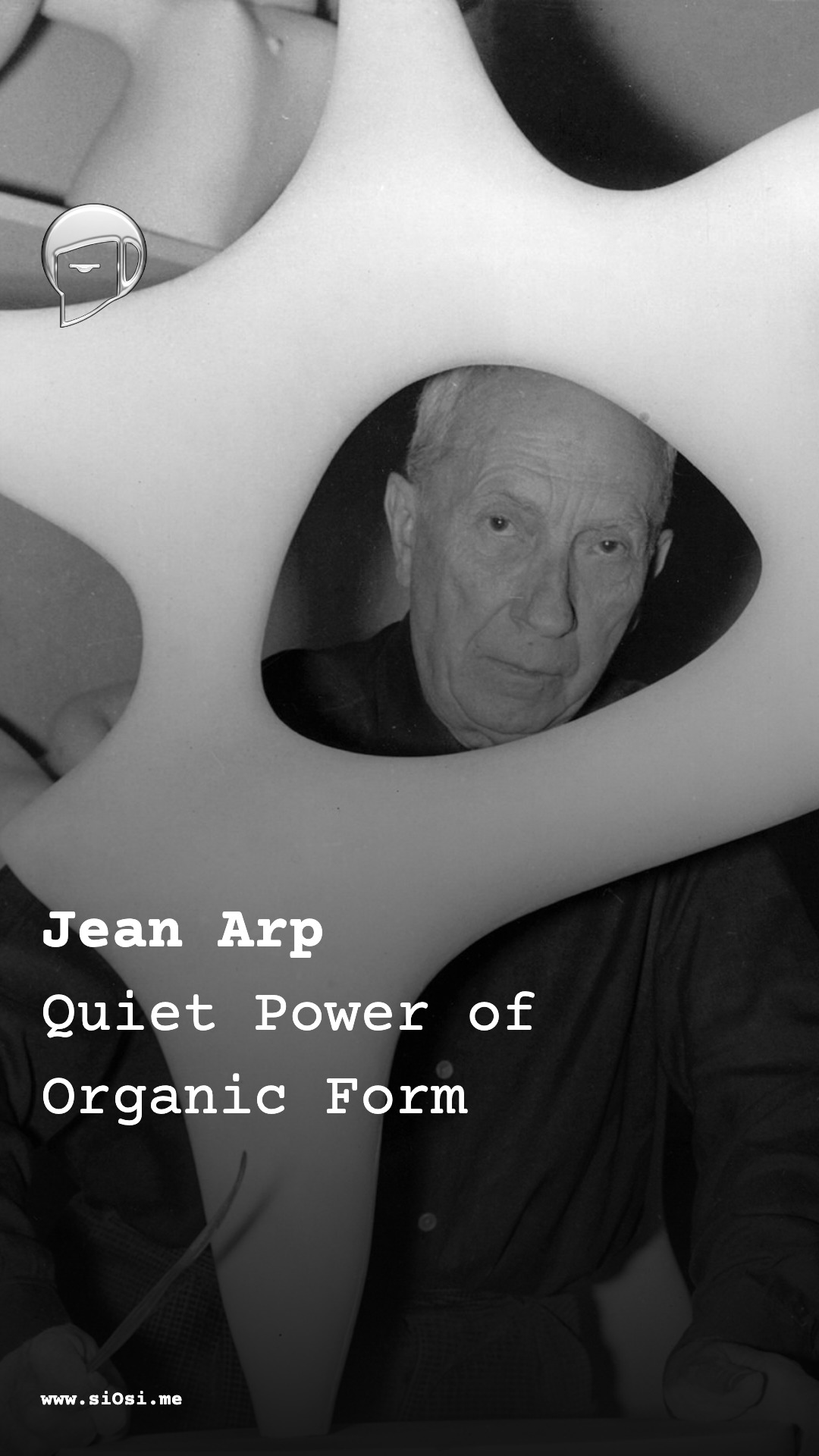
Jean Arp made sculpture feel like it grew on its own. Rounded curves and swelling volumes replaced sharp edges with something softer and more alive. His biomorphic shapes evoke seeds swelling or stones smoothed by water, shaped by chance rather than control. That fertile, tranquil energy still lands today, inviting the eye to follow each gentle contour. It is beauty that settles in rather than shouts.
Jean Arp, born in Strasbourg on 16 September 1886, helped shift modern visual culture toward a quieter, more bodily abstraction, one that replaced hard-edged drama with supple, organic growth. His work changed the feel of sculpture and collage from something constructed and imposed into something generated, as if form had risen naturally from matter, like a seed swelling, a shell turning, or a stone rounded by water.
Arp’s signature visual language was biomorphic: rounded contours, closed silhouettes, and forms that seem to breathe rather than pose. In works such as Configuration in Serpentine Movements I, the Met describes his biomorphic art as l’art concret, noting that it evokes natural forms without imitation, “as if the sculpture had been created by natural forces rather than his own hand”. That distinction matters aesthetically. Arp did not chase anatomical realism, polished theatricality, or decorative excess. He sought a softer, more inward kind of beauty, one based on contour, mass, and the slow eloquence of growth.
His attitude toward the body was never rigid or heroic. Instead, the body in Arp’s work becomes a flowing principle, suggested through torsos, fruits, seeds, and swelling volumes that feel both human and vegetal. The Art Institute of Chicago notes that his language of biomorphism infused Surrealism with forms alluding to growth, fecundity, and the natural world. That is the emotional register of his art: fertile, lunar, tranquil, and oddly intimate. It does not strike so much as settle. It invites the eye to travel along curves, to rest in the fullness of a rounded edge, to feel shape as a kind of quiet pulse.
Materially, Arp’s work often feels smooth, pale, and tactile, with surfaces that seem to have been polished by time or weather rather than by virtuoso finish. Critics and museums repeatedly emphasize that his forms appear alive, yet impersonal, shaped by chance, instinct, and natural process. His early collages and later sculptures used chance procedures and organic abstraction to move beyond fixed geometry, allowing fragments and contours to arrange themselves into something unexpectedly balanced. Even when the forms are abstract, they carry the sensation of flesh, bone, pebble, seed, or cloud.
Arp’s philosophy of beauty was anti-ornamental and anti-illustrative. He wanted art to grow rather than to copy. In one widely cited formulation, he compared art to fruit growing in a plant, or a child in a mother’s womb. Another source records his belief that sculpture should be “light as the spoor of an animal in snow,” and that art should merge with nature, shedding self-conscious virtuosity. This gives his work its peculiar emotional weather: it feels weightless but not empty, serene but not cold, elemental rather than polished. There is grace in it, but also humility. The forms do not dominate the space around them, they seem to inhabit it gently.
His influence on style is less about clothing, cosmetics, or fashion silhouette in the literal sense than about a broader modern aesthetic of softness, organic line, and nonviolent form. Arp helped authorize a visual world in which curves could carry authority, and in which abstraction could be sensual without becoming decorative, modern without becoming severe. That sensibility echoes through later 20th-century abstraction, where artists drew on his biomorphic idiom and his faith in forms that feel grown rather than designed.
Today, Arp’s work still evokes a calm, almost herbal glow. It feels like early morning light on stone, or the muted sheen of a shell interior, or the silence inside a seed before it splits. The emotional effect is tender and enduring: a reminder that beauty can be rounded, unfinished, and alive to chance.