

Sun in VirgoMoon in CancerWaning Crescent
Jacques Fath: The Designer Who Made Fabric Dance
Jacques Fath made postwar fashion feel like it was caught mid-twirl. He nipped waists tight then let skirts burst into pleats that caught every breeze and step. His bold color clashes and floating panels turned walking into a performance. One standout detail: those wide fluttering skirts made for women pedaling through gasoline rationing, fabric rippling with each turn of the wheel. The result was glamour that refused to sit still.
Jacques Fath, born on 6 September 1912, belongs to that small circle of couturiers who turned postwar fashion into a theatre of movement and light, using the female body as both architecture and improvisation. His work reads as a continuous line of sensation: constricted waists that release into cascades of fabric, necklines that tilt and veer, colors that clash slightly then harmonize in the eye at a second glance.
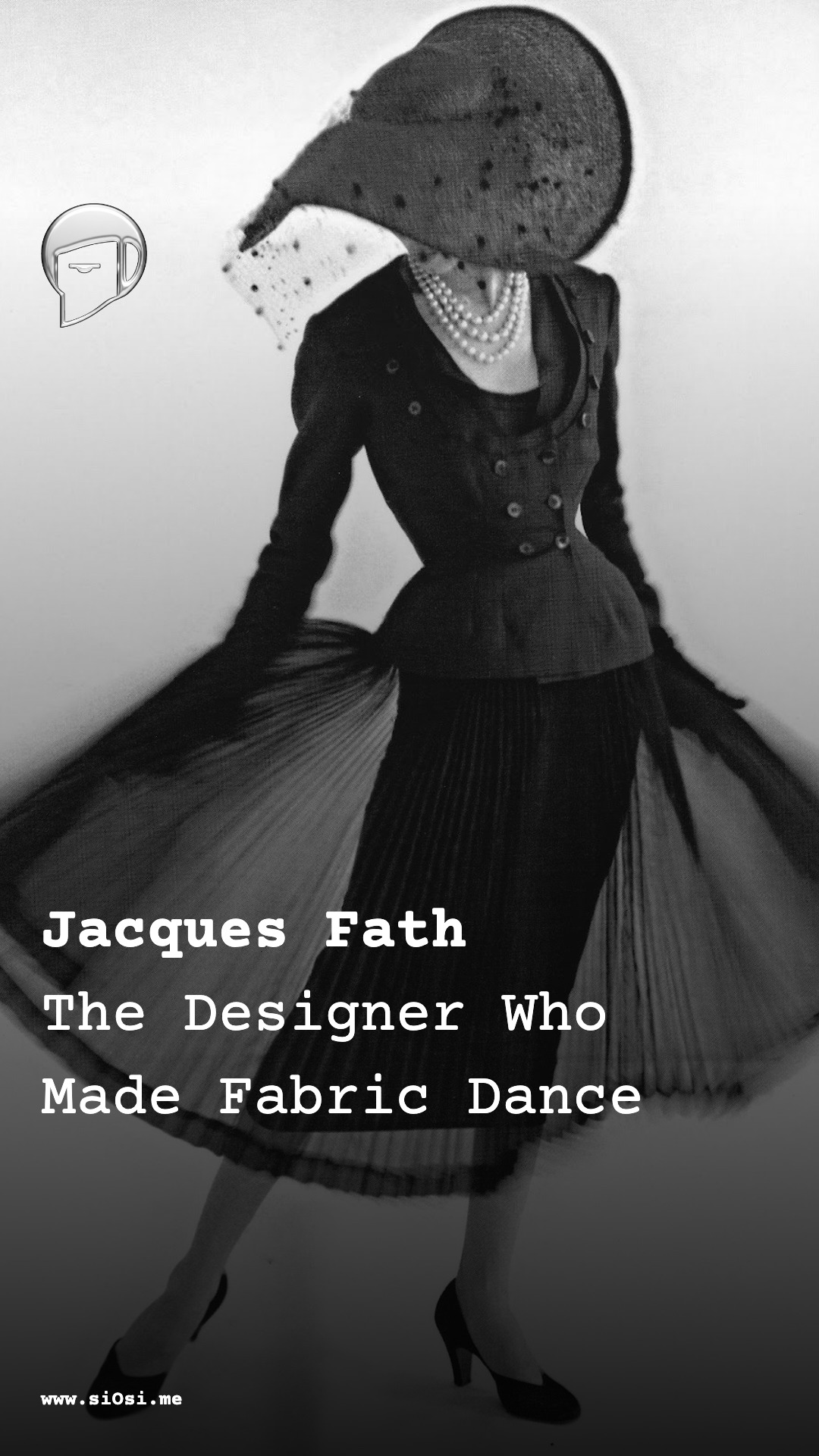
He imagined fashion as a choreography of curves and diagonals. A typical Fath dress drew the bodice tightly to the torso, moulding the waist into a fine column that swelled deliberately over bosom and hips, giving the impression of a body in mid‑breath. Skirts were either very slim, spiralling around the legs like a narrow sheath, or abruptly full, bursting out in whirlpools of pleats and draped panels, with little interest in compromise. There is a sense of decisiveness in this refusal of the middle ground: the figure is either sharpened to a line or allowed to billow into a cloud.
Silhouette, line, and movement
Visually, his silhouettes were part of the same postwar conversation that produced the so‑called New Look, yet they brought a different emotional temperature. Where some contemporaries pursued pure architectural rigor, Fath’s lines undulated, twisting across the body in diagonals and asymmetries that seemed to catch an invisible breeze. Diagonal seams, slanting button plackets, and floating panels were integral to his language, breaking the symmetry of the torso and suggesting motion even in stillness.
His hourglass was not static. The waist was nipped, often fiercely, but above and below the body appears to be in motion: irregular necklines that pull the gaze towards the décolletage, sleeves that flare or fold at unexpected angles, skirts that swing out from the hips, pleats opening like a fan as the wearer walks. Contemporary descriptions emphasize his use of asymmetrical drapery and “floating panels” to imply movement, an effect heightened by walking, turning, or simply the act of breathing.
During and immediately after the war, he showed a particular sensitivity to movement in constrained circumstances. Accounts describe his “wide fluttering skirts” designed for women on bicycles under gasoline rationing, the cloth lifting and rippling with each pedal stroke, the utilitarian gesture of cycling translated into a visual flutter. Even the practical becomes theatrically kinetic in his hands.
Surface, texture, and fabric
There is a tactile vividness to Fath’s work. He was willing to play with material in ways that border on the mischievous: hemp sacking, sequins cut from walnut and almond shells, cloths that would normally belong to sacks or workwear turned into couture surfaces. The texture here is double. From a distance, the garments read as refined silhouettes; up close, the eye detects tiny irregularities, grain, and a faint rustic stubbornness beneath the polish.
He had a marked fondness for pleating, drapery, and tiering. Tucks, tiers, knife pleats and cascades appear again and again in descriptions of his collections, often starting smoothly at the waist then multiplying into complex surfaces that catch light in multiple directions. These structures turn the skirt into a kinetic object: as the body moves, each fold alternately darkens and brightens, producing a slight shimmer even in matte fabric.
His eveningwear embraced sumptuous fabrics – velvet gowns are mentioned in accounts of his work – that lend depth and weight to his silhouettes. Velvet absorbs light, making the hourglass appear more sculptural and dense, while details such as asymmetric bows, knots, or draped panels carve out glints of highlight across the surface. For daytime, he often set his strict tailoring against unexpected materials or prints, such as tartan combined with plain fabrics in a single garment, so that color and pattern slice across the clean lines of a jacket or skirt.
Color and contrast
Color for Fath was neither timid nor merely decorative. Multiple sources emphasize his fondness for daring combinations, including bright blue with green, a pairing that can feel almost electric in cloth. He juxtaposed soft, near‑tonal contrasts with “loud prints in solid hues”, pushing chromatic tension against the order of his cutting.
This use of color deepened the sense of movement. Bold modern prints traversed tailored surfaces, so that when the wearer turned, the print seemed to shift direction, slide over seams, and reassemble itself. In some garments, tartan intersects with plain fabric, the check pattern abruptly cut off by a solid panel, giving the effect of visual interruption and restart. Fath’s colors can feel almost musical: long notes of navy or black broken by bright, staccato chords of blue‑green or tartan.
Necklines, posture, and the body
Descriptions of his typical dress place particular emphasis on the upper body. The bodice is closely moulded, and irregular necklines are designed to draw the eye toward the breasts and the curve of the shoulders. Pointed collars, or collars skewed off‑center, slice into the neckline like graphic accents, often forming a sharp V or angled line that frames the face and chest.
This approach demands a certain posture. The Fath woman stands upright, the waist narrow, shoulders slightly thrown back to balance the emphasis on bosom and hips, the head poised as if aware of being observed from every direction. His sheath gowns with pointed collars, described as suited to tall, slender women, further emphasize verticality: the body becomes a column through which line and detail travel.
Sleeves and collars were not afterthoughts but key actors. The designer is noted for paying particular attention to sleeve and collar treatments, favoring unusual shapes and asymmetries that introduce small surges of energy into the silhouette. A diagonally cut collar, a sleeve with an unexpected fold or flare, could shift the wearer’s physical awareness, asking the arm to move differently, the neck to turn more slowly. In this sense, Fath’s clothes choreograph not only how the body looks, but how it occupies space.
Draping as living process
Unlike some contemporaries who relied heavily on patterns and atelier systems, Fath was known for working directly on the body, draping fabric on his models and shaping forms in real time. This method resonates strongly in his finished garments. The dresses feel less like abstractions imposed upon a generic torso, more like traces of an encounter between specific fabric and specific figure.
The drapery is often described as being executed on “live mannequins”, which suggests a design process attuned to gesture, breathing, and the way cloth reacts to movement. The resulting lines tend to follow and then deviate from natural curves: a diagonal seam that originates where a shoulder blade turns, a drape that falls from the point where a hip begins to widen. There is a faint echo here of dance and theatre, both of which are cited as inspirations for his work, along with historic costume.
The bustle and corsetry reappear as motifs within his collections, not simply as historical quotations but as engines for volume and rhythm. A bustle can be read as a stored movement, fabric gathered at the back as if the skirt has just been caught by a gust. Corsetry, particularly when combined with his trademark nipped waist, produces a disciplined core against which all other parts of the garment can flutter, tilt, or swing.
Emotional tone and postwar atmosphere
Within the landscape of postwar haute couture, Fath was one of the “dominant influences”, often grouped with Christian Dior and Pierre Balmain in accounts of the period. Yet his contribution has a distinct emotional register. If Dior and Balenciaga are frequently described in terms of architectural grandeur or sculptural purity, Fath is remembered for glamour and vivacity. His clothes exude sociability – a readiness for evening, for conversation, for movement through crowded rooms.
His designs aligned with the broader postwar appetite for luxury and visible beauty after years of restriction, yet there is a almost playful defiance in his exaggeration of femininity. Narrow waists, pronounced hips, plunging necklines, and swirling skirts would have felt like a collective exhale, an insistence on pleasure and spectacle. Contemporary commentators note that his work reflected the optimism and joy of the period, channelling a renewed desire for dressing up, for going out, for being seen.
There is also a subtle tension between discipline and exuberance. The tailoring is clean, the hourglass refined, yet colors clash, asymmetries disrupt, and materials misbehave just enough to keep the eye awake. The result is an atmosphere of chic that never settles into serenity; something is always on the verge of tilting, fluttering, or opening.
The contemporary feel of his aesthetic
Viewed today, Jacques Fath’s work still carries a luminous theatricality. The sharp waists and emphatic hips register, to contemporary eyes, less as prescriptions for the ideal body and more as visual declarations: a celebration of contour and curve as expressive line. His asymmetries and diagonals feel strikingly modern, aligned with current fascinations for garments that display motion even when hung on a rail.
The mixture of refinement and irreverence – couture made with hemp sacking, shells cut into sequins, tartan spliced into a tailored suit – resonates with current interests in material experimentation and subverted luxury. These details give his work a kind of textured humanity: one imagines not only the finished dresses, but hands cutting shells, bodies turning in front of mirrors, fabric being pinned and repinned in search of the right fall.
Emotionally, the clothes still project a kind of extroverted poise. They feel designed for individuals who take pleasure in their own visibility, not in an aggressive way, but with a composed brightness. The flutter of a pleated skirt, the oblique line of a collar, the glint of an unusual button arrangement, all suggest a quiet delight in performance.
In the archive of twentieth‑century style, Jacques Fath’s legacy is less an isolated silhouette than a sensibility: a belief that fashion should move with, and slightly ahead of, the body; that color can be both elegant and daring; that asymmetry can be a form of grace. His garments still appear, in photographs and surviving examples, like frames from a film that never quite stops playing, each fold and diagonal seam holding the possibility of the wearer’s next step.