
Sun in VirgoMoon in GeminiThird Quarter
When Bodies Turn Into Brushstrokes
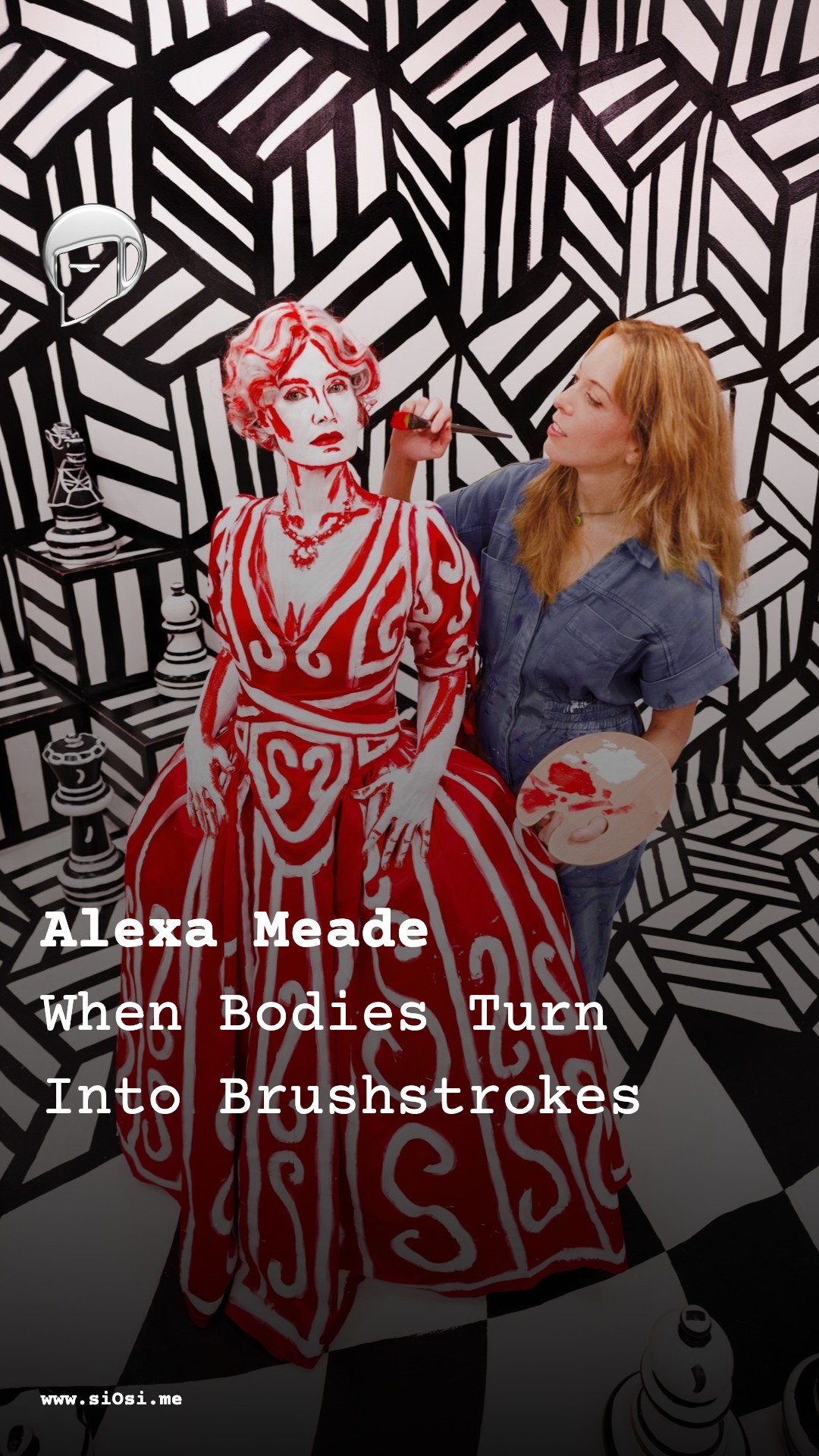
Imagine watching a person melt into a flat canvas before your eyes. Alexa Meade maps shadows straight onto skin and rooms, turning real life into a painted plane that only breathes when someone blinks. Thick acrylic ridges catch the light on cheekbones and fabric folds alike. The result feels like a living postcard where depth plays hide and seek with the camera. One quiet shift of posture and the whole illusion cracks open.
Alexa Meade, born in 1986, occupies a singular place in contemporary visual culture as an artist who paints directly on living bodies and surrounding space in order to make three–dimensional reality appear flat, as if pressed gently into the skin of a painting. Her work is less a matter of trickery than of a sustained meditation on perception, surface, and the emotional tension between presence and disappearance: the body is there, breathing, but visually it recedes into image.
At the level of pure aesthetics, Meade’s signature gesture is the deliberate collapsing of depth. She paints on human skin, clothing, furniture, and architecture with acrylics that imitate the brushwork of traditional painterly portraiture. Heavy strokes, visible ridges of pigment, and purposeful “imperfections” evoke the language of expressive canvas painting – yet they spread across cheekbones, hands, and hair, turning flesh into a site of painterly texture. When photographed, these painted bodies and spaces appear uncannily flat, like vigorous but conventional paintings, until the viewer registers a glint in the eye, a strand of hair, a subtle shift of posture that betrays life and depth. This oscillation between flatness and volume constitutes the emotional heartbeat of her work.
Color in Meade’s practice tends to be saturated and declarative. Many of her portraits immerse the subject in cohesive palettes – vivid primaries, strong reds, cobalt blues, thick whites that recall studio lighting or theatrical greasepaint. These colors are laid in firm, high–contrast planes that exaggerate light and shadow. She has described beginning with an interest in shadows, painting them directly onto grass and then onto human bodies in order to test how far she could manipulate spatial perception. The resulting aesthetic is one in which shadows do not simply fall across a face, but are sculpted, mapped, and amplified; the contour of a jaw becomes a painted stripe, a fold in clothing a diagram of value. It is a visual language that turns everyday chiaroscuro into something almost architectural, color and darkness functioning like structural lines.
Her handling of line and shape intensifies this effect. Rather than smoothing contours to naturalistic gradients, she often outlines features with assertive strokes: a curve around the eye socket, a darker trace along the nose, a contour around lips and jaw. This is the language of illustrative painting applied to anatomy, which produces a double sensation: the person seems both stylised, as if drawn, and strangely vulnerable, their natural volume surrendered to graphic design. Hair becomes a field of strokes, sometimes streaks of contrasting color, reinforcing the idea of the head as painted form rather than organic texture. Clothing is treated similarly; the fabric’s folds are parsed into painted bands of light and shadow, turning garments into part of the overall composition rather than carriers of independent fashion detail.
The silhouette in Meade’s work is paradoxically important and denied. In life, her subjects occupy full three–dimensional space, seated, standing, leaning against a wall or reclining on furniture. Before a model arrives she may spend dozens of hours painting the room itself, the clothing, and the objects that will surround them, carefully integrating the body into a larger tableau. Yet the final photographic image presents the figure as a flattened cut–out, a shape embedded into the painted scene rather than a body that sits within it. The visual logic is closer to collage or graphic poster design than to classical portrait photography: the human silhouette is a compositional element, its depth visually cancelled by the consistency of painterly treatment across skin and environment.
Texture is one of her most significant contributions to contemporary beauty and style discourse. In a culture that often prizes polished, smoothed, digitally filtered surfaces, Meade insists on the visibility of the brushstroke, the thickness of paint, the handmade irregularities that speak of labor and time. On skin, these textures feel both protective and exposing. The pigments mask natural blemishes and variation, yet the dense, tactile layers proclaim an artifice that cannot be mistaken for “natural” beauty. When the viewer sees the photograph, this rough texture becomes a subtle backdrop to the illusion of flatness: the body seems like a painted board, but the eye lingers on the ridges and seams of pigment. Beauty, in this language, is not a flawless surface but the friction between paint and flesh, image and person.
Movement in Meade’s installations is charged with a kind of quiet unease. In exhibitions, she has painted entire small rooms and placed a human subject within them for the duration of a show, transforming the space into a live painting. As long as the model remains relatively still, the scene reads as a static 2D image. The moment the subject shifts – a hand trembles, eyes blink, torso turns – the enchantment fractures and reconstitutes: the viewer becomes suddenly aware that the “painting” is inhabited, that the flat figure is a person temporarily absorbed into pictorial space. This subtle movement reshapes the emotional tone of the work. The flatness that first feels whimsical or visually clever becomes a meditation on fragility, on how quickly a body can seem to vanish into aesthetic codes, and how insistently it reasserts itself through motion.
Light and contrast are central to the illusion she creates. Her practice involves mapping existing light and shadow onto the body with paint, effectively re–inscribing what is already there. By heightening dark zones and bright highlights, she exaggerates the drama of illumination; faces can appear carved by bands of stark value, clothing segmented by blocks of brightness and depth. In photographs, this heightened contrast contributes to the impression of a painted image photographed straight on. The light itself becomes part of the stylistic vocabulary, a collaborator in the flattening of depth and the creation of a dreamlike atmosphere where the viewer cannot immediately trust what is seen.
For fashion and beauty, Meade’s influence lies less in specific garments or cosmetics than in a broader conceptual attitude: the body as medium, not merely canvas. Unlike festival body painting or decorative makeup, her approach uses paint to negate dimensionality, to convert the wearer into a sign of themselves. She has described painting “a version of [a person] on top of themselves”, creating a layered identity in which the painted portrait overlays the living subject. In aesthetic terms this results in a heightened awareness of self–presentation. Hair, skin, clothing do not simply participate in style; they are integrated into an encompassing visual system that defines how the person appears at all. The beauty ideal suggested here is not about enhancement of existing features but about full transformation into a constructed image that still, quietly, contains a human core.
This philosophy aligns with Meade’s conceptual concerns about perception and reality. Commentators note that her work blurs the line of what is real and what is representation, making viewers question their assumptions when looking at the world. Some have described her process as “portraiture in triplicate”: an actual person, a painted version of them, and a photograph of that painted body, layered into one experience. The emotional register of this triad is complex. There is playfulness in the visual trick, a delight in discovering that what seemed to be a canvas is in fact a living being. At the same time, there is a subtle melancholy, an awareness that the “real person” is hidden beneath a mask of paint and then further translated into an image. The body becomes a site where perception, identity, and representation interlace, never fully separable.
In terms of lineages of art and style, Meade works in dialogue with trompe l’œil, the historical technique that uses paint to make flat surfaces appear three–dimensional. She has been described as executing a kind of reverse trompe l’œil: instead of convincing the eye that a 2D painting is real space, she convinces it that real space is a flat painting. This reversal has poignant implications for contemporary image culture. In a world filled with screens, filters, and photographic manipulation, Meade’s work stages the collapse of reality into image as a physical, tactile event. The sitter must submit to hours of painting; clothes must be coated; rooms must be overpainted. Fashion and beauty here are not ephemeral, instantly changeable styles, but temporarily fixed states, dense with pigment and intention, framed by the camera.
Her installations and portraits often evoke a sense of dreamscape. Articles describe her painted environments as “two-dimensional painted dreamscapes”, spaces in which breakfast leftovers, furniture, and human figures all share the same painted treatment. The mood is surreal yet gentle. Everyday objects – a chair, a table, a bowl – lose their prosaic identity and become elements in a continuous field of color and line. The human figure, submerged in this field, feels both at home and estranged, an inhabitant of a world that no longer respects ordinary distinctions between body and background. Emotionally, these scenes can feel like memories pressed flat, as if the day had been turned into a page in a sketchbook.
Today, Meade’s work still carries a distinctive glow: a mixture of wonder, quiet disquiet, and meditative curiosity. Looking at her images, one senses the tenderness of painting on another person’s skin, the intimacy of mapping their shadows and contours, and the strange, reflective distance introduced when that person becomes visually “just” a painting. The viewer’s eye oscillates, unsure whether to focus on the formal beauty – the color harmonies, the thick textures, the expressive lines – or on the hidden body underneath. This oscillation is perhaps the most enduring emotional presence of her work: a reminder, in visual form, that style and beauty always hover between surface and depth, that what appears flat may be breathing, and that images, however resolved, are inhabited by lives they can never fully contain.