
Sun in LibraMoon in AriesFull Moon · Harvest Moon
Pilar Albarracín's Blood-Dotted Flamenco Revolution
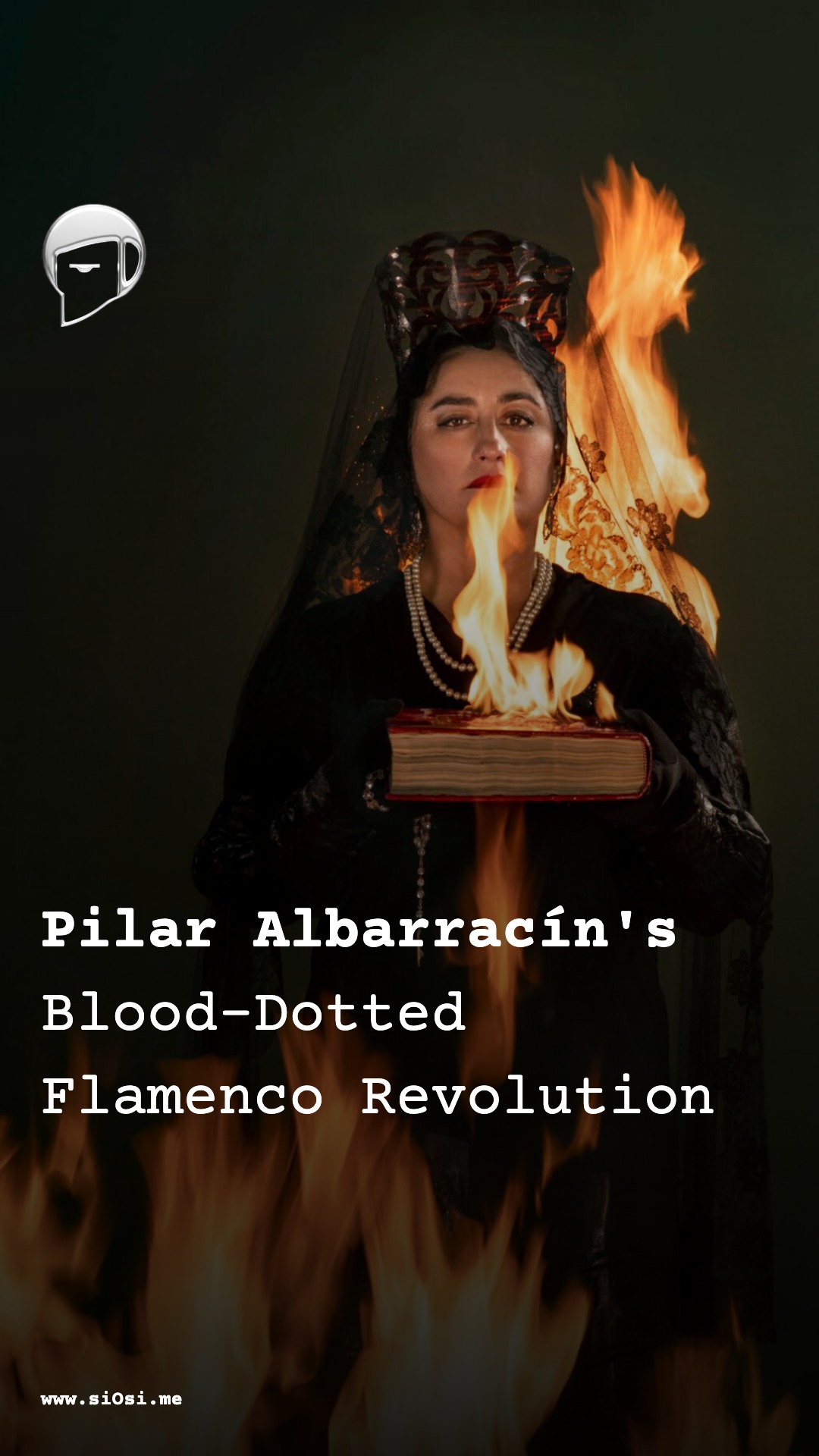
A white bata de cola soaked in pin-prick blood dots instead of printed polka dots still hits different. Pilar Albarracín turns every ruffle and train into a quiet act of resistance while owning the stage. Her tight cinched waists and sweeping skirts flip Andalusian tradition into sharp cultural critique. The red stains on immaculate fabric say more than words ever could. She dances through the weight of it all with pride and a little defiance.
Pilar Albarracín, born on 27 September 1968, has fashioned an unmistakable visual universe in which the female body, Andalusian folklore, and the theatricality of Spanish ritual are staged, adorned, wounded, and exalted, all at once. Her impact is felt less as a sequence of artworks than as a persistent aesthetic atmosphere – white flamenco fabric under harsh light, the deep red of blood and carnations, the glint of bullfighter embroidery, the suffocating intimacy of tavern interiors.
Her work resides where style, costume, and choreography become instruments of cultural critique, yet retain their sensual torque and visual seduction.
1. Silhouette, costume, and the sculpting of the body
From the outset, Albarracín uses her own body as the central medium, repeatedly dressing herself in the emblematic garments of Andalusian femininity: flamenco dresses, bata de cola with its trailing train, Sevillian ruffles, mantillas, and folkloric accessories.
The silhouette she prefers is highly codified:
- A tightly cinched waist, emphasizing the torso as a column of contained energy.
- A broad, undulating skirt, often flounced, that breaks into rhythmic movement at the slightest gesture.
- Sleeves that cling and then flare, echoing the expansion and contraction of breath in song and dance.
In performances such as Lunares (Dots, c. 2001–2004) and Prohibido el cante (2000), Albarracín appears in immaculate white flamenco attire – a dress that clings to the hips and then spills outward with layers of fabric, a shape both festive and ceremonial. The whiteness is critical: it transforms the dress into a temporary, fragile purity, a canvas on which any stain, fold, or tear becomes visible.
The bata de cola, used in Lunares according to curatorial accounts, intensifies this effect. Its extended train drags along the floor, heavy and obstinate, forcing the performer to navigate its weight with each step. It is a garment designed for exceptional nocturnal performances, and Albarracín exploits its luxury and impracticality: the train gathers dust, blood, and movement-history, turning elegance into evidence.
Her costumes borrow from bullfighter attire and religious vestments as well as flamenco dresses. Embroidered jackets, intricate gold thread, and tight trousers appear across her oeuvre as emblems of ritualised masculinity repurposed on a woman’s body. This crossing of gendered silhouettes – the female flamenco dress and the male torero suit – creates layered identities: the body becomes, simultaneously, the dancer and the sacrificial animal, the saint and the spectacle.
2. Color, texture, and the chromatics of pain
Albarracín’s palette is economically deployed yet emotionally dense. The triad of white, black, and red recurs throughout her work.
- White: dresses, blouses, tablecloths, walls. White acts as a ground, an expectation of purity and propriety, especially when associated with the Andalusian woman idealised under Franco.
- Red: blood, carnations, thread, lipstick, nail varnish. Red arrives as punctuation – a dot, a stain, a sudden insistence – that marks the body as vulnerable and ardent.
- Black: hair, traditional shawls, mantillas, shadows in taverns, the dark interior of night performances. Black folds the scene into intimacy and threat, framing the white and red with depth.
In Lunares, Albarracín pierces her skin with pins, allowing drops of blood to fall onto her white dress, creating red polka dots that mimic the decorative pattern typical of flamenco costumes. The transformation is explicitly chromatic: what should have been printed fabric becomes bodily exudation. The familiar Spanish polka-dot motif – lunares – shifts from light-hearted festivity to a record of pain. Each dot is precisely placed, controlled, yet emerges from an act of wounding rather than design.
Texture, in this performance, moves from smooth to disturbed. The soft cotton or synthetic fibres of the dress are soaked, stiffened; the garment loses its crispness as it absorbs the body’s fluid. Albarracín works at this threshold where ornament becomes scar and pattern becomes testimony.
In Prohibido el cante (2000), she appears gagged and bound to a chair in a bar decorated with bullfight photographs, hanging hams, and the head of a bull – the quintessential Andalusian tavern interior. Here, color is less about bright spectacle than about saturation: dark woods, dense shadows, yellowed walls, the earthy tones of cured meat and aged photographs. Against this environment, her flamenco dress, with its Sevillian ruffles, may carry bright reds or whites, asserting the body as a luminous, constrained figure in an otherwise weighty setting.
Across various works, Albarracín introduces embroidery and textile work as a mode of patient inscription. Traditional Andalusian clothing, including bullfighter costumes and flamenco dresses, is reappropriated through stitching, cutting, and collage. Embroidery becomes another kind of marking on the body’s surface, a decorative pain that parallels the pin-pricks of Lunares and the gag of Prohibido el cante.
3. Movement, posture, and emotional presence
Albarracín’s performances are choreographed around the intense gestural vocabulary of flamenco, but her use of movement is deliberately ambivalent. Flamenco steps, arm movements, and torsion are present, yet they are frequently interrupted by constraint, injury, or ritual.
In Lunares, she dances while pricking her skin, continuing to move even as blood appears on her dress. The performance aligns the flamenco dancer with the bull in the ring: both are bodies under scrutiny, circling within a choreography that leads toward exhaustion and possible destruction. The emotional presence here is a complex blend of pride, defiance, and vulnerability. The dancer’s posture – upright spine, open chest, sharply angled arms – conveys authority, but the bleeding transforms this authority into a more fragile, sacrificial state.
In Prohibido el cante, she is bound to a chair, gagged, yet continues to sing and eventually tears her dress, metaphorically ripping her own heart out and throwing it onto the flamenco stage. The visual paradox is stark: a figure whose mobility and voice are restricted nevertheless emits sound and movement to the point of rupture. The chair limits her bodily range, turning small gestures – tightening hands, straining neck muscles, shifting weight – into charged events. The emotional temperature rises from lament to near-orgasmic wail, but visually we see a performer held in place, adorned yet trapped.
In many artworks, Albarracín’s posture oscillates between theatrical poise and domestic fatigue. Critical texts note her embodiment of numerous female archetypes – prostitute, dancer, singer, gypsy, housewife, emigrant – each with distinct carriage and gesture. Yet all share a sense of the body as site of labour and display. The tilt of the head, the slump of shoulders, the proud lift of the chin: these small shifts narrate the passage from social expectation to interior rebellion.
Her emotional presence on screen and in photographs is rarely neutral. Even when she adopts a static pose, there is an undercurrent of tension – clenched jaw, narrowed eyes, a deliberate facing of the camera. She confronts the viewer as if meeting a gaze that has historically objectified Andalusian women, turning that gaze back on itself.
4. Light, contrast, and the staging of Spanishness
Visually, Albarracín’s works are often staged in environments dense with Spanish vernacular symbols: taverns filled with bullfight imagery, flamenco stages, domestic kitchens, religious contexts, and outdoor settings suffused with local colour. Light plays a crucial role in how these spaces are perceived.
In performance documentation and photographic works, lighting frequently isolates her figure against deep shadows. Musicians may be half-hidden, as in some versions of Lunares, where she dances surrounded by players who are submerged in darkness. The spotlight falls on the white dress, making blood stains and fabric folds sharply legible. This high-contrast arrangement echoes the arena of the bullfight, where the arena floor is sunlit while the stands recede into shadow, reinforcing the sense of exposure and spectacle.
Interior scenes like Prohibido el cante exploit warm, low lighting typical of bars and taverns. Reflections in bottles, brass fixtures, and glazed tiles create small flashes in otherwise dim surroundings. The tied body in its ornate dress glows faintly against this setting, like a votive figure placed amid everyday objects. The light here is less theatrical than atmospheric, conveying humidity, closeness, and the faint claustrophobia of spaces saturated with tradition.
Albarracín's ongoing interest in Catholic rituals and baroque art further shapes her approach to light. Baroque aesthetics privilege strong chiaroscuro, luminous skin against dark fabric, and meticulous attention to the fall of light on ornament. Her compositions similarly highlight the surfaces of clothing, skin, and symbolic objects, turning each performance into a contemporary altarpiece of Spanishness – devotional and critical at once.
5. Signature visual language: lines, shapes, and iconography
Across media – performance, video, photography, embroidery, installation – Albarracín develops a signature visual language rooted in Andalusian culture but pushed toward irony, parody, and sometimes brutality.
Key elements include:
- Curved lines of skirts and trains, suggesting both sensuality and encumbrance. The arc of the bata de cola, extended behind the body, becomes a drawn line on the ground, marking paths and obstacles.
- Sharp, vertical lines of the torso and spine, insisting on the performer’s dignity even when she is bound or wounded.
- Circular motifs, especially polka dots, repeated in clothing, decoration, and later transformed into blood stains. These circles oscillate between playful ornament and index of pain.
- Iconic objects of Spanish folklore – hams hanging from rafters, bullheads mounted on walls, religious icons, guitars, wine glasses, sewing implements – arranged with careful attention to composition.
Her works often feature a tension between ornamental excess and physical restriction. Ruffles, embroidery, and decorative trims proliferate, yet hold the body tightly. High heels, fitted bodices, long trains, and elaborate hair arrangements contribute to a visual richness that also implies discomfort. Beauty here is not effortless: it is produced through layering, tightening, and sustaining weight.
Albarracín’s hair is frequently worn long, dark, and glossy, echoing the archetype of the Andalusian woman. Sometimes it is partially covered by mantillas or veils, adding another layer of visual modesty that contrasts with the intensity of her performances. Makeup tends toward bold lips and defined eyes – stylised, theatrical, suited to stage and camera – reinforcing the sense that she inhabits and exaggerates the codes of feminine display.
6. Philosophy of beauty and the body
Albarracín’s aesthetic approach cannot be separated from her conceptual stance toward Spanish identity and the female body. She has consistently focused on the construction of “Spanishness,” particularly the image of the Andalusian woman glorified and instrumentalised during the Franco era. This figure, with her flamenco dress, religious devotion, and domestic responsibilities, becomes the artist’s primary subject and material.
Her philosophy of beauty rests on exposure of contradiction:
- Beauty as both protective mask and instrument of discipline.
- Costume as both celebration of cultural heritage and evidence of its gendered demands.
- The body as both stage for national identity and site of personal resistance.
She works with irony and sarcasm, yet her visual language remains sensuous and carefully composed. This duality is crucial. The viewer is drawn in by the richness of fabric, the familiar rhythm of flamenco poses, the allure of a well-lit dress. Only gradually does one recognise that these same elements are revealing repression, sacrifice, and commodification.
Performance studies note that Albarracín uses her body as a privileged site of her artistic démarche – a recurring subject across several media. Through actions such as gagging, binding, pricking, and tearing garments, she foregrounds the fragility and resilience of the female body. Beauty is not denied; it is intensified to the point at which its constraints become visible.
Her supportive attitude toward bullfighting, while controversial, appears in aesthetic terms as recognition of its role in sustaining flamenco and local economies, and as an imagery she repeatedly uses and transforms. She draws parallels between the dancer and the bull – both beautifully costumed, both moving in prescribed patterns toward exhaustion and possible death. This analogy shapes her philosophy of the body as something simultaneously cherished and endangered, decorated and exposed.
7. Emotional resonance today
Seen from the present, Albarracín’s work continues to emit a dense emotional glow. It does not feel nostalgic so much as insistent: a reminder that cultural symbols, however charming, are never neutral.
The atmosphere of her performances remains strikingly contemporary. In a time when bodies, identities, and traditions are constantly mediated and circulated, her images of a lone dressed figure in a charged environment – a bar full of bullfight paraphernalia, a shadowed stage, a domestic interior lined with religious and folkloric signs – read as meditations on visibility and constraint.
Emotionally, her work oscillates between:
- Defiant joy – the pleasure of movement, the sensuality of ruffled fabric and rhythmic sound.
- Resigned fatigue – the heaviness of costumes, the repetition of roles, the quiet endurance of binding and gagging.
- Subtle horror – the realisation that blood, pain, and silence are woven into the patterns of everyday beauty.
The visual impact of a pristine dress gradually stained with blood remains particularly resonant. It suggests that the very aesthetics that define a culture – its patterns, dances, costumes – are inseparable from histories of gendered labour, violence, and sacrifice. Albarracín’s work does not abandon these aesthetics; instead, it inhabits them fully, turning them inside out so their seams, stains, and tensions are visible.
Today, the images of her lunares dress, her gagged singer, her embroidered reconfigurations of bullfighter attire, still feel like a quiet burning: luminous, elegant, but edged with unease. They invite slow looking, attuned to fabric, posture, and shadow. In that attentive gaze, her art continues to reshape how beauty, style, and national iconography are felt and understood.
Sources
- archives.lamaisonrouge.org
- awarewomenartists.com
- en.wikipedia.org
- institutfrancais.com
- labiennaledelyon.com
- labiennaledelyon.com
- galerie-vallois.com
- fundacionnmac.org
- art-madrid.com
- es.wikipedia.org
- archives.lamaisonrouge.org
- galerie-vallois.com
- archipel.uqam.ca
- pilaralbarracin.com
- pilaralbarracin.com