
Sun in VirgoMoon in LeoWaning Crescent
Future Relics Born in 1980: Daniel Arsham's Eroded World
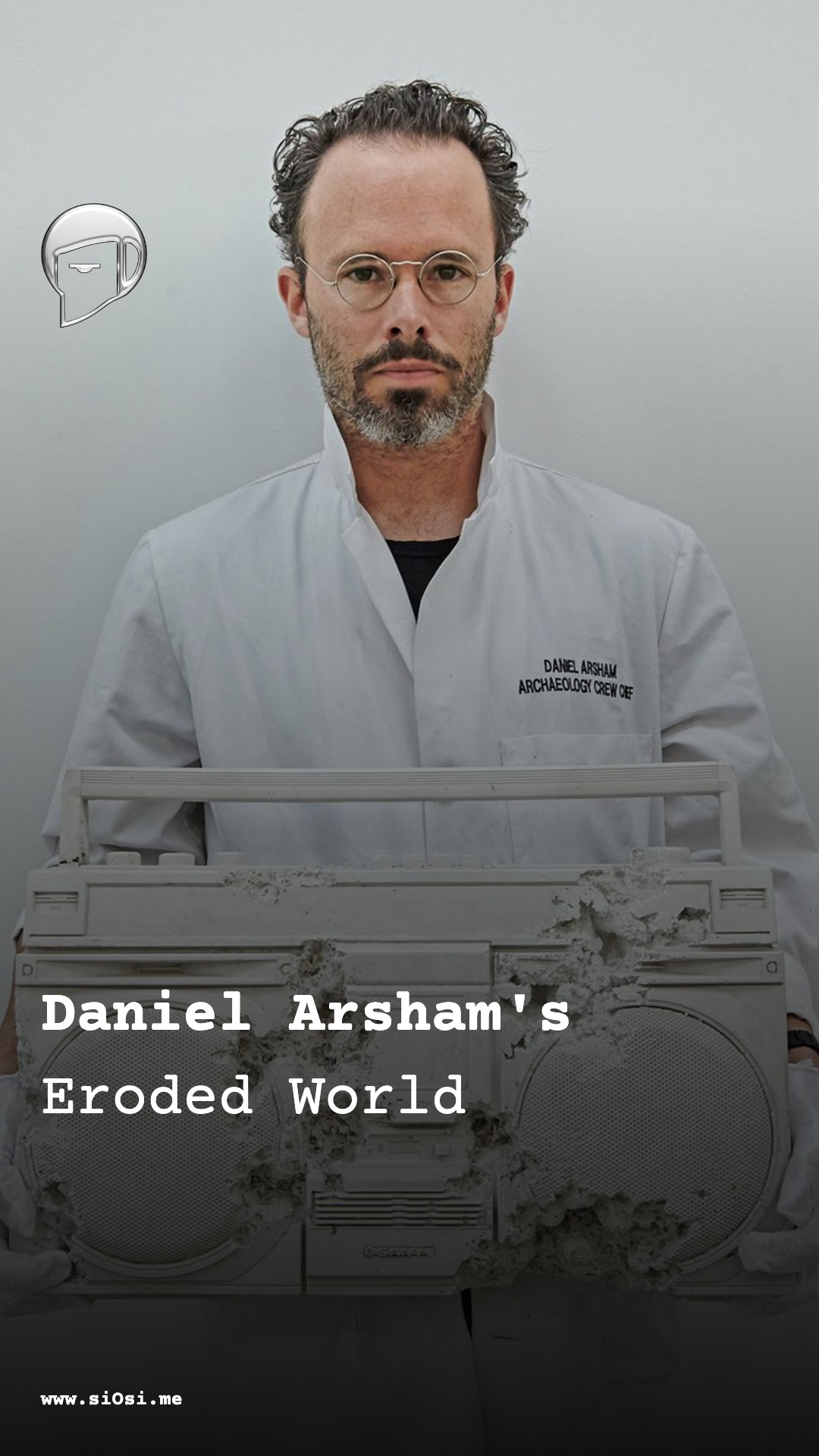
Imagine your headphones unearthed in a thousand years, edges soft and crystals spilling out like secrets. Daniel Arsham turns everyday objects into future relics with plaster, ash and quartz that catch the light in quiet bursts. His Dior letters crumbled at the seams yet bloomed with stones, turning a runway into an excavation site. The vibe feels both ancient and just waking up, like time decided to grow instead of decay.
Daniel Arsham, born in 1980, has fashioned an aesthetic world in which time does not simply pass but becomes visible in surface, fracture, and crystal. His work has altered contemporary perceptions of beauty, style, and material presence by treating familiar objects as if they were archaeological discoveries, eroded yet luminous, fragile yet somehow enduring.
At the core of Arsham’s visual language is the notion of “future relics” – contemporary items recast as artifacts that appear to have been unearthed thousands of years hence. Everyday tools of modern life, such as cameras, keyboards, headphones, sports equipment, even luggage, are remade in materials associated with geological time: plaster, cement, volcanic ash, sand, obsidian, pyrite, quartz, calcite, amethyst. The surfaces are deliberately distressed and pitted, as if eaten away, then interrupted by crystalline growths that spill from cavities and seams. This simultaneous erosion and accretion produces a striking tension: the object seems to be decomposing, yet the crystal formations suggest a countervailing movement of growth and repair. Arsham himself has spoken of this ambiguity, noting his fascination with crystals as agents of growth that complicate the perception of decay; the work hovers between disintegration and becoming, never fully one or the other.
Visually, these pieces have a particular silhouette: familiar outlines softened and blunted by imagined centuries of wear. Corners slump, edges lose their sharpness, surfaces appear chalky or sandy. The forms are rarely theatrical in outline; instead they cling to recognisable geometry but are gentled, as if time has abraded every assertive angle. Into these quiet silhouettes he cuts voids and craters. From within, crystals surge outward, catching the light, introducing points of optical intensity and granular texture against the matte, almost bone–like grounds. The aesthetic is at once archaeological and futuristic, as though classical statuary and industrial design had met in a mineral bath.
Color in Arsham’s universe is restrained yet emotionally precise. Many early and emblematic works appear nearly monochrome, in pale whites, greys, and stone–like neutrals, emphasizing texture and form over hue. The absence of strong color directs attention to the tactile qualities of rough plaster, powdery cement, and the cool gleam of crystalline inclusions. Later, and particularly after he began working with special glasses that altered his perception of color, he introduced more insistent tones via crystals themselves. In the large installation “Connecting Time” at the Moco Museum, for example, he uses blue and purple calcite crystals whose color emerges from the mineral structure rather than applied pigment, saturating the eroded objects with deep, luminous blues and violets. A glowing basketball, coated in amethyst–obsidian crystals and mounted like a strange beacon in front of a mirror, repeats this language: an object of sport transformed into a jewel–like fossil, radiating violet light and refracted self–image.
In fashion and style contexts, Arsham’s aesthetic has been meticulously translated into garments, accessories, and spatial design. His collaborations with Dior Men for Spring/Summer 2020 are perhaps the most complete articulation of his language within the fashion system. For the show, he sculpted monumental versions of the four letters of “Dior”, rendered as if eaten away by erosion, from whose cavities crystals and precious stones appeared to burst. The letters stand not simply as branding but as sculptural propositions: the house’s identity imagined as an artifact, its edges crumbling, its interior mineralised. The runway and set design extended this mood, surrounding the moving bodies of models with forms that suggested excavated ruins and speculative geology. The capsule of art objects developed around this collaboration followed the same principles. Watches, clocks, and other accessories were reinterpreted with artificial erosion and crystalline protrusions, packaged in boxes that echoed the Dior Oblique motif yet resembled aged wooden shipping crates, complete with hourglass and white gloves. Fashion here is presented not as seasonal novelty but as a set of things destined one day to become relics, already visibly marked by the passage of time.
This translation of erosion into sartorial language continues in Arsham’s broader fashion work. His clothing brand, Objects IV Life, builds a wardrobe of garments whose design reflects his sculptural processes. Pieces often appear utilitarian, with an emphasis on construction and durability, but carry subtle signs of temporal disturbance: washed fabrics, softened palettes, technical embroidery, and tonal finishes that echo his erosion sketches. In collaboration with surfboard makers and fashion designers, he has created capsules where monochrome garments feature delicate line work that reproduces the fissures and contour lines of his sculptures, rendering geological time as graphic surface. The result is a style that feels both contemporary and already historical, as if the clothing had been lived in for decades and yet carefully preserved.
Arsham’s impact on concepts of beauty and the body is indirect yet significant. His work seldom idealises the human figure in traditional terms; instead, it reframes the body’s environment – its objects, its architecture, its tools – as temporally unstable. In doing so, it invites viewers to experience their own presence as something situated within deep time. Installations such as the blue zen garden in Atlanta, constructed with sand, stone, and crystalline elements, establish contemplative spaces where the visitor’s movement is slow, choreographed, almost ritualistic. The erosion aesthetic here translates into a bodily disposition: the body becomes cautious, attentive, compelled to step lightly around fragile surfaces and luminous stones. In retail and exhibition settings, including fitting rooms designed for Dior Homme, his plaster erosions transform walls into quasi–geological strata, suggesting that the body trying on clothes is doing so in a transitional, historical layer rather than a neutral box. Beauty in these spaces is not about an unmarked, perfected body, but about a body aware of its own transience, surrounded by forms visibly in flux.
His use of light and contrast intensifies this mood. Crystals embedded in eroded surfaces catch ambient light and refract it into small, concentrated glows, set against the velvety dullness of plaster and ash. In installations where colored crystals dominate, the light takes on a chromatic character, bathing the scene in blues or purples that feel both aquatic and nocturnal. Mirrors, such as the full–length mirror in “Connecting Time”, fold the viewer into this circuitry: one sees oneself in proximity to glowing, eroded objects, the reflection punctuated by mineral flashes and the suggestion of future archaeology. Movement through such spaces acquires a cinematic quality, slow pans and pauses rather than quick gestures, as the eye is drawn repeatedly to points of light embedded in apparently ruined surfaces.
Emotionally, Arsham’s work today often evokes a subtle blend of melancholy and serenity. The eroded objects stage loss: of clarity, of structural integrity, of technological newness. Cameras and phones, once icons of cutting–edge design, appear fossilised, their buttons and screens eaten away, their surfaces crumbling. Yet the crystals within them speak of another trajectory, one of growth and internal transformation. As Arsham has observed, introducing crystals means that while objects seem to be falling apart, they might also be forming themselves into some new completeness. This duality yields an atmosphere that is not apocalyptic but reflective. His “future relics” invite viewers to consider how fashion, design, and technology will be remembered, what will remain, what will be buried, and what might slowly recrystallise into significance.
Within contemporary fashion culture, his influence has been to encourage a more archaeological attitude toward style. Collaborations with luxury houses and brands have foregrounded wear, patina, and temporal narrative over pure gloss. Accessories remade as eroded sculptures, luggage redesigned as aged artifacts, jewelry embedded within mineral–coated objects – all propose that luxury might reside not in untouched perfection but in the visible inscription of time and transformation. This has quietly shifted visual expectations: the crack, the crater, the mineral bloom become signs of aesthetic intention rather than damage.
Seen from today’s vantage, Daniel Arsham’s work has the emotional presence of a gentle haunting. Objects of our present are shown as if they already belonged to the past, yet they glow from within, carrying crystals like memories that have hardened into matter. The viewer is invited to inhabit a kind of speculative museum, where fashion, technology, and sport are displayed as fossils while still feeling strangely alive. The beauty here is contemplative, tactile, suffused with the knowledge that every surface is temporary and every silhouette subject to erosion, yet within that inevitability there is a quiet, mineral radiance that continues to grow.