
Sun in VirgoMoon in CapricornWaxing Gibbous
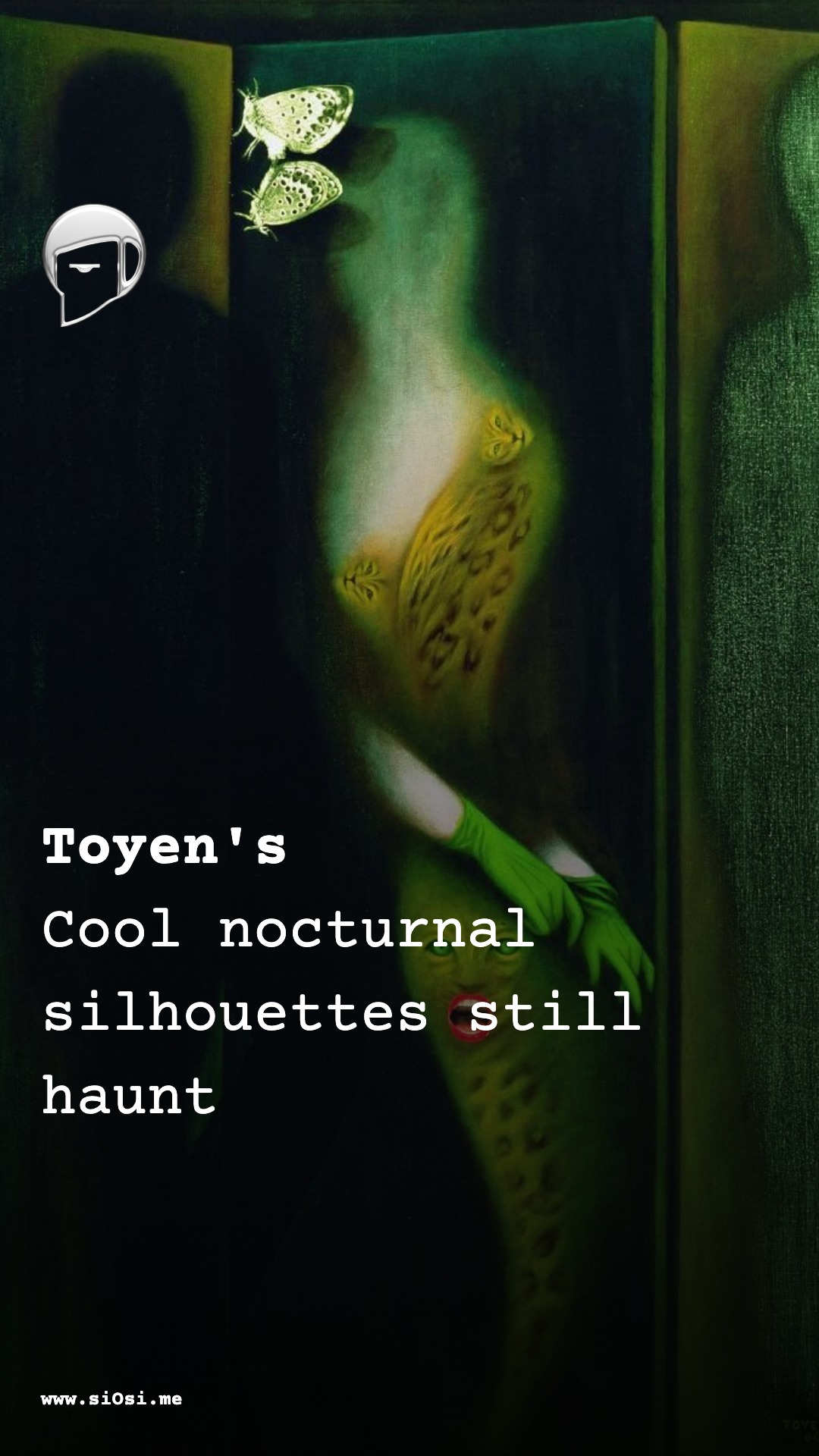
Toyen's cool nocturnal silhouettes still haunt
Toyen's cracked eggs and floating corsets hit like quiet shocks. Her mineral blues and greys turn empty space into something electric. Silhouettes hover without bodies, desire shows up in fragments and folds. The vibe stays icy yet charged, like moonlight on stone. It feels modern and mysterious all at once.
Toyen – born Marie Čermínová on 21 September 1902 – brought to twentieth‑century visual culture a singular, unsettling beauty: cold, nocturnal, erotic yet austere, poised between dream and mineral, body and absence. Her work transformed the visual language of surrealism by fusing poetry and painting into an atmosphere of convulsive beauty, where silhouettes dissolve, objects crack open, and desire speaks in fragments rather than poses.
The silhouette of absence
Toyen’s paintings are haunted by a distinctive silhouette of absence: clearly delineated figures or objects, held sharply against abstract, often near‑empty grounds that feel like unlit stages or psychic plateaus. Recurring forms – cracked eggs, eyeballs, shells, stones, corsets – appear as isolated presences, suspended in fields of color that rarely offer spatial comfort. The effect is architectural yet hollow: one senses rooms, caverns, deserts of the mind, but they remain stripped of narrative furnishings, leaving the viewer alone with a single, charged motif.
Early in her career, before fully turning to surrealism, Toyen and Jindřich Štyrský developed Artificialism, a mode of painting meant to inspire “poetic emotions that are not only optical, to stir a sensitivity that is not only visual”. This philosophy altered the surface itself: paint could be dripped or sprayed through grids or stencils, creating veiled, lyrical fields where line and color behave like verse rather than illustration. Even as her work later became more recognizably surrealist, this artificialist legacy remained in the way backgrounds operate – not as neutral supports, but as atmospheres, tonal poems against which figures seem to tremble.
Across the decades, her silhouette shifts from the geometric residue of Cubism to fragmented, ghostly outlines that barely cohere as bodies. Disembodied limbs, torsos, and partial anatomies float in nocturnal space, their contours precise yet emotionally blurred. The body, in Toyen’s hands, is rarely presented as a complete figure: it is an interrupted shape, a cut, a remainder, mapping erotic tension onto formal incompleteness.
Color as temperature and tremor
Toyen’s palette is typically cool, nocturnal, mineral: deep blues, greys, and blacks that evoke night, stone, and psychic shadow. These are punctuated by sudden, almost brutal flashes of white – cracked egg shells, eyeballs, glinting spheres – or the pale surfaces of skin, treated not warmly but with a kind of clinical luminosity. Color often functions as temperature: the scenes feel cold, as if lit by moonlight or by a lamp in a bare room, and this chill is part of their erotic charge.
In some artificialist works, color dissolves into lyrical gradations, thin veils where pigment seems sprayed, misted, or soaked rather than brushed. This produces a tactile sensation of humidity and vapor, as though the image were a weather system rather than a stable picture. Later surrealist pieces retain traces of this approach in their transitions from one shade to another – backgrounds moving from dark to less dark, from bruise‑like purples to stone‑green, creating the impression of slow breathing rather than simple flatness.
Red, when it appears, rarely behaves as decorative warmth. It often signals danger, erotic heat, or violence, folded into the broader exploration of fear, death and desire central to her motifs. Yet Toyen avoids sensational color; her eroticism is not painted in flamboyant hues but in restrained, almost ascetic tonalities, so that desire appears as tension within a subdued chromatic field.
Texture and surface: the skin of the image
Toyen’s surfaces frequently convey a paradoxical combination of smoothness and abrasion. Artificialist works introduced innovative methods – dripping or spraying paint through grids or stencils – that gave the canvas an indirect, mediated texture. The paint does not simply sit as a skin; it filters, stains, and shadows, as if the image were seen through thin fabric or mesh. This filtering contributes to the sense of secrecy: something in the scene is always partially concealed, even when formally explicit.
Her mature surrealist imagery develops a more mineral texture. Shells, stones, crystals and cracked eggs recur, rendered with a hard, polished clarity that contrasts with the more nebulous backgrounds. The viewer feels, almost physically, the smooth coldness of shells, the brittle edge of an eggshell, the opaque weight of stones. Against these, there are textures of cloth – rags, corsets, garments – that fold, sag, bind, or overflow into forms suggestive of labia, tongues, and vaginal openings. Cloth becomes not just a material but a metaphor for mutable flesh, its frayed edges and soft droop standing in for the body’s vulnerability and erotic ambiguity.
This play of hard and soft surfaces is central to Toyen’s sensuality. The eye moves from polished, almost jewel‑like objects to the precarious softness of fabric and skin, echoing the dialectic of pleasure and pain, constraint and release, that critics have noted in her exploration of erotic humor and sexual angst. The painting’s texture feels like a field where the viewer’s own bodily awareness is activated: one imagines touching cold stone, then suddenly encountering the yielding texture of cloth, or the imagined warmth of flesh hidden within folds.
Lines, shapes, and movement
Toyen’s line is typically crisp, decisive, and controlled, even when it delineates disturbing or uncertain forms. Objects stand out with sharply defined edges, almost graphic in their precision, contributing to the uncanny clarity often associated with surrealist dreams. Yet these lines rarely organize space in a classical manner; they occupy empty fields, hover, approach one another without resolving into clear narratives.
Geometric influence from her early Cubist period persists in certain compositional decisions: planes, angles, and broken contours structure space, but they are subverted by erotic and psychological themes. Spheres, ovals, elongated phallic shapes, and slit‑like openings form a quiet vocabulary of desire. These shapes often hover or overlap, suggesting potential movement – a sphere that might roll, a tongue‑like form that might extend – yet the scenes are held in a suspended moment, as if movement were permanently deferred.
Toyen’s treatment of movement is fundamentally latent. Rather than depicting bodies in action, she grants motion to the imagination. Shadowy ghosts, kissing animals, ambiguous hybrid forms appear in ways that imply encounter and contact, while the compositional stillness keeps them frozen in a tension between anticipation and memory. This latency heightens emotional presence: the viewer feels acutely the possibility of violence, tenderness, or erotic touch without seeing it unfold.
Erotic language and queer desire
From the beginning of her career, Toyen explored sexual fantasy and transgression with remarkable candor. Early works feature orgies, lesbian encounters, phallic toys, and women who are part animal – scenes that test and exceed conventional boundaries of representation. As she transitioned more fully into surrealism, her eroticism became veiled and symbolic, though no less intense. Imagery of labia, tongues, and vaginal openings is embedded in cloth, shadows, and abstracted organic forms.
Toyen’s drawings and lithographs are described as full of unconcealed queer desire and homoerotic themes, often granting women an active role in erotic exchange. Motifs include kissing animals, ghost‑like presences, ambiguous images that evoke queer aspects of sexuality and femininity – rags of cloth overflowing into vaginal forms, erotic tongues, shadows that suggest, rather than state, erotic contact. Her work navigates what surrealists termed convulsive beauty: beauty that shocks, unsettles, and disrupts habitual ways of seeing the body.
The emotional tenor of this erotic language is complex. In the 1930s, Toyen’s surrealist imagery stressed emptiness, fragmentation, and phantasmatic horror, radiating sexual angst and pain rather than titillation. Desire appears entangled with fear, anxiety, and the specter of violence. Yet humor and erotic play also surface, particularly in works that use phallic themes with a certain mocking lightness. Pleasure and pain exist in a delicate, unresolved dialectic, mirrored in the alternation of soft and hard forms, curved and sharp lines, intimate motifs and depersonalized space.
Gender, the body, and the refusal of fixed beauty
Toyen’s choice of a gender‑neutral pseudonym, and her tendency to be addressed with masculine grammatical forms in Czech contexts, inflect her visual practice with a refusal of fixed gendered identity. This refusal appears not as explicit manifesto but as aesthetic strategy. Figures in her work are frequently androgynous or partially disembodied, evading gender legibility. The corset – recurring motif in her paintings – symbolizes both the literal binding of women’s bodies and the social constraints that shape feminine identity. It appears as an object sometimes empty, sometimes ominously present, standing in for the absent torso or for the pressure exerted upon it.
Her philosophy of beauty resists classical ideals of wholeness, harmony, or ornamental femininity. Beauty resides in fracture, vacancy, and tension. The female body often appears not as a complete figure but as a site of anxiety, desire, and transformation – places of opening, cutting, binding, or dissolution. Child figures, dreams, mimicry, and the uncanny form a cluster of motifs through which she investigates gender and eroticism at the level of psychic experience rather than social spectacle.
In this visual world, beauty is inseparable from risk. The body is something that can be dismembered, hollowed out, bound, or merged with animal or mineral forms. Yet this very instability becomes a source of fascination. Toyen’s images invite a contemplation of the body as mutable, porous, open to queer desire and dream logic, resisting the neat categorization of male/female, active/passive, beautiful/ugly. Her aesthetic refuses the smooth, stable silhouette and instead offers beauty as a shimmering uncertainty.
Light, shadow, and emotional atmosphere
The lighting in Toyen’s paintings is rarely bright or centralized. It feels as if it comes from offstage, from an unspecified source, creating long shadows and pockets of darkness. This weak, oblique light gives her objects a quiet glow – the sheen on shells, the pale orb of an eyeball, the gloss of an egg’s inner surface – while keeping the surrounding space dim and uncertain. The visual sensation is akin to standing in a half‑lit room where only certain things are visible, and where each visible thing therefore becomes imbued with symbolic weight.
Shadow is not merely absence of light but an active participant in the narrative. Ghosts, ambiguous shapes, and traces of figures appear as if emerging from darkness, or dissolving back into it. Emptiness itself is lit: swathes of unoccupied space are given subtle tonal shifts, suggesting psychological rather than physical depth. The overall atmosphere is not dramatic in a theatrical sense; it is quietly oppressive, suffused with the feeling of something unspoken pressing against the edges of vision.
Emotionally, this produces a complex blend of melancholy, unease, and a distant, icy sensuality. Her paintings do not shout; they whisper with insistence. The viewer encounters desire that feels slowed, cooled, and filtered through dream and trauma. Violence and death, fear and eroticism, are intertwined as key topics in her exploration of surrealism, contributing to an environment in which beauty is always shadowed by loss or threat.
How Toyen’s work feels today
Seen today, Toyen’s images retain a striking contemporary resonance. Her interrogation of gender identities, eroticism, and queer desire speaks directly to present conversations, yet without losing the singular atmosphere of interwar and postwar European avant‑garde culture. The androgynous figures, the refusal of fixed bodily boundaries, the erotic abstractions of cloth and openings, all appear astonishingly modern, yet they are anchored in the intense poetic and political commitments of Prague and Paris surrealism.
Emotionally, her work feels magnetic and distant at once. The viewer is drawn into the images by their stark clarity of motif – an egg, an eye, a corset, a rag – and then held at a contemplative distance by the emptiness and abstraction around them. There is a kind of quiet glow in these objects, a small illumination in otherwise dark spaces, suggesting that desire, trauma, and memory are tiny lamps within a largely unlit psyche.
Toyen’s paintings still evoke a sense of frozen movement, an arrested gesture that never quite resolves. This unresolved quality gives them their lasting power. They continue to ask: what is a body, when stripped of its narrative roles and gendered costumes? What remains when beauty is no longer a matter of symmetry or adornment, but of fracture, vulnerability, and secret longing? In the cool, mineral light of her canvases, beauty becomes a delicate vibration between presence and disappearance – a sensation that, even now, feels profoundly alive.