
Sun in LibraMoon in TaurusWaning Gibbous
Diana Vreeland: Born to Turn Fashion Into Drama
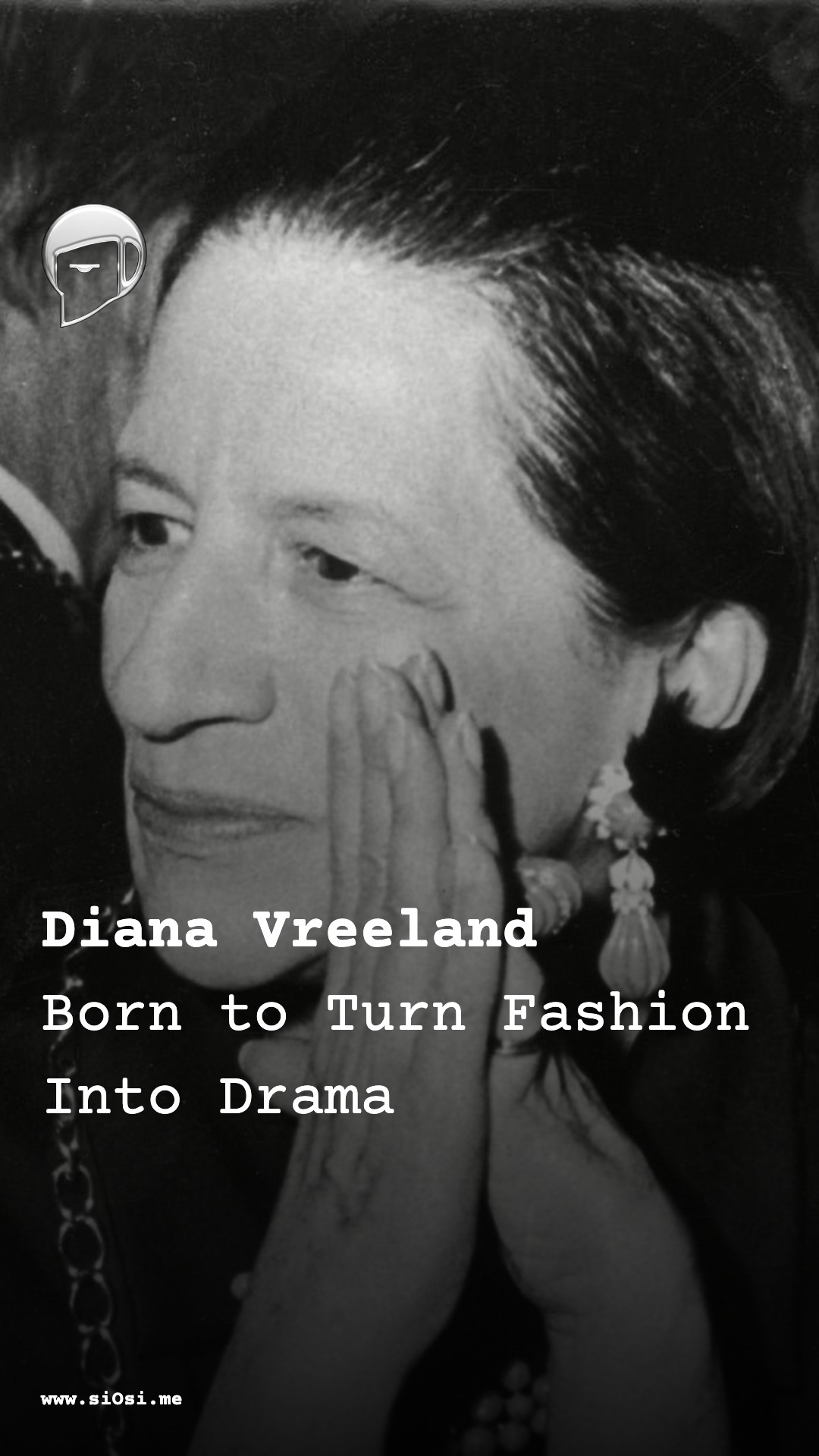
Diana Vreeland landed in 1903 ready to shake up every page and pose. She treated red like a pulse that made every other color pop and lacquered her hair until it framed her face like architecture. Her spreads at the magazines turned static shots into scenes of women in motion, jetting off or slicing through water. Exaggeration was her truth and she made sure every bump and stride counted. Style for her was never about fitting in, it was about owning the air around you.
Diana Vreeland’s birth in 1903 feels, in retrospect, like the quiet arrival of a sensibility that would later rearrange the visual grammar of twentieth‑century fashion – an eye that treated clothes, faces, and bodies as instruments of drama, exaggeration, and delight rather than mere surfaces to be corrected. Her impact is less a sequence of trends than a continuous vibration: an insistence that beauty is an atmosphere, a perfume of attitude and imagination that pervades a person and a page.
An editor of images, an architect of atmosphere
Vreeland’s editorial work at Harper’s Bazaar and later Vogue introduced a new kind of visual storytelling in fashion, in which clothes were only one note in a much larger composition of gesture, light, movement, and fantasy. She favored images that felt like scenes from a dream: women water‑skiing, boarding jet planes, inhabiting distant locales, their bodies depicted as agile, capable, and alive rather than posed ornaments. The pages she oversaw were described as revolutionary in editorial style, a shift away from static, frontally lit fashion documentation toward theatrical mise‑en‑scène.
This editorial revolution was tactile as well as conceptual. Fabrics were chosen and photographed for their ability to carry light and motion: liquid satins, crisp taffetas, sculptural wools, shimmering lamés, each handled in ways that made the reader almost feel the drape or rustle. Under her gaze, silhouettes lengthened and sharpened, waists sometimes loosened to allow a freer stride, hems swung with the momentum of bodies in action. Photographs were frequently high‑contrast – the cut of a coat against sky or shadow, the curve of a profile emerging from darkness – making fashion less about correctness and more about impact, like a single stroke of ink on white paper.
Signature visual language: red, lacquer, and exaggeration
Vreeland’s own appearance distilled her philosophy into a living emblem. Accounts describe her obsidian hair, lacquered back until it sharpened the lines of her face, creating a sleek, almost architectural frame. The hair was not soft or yielding; it was polished, directional, making the head itself an object of design. Her mouth, painted an uncompromising red, and the scarlet‑tipped index finger that “jabbed” at the air, became symbols of her presence – flashes of color and intent in a world of polite neutrals.
Her devotion to red reveals much about her aesthetic. She called red “the great clarifier – bright, cleansing, and revealing,” insisting that it “makes all the other colors beautiful.” In visual terms, red was for her a kind of moral color: it insists on decision, it refuses pallor, it demands that other hues declare themselves in relation to it. To grow bored with red would, she suggested, be like growing bored with a person one loves. Red, then, is not merely pigment; it is continuity and fervor, an emotional constant that binds a look together like a pulse.
Equally characteristic is her affection for exaggeration. “Exaggeration is my only reality,” she admitted, not as a confession of falsehood but as a declaration that truth in fashion lies in heightened form. In images under her leadership, lines were elongated, contrasts intensified, gestures made theatrical. She often preferred an unusual angle of the face, an emphatically arched brow, a nose that cut the air rather than receded from it. The result is a visual language based on emphasis rather than smoothing: the bump on the nose, the long neck, the high stature elevated by even higher heels, the “defect” turned into the focal point.
Her own makeup followed this philosophy. Accounts describe copious blush across forehead, ears, cheeks, and lips, transforming her face into a spectacle rather than a polished mask. The effect was not naturalism but apparition – an insistence that the face can be painted into a role. She refused to treat cosmetics as corrective; instead, they were instruments of character, making her, and the women she celebrated, appear as if lit from within by temperament.
Beauty as originality, allure as aura
For Vreeland, beauty was fundamentally tied to style, and style meant originality rather than conformity. “Style – all who have it share one thing: originality,” she remarked. In her universe, the most deadly enemy was “too much good taste,” which she regarded as boring. Taste, if merely aligned with convention, flattened difference. She preferred the jagged, the unexpected, the deliberately off‑balance harmony that makes an image linger in memory.
She articulated beauty as a changing idea, one that had shifted away from the blandly symmetrical face toward the marvelous body and good carriage – the way one stands, moves, and occupies space. A bump on the nose, a gap in the teeth, a long neck: these were not flaws to disguise, but features to expose, even to accentuate, so that they became a person’s “most beautiful part.” The instruction to “hold your head high” encapsulates her ethic: beauty begins in posture, in the refusal to diminish oneself.
Her notion of allure further refines this attitude. Allure, she suggested, is “something around you like a perfume or like a scent. It’s like memory… it pervades.” Here beauty is not a collection of proportions but an atmosphere: a subtle continuum of choices, textures, motions, glances. Allure clings to a person the way a faint fragrance does, intangible yet unmistakable. In the photographs assembled in her book Allure, commentators note her appreciation for unconventional beauty and a “perverse passion” for things not common or typical. She sought images that hold the viewer not through perfection but through an indefinable tension – the unusual angle, the unexpected pairing, the slightly unsettling scene.
Her insistence that “the only real elegance is in the mind” is crucial. Elegance, for Vreeland, starts as an interior clarity: if thought and sensibility are refined, the external expression, however eccentric, will cohere. Clothes, posture, grooming become extensions of mental poise. This view freed elegance from class and convention; it was not a matter of discreet pearls but of imaginative discipline.
Bodies in motion: freedom, fitness, and the bikini
Vreeland’s comments on the body are startlingly contemporary in their emphasis on freedom and fitness. “Nothing is more beautiful than freedom of the body,” she asserted, celebrating blue jeans as “the most beautiful things since the gondola” and declaring the bikini “the most important thing since the atom bomb.” The extremity of these statements, deliberately hyperbolic, points to the depth of her conviction: bodily liberty, the ability to move, to feel the body unconstrained by cumbersome fashions, is central to modern beauty.
She insisted that “the body must stay fit. Fit people like themselves much better.” Fitness, in her sense, is less about athleticism than about self‑liking, a physical ease that translates into carriage. A fit body, well carried, stands, walks, and sits with assurance; this assurance, she suggests, is more compelling than facial prettiness. In her imagery, bodies are shown water‑skiing, travelling, engaging with speed and landscape. Clothing must accommodate and celebrate this dynamism.
Her exaltation of the bikini reflects a radical shift in silhouette. Where earlier decades prized structured undergarments and dense fabrics, the bikini reduces coverage to a minimum, making the line of the torso, the curve of the waist, the tilt of the pelvis entirely visible. To call it “the most important thing since the atom bomb” is to acknowledge its explosiveness: it detonates earlier ideas of modesty and reorients the gaze toward athletic, sun‑touched skin, toward musculature and movement. Such garments, small as they are, transform the beach into a stage where the body’s confidence or self‑consciousness becomes instantly legible.
Her praise of blue jeans similarly redefines modern elegance. Jeans, cut close, slightly stiff yet yielding to wear, create a straight, democratic silhouette, one that traces the leg with honesty rather than idealization. They are functional, durable, imbued with work and leisure, and thus carry a sense of freedom that she found beautiful. In equating jeans with gondolas – both vehicles of movement – she suggests that beauty lies as much in the journey as in the object itself.
Fashion as intoxication, life in the dress
Vreeland described fashion as “the most intoxicating release from the banality of the world.” Intoxication here is not frivolity, but a necessary escape from dullness: color, cut, and embellishment release the mind into a realm of heightened sensation. Yet she was clear that the garment itself is not the destination. “It’s not about the dress you wear, but it’s about the life you lead in the dress,” she insisted, emphasizing that a new dress “doesn’t get you anywhere; it’s the life you’re living in the dress… and what you will do in it later.” The visual impact of fashion, therefore, is inseparable from narrative. A dress is a vessel for memory and intention.
This attitude shaped the way she staged clothes in magazines. Garments were rarely photographed as static objects; they were shown in situations that implied a story – the rush through an airport, the poised arrival, the leisurely sport. Textures were chosen to catch light at the moment of movement: a sleeve thrown back to reveal a lining, a skirt lifted by a stride, a coat belled by wind. The reader is invited to imagine not just how the clothes look, but what kind of life would fill them.
Her admiration for certain couturiers – such as her remark that a particular designer made “the most delicious evening clothes,” contrasted with her lament that “clothes aren’t delicious anymore” – expresses a sensory standard. “Delicious” here is a tactile, emotional term: fabric that caresses the skin, colors that feel edible, silhouettes that make the wearer nearly taste their own presence. When she complains that clothes have lost this quality, she is mourning a decline in sensuality, a flattening of fashion’s ability to stimulate the senses.
Emotional presence and the glow of her work today
Today, Vreeland’s work retains a distinctly emotional glow. Her pages and pronouncements still radiate a mixture of mischief, rigor, and ardent belief in personal distinctiveness. The images she fostered feel like fragments of an ongoing dream of modernity: planes, beaches, cities, bodies in motion, faces that do not apologize for their singular lines. They evoke a mood of buoyant seriousness – the sense that life is both play and art, that to dress and to carry one’s body is to participate in a theater of self.
Her impact on beauty and style can be felt in several persistent currents:
-
The enduring celebration of unconventional beauty, visible in contemporary fashion’s interest in asymmetry, unusual features, and diverse bodies, owes much to her insistence that “you don’t have to be born beautiful to be wildly attractive.” Attraction, in her view, is a composite of carriage, wit, and imaginative styling.
-
The notion that flaws should be highlighted rather than concealed – the gap in the teeth, the prominent nose, the extreme height – has seeped into how photographers, stylists, and makeup artists approach faces today. A strong feature is now often accentuated, not neutralized, echoing her advice to “let defects become the most beautiful part.”
-
The idea of fashion as an escape from banality, as an “intoxicating release,” still infuses editorial and runway practice. Color stories built around saturated reds, textures that demand touch, and staging that transports the viewer into imagined worlds are direct descendants of her sensibility.
Emotionally, her legacy feels like a continuous permission: a quiet but insistent voice telling the viewer to enlarge rather than reduce themselves, to choose exaggeration over timid neatness, to believe that elegance begins in the mind and radiates outward into posture, color, and line. The glow that her work evokes now is not nostalgic sweetness, but a bracing, clarifying light – like the red she adored – that makes other colors, and other lives, more beautiful by contrast.
Philosophy of beauty and the body
Vreeland’s philosophy can be distilled into a few intertwined convictions:
-
Beauty is dynamic. It resides in movement, in the freedom of the body, in the way a person inhabits clothing and space. Photographs of water‑skiing, jet travel, and sport are not incidental; they are core images of modern allure.
-
Style is originality made visible. True style is a unique configuration of features, tastes, and gestures, never mere compliance with prevailing norms. This originality should be cultivated, not softened.
-
Elegance begins in thought. The mind, if elegant, will produce an elegant body language, an elegant use of color, an elegant refusal of boredom. Cosmetics, clothes, and accessories are tools for expressing mental poise and curiosity.
-
Allure is an aura. It pervades a person like scent or memory, inseparable from the emotional resonance they carry. Visual elements – red lips, lacquered hair, dramatic silhouettes – are anchors for this aura but not its essence.
Her birth in 1903 prefigures a century in which beauty would repeatedly shift from surface to depth, from fixed ideals to fluid identities. Vreeland stands at the center of that process: a woman who turned pages into worlds, faces into icons of singularity, bodies into expressions of freedom. The visual, emotional, and tactile language she developed – red as clarifier, exaggeration as reality, allure as invisible fragrance – continues to shimmer in contemporary fashion, an archival light that still feels strangely, insistently modern.