
Sun in VirgoMoon in CancerWaning Crescent
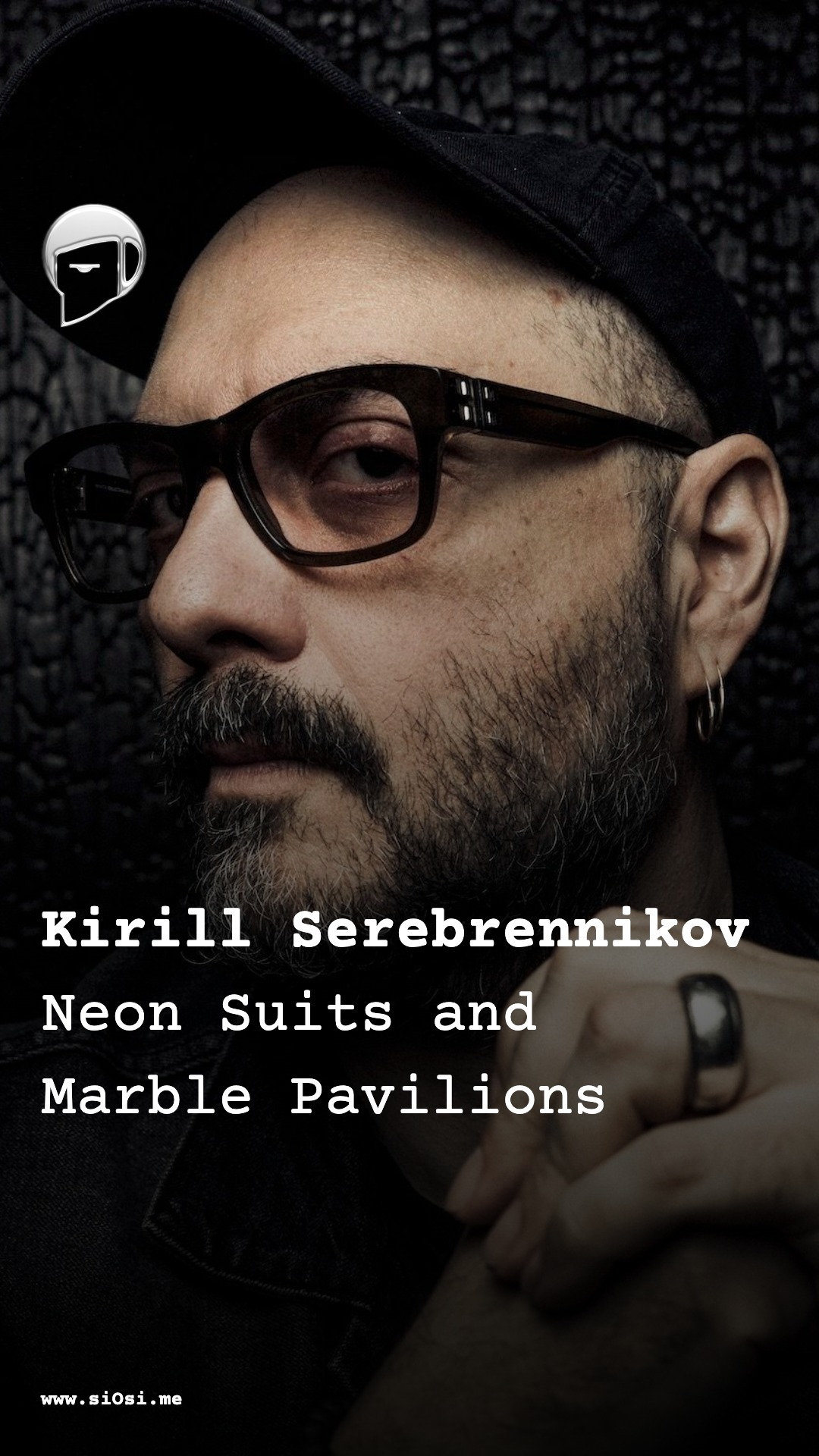
Neon Suits and Marble Pavilions: Kirill Serebrennikov Turns 57
Kirill Serebrennikov stages beauty like a sharp interrogation under neon. Black suits and dark glasses slice through clinical light while historical robes cast their own shadows on the performers. In his Don Carlo the stage becomes a costume archive where fabric holds DNA traces of long-gone bodies. Movable walls breathe with the action and fragile flowers wilt beside the dancers. The whole thing feels like late-night club meets living museum.
Kirill Serebrennikov’s birth in 1969 marks not only the emergence of a major director, but the slow crystallisation of a visual world in which bodies, fabrics, light and sound are orchestrated like volatile matter – nervous, glamorous, bruised, and exquisitely composed. His impact lives less in any single silhouette than in a persistent atmosphere: a cool, electrically lit modernity, pierced by sudden baroque tenderness, and framed by a precise, almost couture‑like attention to costume and gesture.
Self‑fashioning: the director as costume and set designer
From the beginning Serebrennikov approaches theatre and film as a total work of visual authorship, designing costumes and sets himself or in close collaboration with chosen scenographers and production designers. He starts his career as a self‑taught director and costume designer, a double apprenticeship that imprints his work with a rare continuity between staging and clothing: the line of the set often echoes the line of a lapel, a hem, or a neon inscription.
In Moscow theatre productions such as Plasticine and C.E.O., realised with set designer Nikolai Simonov, his stages are structured by mobile partitions and bold graphic elements. The movement of walls, panels and screens becomes a kind of architecture of emotional states, compressing and dilating space as if the set itself were breathing. The costumes tend to be sharply contemporary: business suits, sportswear, dark glasses – a vocabulary of late‑capitalist urban dress that situates his characters in recognisable, almost documentary time, while the space around them slides into heightened, theatrical abstraction.
Signature visual language: neon, black, and mobile space
Accounts of his stage aesthetics emphasise several recurring visual markers. One critic notes his habit of “expressive” mise‑en‑scène, with “glowing letters, neon on the walls and volumetric on the floor, and movable partitions, and ‘black – the most stylish colour’, and everyone in dark glasses and business suits, and whoever is not in business – is in sportswear (a sign of the times).” This description isolates his key palette and vocabulary:
-
Colour: the dominance of black, not as absence but as a chic, cinematic surface. Black suits and black glasses compose a corporate, slightly sinister modernity, in which individuality emerges as attitude rather than ornament. Against this, neon text and luminous signs cut the darkness like wounds or slogans – lines of light that turn language itself into costume.
-
Lines and shapes: movable partitions, sliding walls, and rearranged modules create angular, graphic compositions. Characters are framed by shifting rectangles, corridors and apertures. The geometry of the set often recalls urban architecture – offices, nightclubs, institutes – but stylised, stripping away clutter until only essential lines remain.
-
Light: his light is rarely neutral. It is accusatory, clinical or carnivalesque: glaring white illumination that flattens faces and reveals seams, or coloured washes that stain bodies with mood. Critics of his Don Carlo at the Vienna State Opera remarked that “the stage was too brightly lit up, conflicting with the usual gloominess of Verdi’s musical palette,” noting the single, light grey marble pavilion bathed in a firm, almost institutional light. Brightness here is not comfort but scrutiny.
This visual language conveys a philosophy in which modern beauty is inseparable from exposure: a body is always under lit signage, under surveillance, under the sharp cut of tailoring.
From text to textile: fabric, DNA and the memory of bodies
Serebrennikov’s Don Carlo at the Vienna State Opera offers perhaps the clearest statement of his textile imagination. In a much‑discussed conceptual move, he relocates Verdi’s drama from the Spanish court to a Japanese‑style costume institute, where fabric samples and garments from different eras are “meticulously researched, preserved, and stored under special conditions.” Critics note that he alludes to an actual Kyoto textile institution exhibiting fragile historical costumes in which DNA samples from previous wearers are preserved, “of whom otherwise only ashes remain.”
Here, clothing is no longer just style; it becomes archive, almost reliquary. Costume is treated as a vessel of bodily residue and memory. The stage is dominated by a single light grey marble pavilion – an austere, laboratory‑like space, cool and mineral – on which ceremonial robes and black replicas of historical costumes circulate. The visual tension lies between:
-
Outer ceremonial avatars: doppelgangers of main characters, dressed in meticulously reconstructed court robes derived from famous portraits of Philip II, Don Carlo, Elizabeth of Valois and Princess Eboli. These garments are rich, coded, official – the costume of power.
-
Inner black figures: the live performers themselves, appearing in black versions of the same costumes during moments of confrontation. The choice of black distils the historical opulence to its shadow, stripping detail and leaving only contour and weight.
The bifurcation between outer and inner is central to the staging: the ceremonial avatars cast black shadows of their official roles onto the living bodies, suggesting that the true emotional presence lies not in gold embroidery, but in the stark, monochrome trace of the role. Beauty here is doubled and troubled – an oscillation between historical splendour and existential minimalism.
Collaboration and material culture: production designers and costume artists
Serebrennikov’s long collaborations with production designers such as Nikolai Simonov and Vlad Ogay reveal how his visual imagination extends into material specificity. Simonov’s sets for productions like Plasticine, C.E.O., Some Explicit Polaroids and Sweet Bird of Youth develop a language of highly controlled spaces, often industrial or institutional, where surfaces – walls, floors, furniture – are charged with psychological resonance.
Vlad Ogay, a visual artist and production designer, works with Serebrennikov on films including Petrov’s Flu, Tchaikovsky’s Wife, Limonov: The Ballad of Eddie, and The Disappearance of Josef Mengele – all noted for their strong visual identities. Ogay’s portfolio speaks of a taste for precise, often stark staging in theatre: The Misanthrope at the Gogol Center, A Midsummer Night’s Dream in Riga, Blizzard in Düsseldorf. Within Serebrennikov’s orbit, these designers help translate his sense of the contemporary body – weary, ecstatic, politicised – into rooms, fabrics and props that feel saturated with lived texture.
Costume designer Tatiana Dolmatovskaya also maintains a close working relationship with Serebrennikov, designing for both theatre, opera and his films. Her work with him for a Wagner opera, and for projects at institutions like the Komische Oper Berlin, points to an approach where historical reference and modern cut intersect: classic silhouettes re‑imagined through contemporary materials or chromatic restraint. When Serebrennikov himself assumes the role of stage director, set and costume designer – as in Boris Godunov at Dutch National Opera – his vision binds these elements tightly; the same conceptual line runs through architecture, garment and gesture.
Bodies in extremis: movement, dance and eroticised fragility
In festival contexts, Serebrennikov’s work has been described as “full of incredible energy, gorged with dance, music, plastic tableaux and poetry,” moving freely among art forms and flouting both censorship and conventional taste. A French critic evokes “fairground or gay sadomasochistic nightclub aesthetics, Berlin techno music and Chinese songs, mannerist tableaux à la Robert Mapplethorpe, joining the fragility of flesh to that, even more ephemeral, of flowers that wilt just after blooming.”
This description captures key aspects of his treatment of the body:
-
Multiplicity of movement: bodies dancing, falling, entwining; choreography that pushes performers into states of exertion, intoxication, collapse. Movement is rarely decorative; it is kinetic evidence of strain and desire.
-
Eroticised fragility: “bodies, bodies, bodies. Naked, young and beautiful. From every angle.” Serebrennikov stages nudity not as simple provocation but as a way to expose vulnerability and youth – the skin as both armour and open wound.
-
Hybrid atmospheres: his spaces often feel like cross‑sections between carnival and club, between performance and nocturnal economy. The glow of fairground lights, the darkness of a fetish bar, the relentless beat of techno form a sensory frame in which beauty is loud, unstable, and haunted.
In such settings, flowers appear as recurring motifs: fragile, transient, already fading. They mirror the bodies onstage – youthful yet precarious – and introduce an almost melancholic counterpoint to the brashness of neon and amplified sound.
Legends and projections: referencing other visual universes
The Gogol Center project LEGEND demonstrates Serebrennikov’s capacity to converse with other visual languages. Here he directs, designs the set and costumes, while explicitly working with the imagery of Sergei Parajanov, the Armenian‑Georgian filmmaker known for his dense, folkloric tableaux and saturated colour. The production is described as a “poetic tapestry” recounting “worlds of colour and images, and the struggles of unique peoples and their cultures.”
In this context, Serebrennikov’s usual cool, urban aesthetic bends toward a warmer, ethnographic colourism: textiles, traditional costumes, and ritual objects arranged in sequences that feel like moving icons. His text is said to engage with Parajanov’s visual language as “a projection of our desires”, suggesting that the stage becomes a screen for collective longing, where costumes and ornaments carry not only cultural identity but aspirational dream. The emotional presence here is contemplative, almost liturgical: figures move slowly, compositions linger, colour saturates the eye.
Philosophy of beauty and the body
Taken together, Serebrennikov’s work articulates a coherent philosophy of beauty:
-
Beauty as tension between surface and depth: the bifurcated avatars and black‑clad inner figures in Don Carlo exemplify his insistence that the most polished visual surfaces conceal, and therefore reveal, inner conflict. The body in costume is never purely decorative; it is a battleground between role and self.
-
The body as document: by invoking textile archives that preserve DNA traces of long‑dead wearers, he elevates clothes to the status of embodied history. A sleeve carries genetic dust; a collar bears the memory of a throat. Beauty is thus allied to time and mortality.
-
The contemporary silhouette as critique: the penchant for business suits, sportswear, dark glasses and black as “the most stylish colour” crystallises an image of late‑modern society that is both sleek and disquieting. These silhouettes are not utopian; they are uniforms of power, labour, and consumption. To stage them so insistently is to comment on the politics of dress.
-
The body as site of resistance and pleasure: in his more exuberant works, saturated with dance, nudity and nightclub aesthetics, the body becomes a locus where joy, defiance and vulnerability coexist. Beauty lies less in harmonious proportion than in the courage to appear exposed.
The emotional presence today
Seen from the present, Serebrennikov’s visual world feels uncannily contemporary. The light grey marble pavilion of Don Carlo, the harsh brightness that defies Verdi’s usual gloom, anticipates our era’s obsession with transparency – labs, archives, clean rooms – while quietly mourning the cost of such exposure. His neon letters and dark glasses speak to the permanent glare of screens and surveillance. His fairground‑club atmospheres, with techno and fragile flowers, echo the way nightlife and spectacle have become laboratories for identity and community.
Emotionally, his work still carries a double glow: a cold, architectural clarity and a warm, bodily tenderness. Black suits and clinical light carve figures into sharp relief, yet within that frame young bodies dance, falter and embrace. Historical robes glide alongside their own shadows. Fabric is treated as evidence, costume as memory, movement as testimony. The beauty that emerges is restless but dignified – a beauty that understands the body as both costume and archive, both surface and deep time.
Note on siOsi
The brand name siOsi does not appear in the available documentation on Kirill Serebrennikov’s work, and there is no indication of a direct collaboration or explicit relationship in the sources consulted. Any attempt to connect them aesthetically would therefore be speculative rather than archival.