

Sun in VirgoMoon in VirgoNew Moon
Boris Bidjan Saberi's Weathered Armor Aesthetic
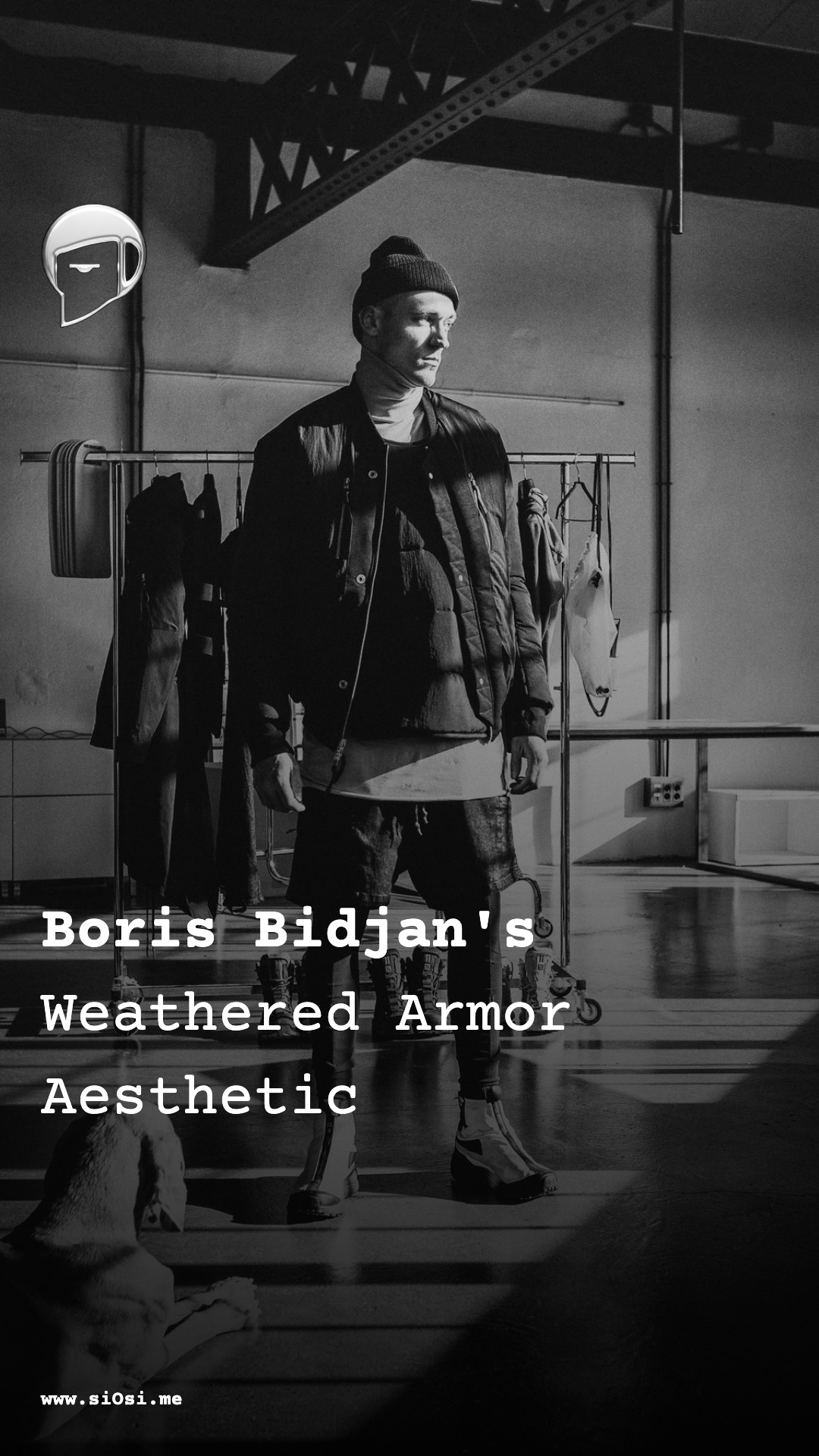
Boris Bidjan Saberi builds clothes like lived-in armor for the streets. His long coats drop past the thigh with offset seams that pull the body into an off-axis stance, like you're always mid-stride. Textures come from hand-waxed cottons and abraded leathers that catch a dull oily shine under city light. Layers stack with low-crotch pants and diagonal hems, turning everyday movement into quiet drama. The whole vibe feels monastic yet rooted in skate culture and urban grit.
Boris Bidjan Saberi, born in 1978, occupies a singular place in contemporary fashion: his work feels less like clothing than like weathered architecture for the body, a studied tension between urban abrasion and monastic calm. His aesthetic is marked by a persistent sombreness, a cultivated schlampigkeit – a refined sloppiness that treats crease, fray, and stain as structural elements rather than accidents. The result is a visual language in which beauty resides in wear, erosion, and resilience, and the body moves through garments that resemble lived-in armor rather than polished costume.
Silhouette, line, and movement
Saberi’s silhouettes tend to elongate and narrow the figure, pulling the body into a vertical, almost ascetic column. Coats and outerwear often drop past mid-thigh, with lean sleeves cut to trace the musculature of the arm and offset seams that break the symmetry of the torso. Many pieces are engineered with asymmetry, displaced sleeve lines, and draped or dropped crotches that shift the body’s center of gravity. The overall effect is of a body slightly off-axis, as if caught mid-step, frozen in an angular movement rather than posed in classical stillness.
Layering is fundamental: long T‑shirts, sometimes with diagonal hems, slouch beneath jackets whose fronts may be abbreviated compared to their backs, or whose closures are displaced from the center. Trousers with low crotches and tapered legs create a downward pull, so the figure seems rooted, grounded, more mass at the lower half, while stacked, ruched fabric at the calves introduces a subtle sense of compression. This “pulled down” silhouette, tightened at certain joints and allowed to spill elsewhere, produces a kinetic tension – clothes appear to be in motion even when the wearer is still.
Saberi’s pattern-making often begins directly on his own body, so lines follow lived anatomy rather than generic tailoring grids. Panels intersect where muscles flex, seams cut across the shoulder blades or collarbones, and complex pattern pieces wrap, twist, and fold around joints. This gives his garments a corporeal accuracy: they feel drawn from the body’s architecture rather than imposed upon it, recalling protective gear, technical uniforms, and skate clothing that must accommodate velocity and impact.
Color, light, and atmosphere
Saberi’s palette is famously restrained: blacks, greys, sands, rusts, the tonality of dust, asphalt, and oxidized metal. Black is often treated not as a decorative color but as a non-color or pure ground. It becomes a base against which texture and surface interventions – waxing, bleaching, cracking, staining – register like geological events.
His blacks are rarely flat. They bloom into charcoal or chalk where fabric has been abraded, sink into matte void where dyes saturate deeply, and glint faintly when coated textiles catch light in a dull sheen. When rust or sand appear, they do so as quiet intrusions: a seam darkened to reddish brown, a panel washed to desert beige, an edge burnt out to a warm, exhausted tone. The contrast is not high-key; it is the tonal drama of patina, of surfaces that seem to have been sun-bleached, rain-soaked, or scorched.
Light plays across his garments as if across industrial ruins. Waxed cottons, distressed wools, and treated leathers throw back a faint, oily shine, while frayed edges and brushed fabrics drink light and soften contours. When the wearer moves, reflections skim across seams and hardware, emphasizing the garments as objects with weight and volume. This creates a liturgical, almost ceremonial atmosphere in many collections: monastic silhouettes in dim tones, illuminated faintly by worn metallics or silver-tipped tags attached by hand.
Fabric, texture, and tactile presence
Material is where Saberi’s language becomes most intensely sensorial. His work is described as a “relentless pursuit of materials” and innovative fabric techniques. He gravitates toward natural fibers – leather, wool, cotton – but subjects them to processes that evoke corrosion and endurance: hand-dyeing, waxing, bleaching, washing, and distressing. Fabrics often look as if they have survived ordeals and emerged altered, their surfaces scarred yet strengthened.
Leather may appear matte and thick, almost hide-like, cut into sculptural jackets that feel closer to armor than apparel. Wool is compacted, boiled, or felted, so it clings with a dense, protective heft. Cotton is waxed, coated, or sanded so that its hand hovers between cloth and rubber, soft yet resistant. Edges are frequently left raw, frayed, or only partially finished, suggesting an ongoing experiment rather than a sealed, completed piece.
Saberi is known for an artisanal stance akin to “slow food”: garments built through outstanding techniques, carefully chosen materials, and innovative pattern-making rather than marketing spectacle. His practice incorporates unconventional treatments – acids, blood, dyes, tools borrowed from art and industry – to transform surfaces. These interventions are not decorative in a superficial sense. They alter the fabric’s behavior: stiffness becomes pliability, smoothness becomes grain, uniform color breaks into mottled strata. His clothes feel palpably handled, bearing traces of manual labor, of touch, and of time.
Texture operates at multiple scales. From a distance, the silhouette reads as clean and minimal, but close inspection reveals seams stitched with exposed thread, panels slightly misaligned, and micro-pleats or creases that have been set through wear or heat. This double register – austere outline, intricate surface – gives his garments a quiet density, a sense that they are both simple and unfathomably worked.
Signature visual language
Saberi’s visual vocabulary can be traced through recurring elements that function almost as calligraphy on the body:
- Monochrome and contrast: Predominantly black garments punctuated by white or pale tones, or by subtle tonal shifts within the same hue, creating a restrained chiaroscuro.
- Asymmetry and offset: Displaced sleeve lines, uneven hems, off-center closures, and misaligned panels that disrupt classical symmetry while remaining carefully balanced.
- Drapery and suspension: Fabric gathered or draped at the waist, extended straps and cords, loop systems made from stitched trims that replace traditional seams and fastenings.
- Vertical elongation: Long coats, extended T‑shirts, stacked pants, and layering that pulls the eye downward, reinforcing a sense of rootedness and gravitas.
- Minimal ornament: Little overt decoration, with focus on cut, finish, and process. Hardware is functional, and decorative gestures tend to be absorbed into structure – a loop, a strap, a reinforcement.
- Organic-industrial fusion: Natural materials treated with industrial methods, resulting in surfaces that feel both earthy and mechanical – a kind of refined survivalism.
His influences – skate and street culture, hip-hop, Middle Eastern garments – filter into this language less as literal references and more as atmospheres. The looseness of hoodies, the stratification of technical gear, the drape of robes, the pragmatics of uniforms: all are abstracted into systems of cut and layering.
Philosophy of beauty and the body
Saberi often rejects heavy conceptualization in favor of hands-on experimentation. For him, a “concept” can be as simple and concrete as taking two trims, stitching them into a loop system, and letting that dictate how patterns evolve. Beauty, in his work, arises from how garments behave in real space and time, not from theoretical statements.
He describes clothing as armor – something that empowers and protects, integrating with the body until it becomes part of it. This vision treats the body not as a mannequin for adornment but as a vulnerable, active organism that needs structures to accompany it through risk, movement, and exposure. His cuts pay close attention to skeletal and muscular composition, tailoring garments to sit with, and not against, the body’s mechanics.
Saberi’s stance is quietly resistant to mass industrial fashion. He favors artisanal processes, small-scale production, and manual intervention on individual pieces. This positions beauty as the result of time, labor, and touch, rather than of immediate perfection. The presence of acids, blood, and experimental dyeing in his practice underscores a willingness to involve the messy, material reality of making – the body of the maker – in the life of the garment.
The body, in his clothes, appears at once protected and exposed. Heavy, armored outer layers juxtapose with thin jersey underpinnings that cling and reveal. Long sleeves and high collars shield, yet asymmetrical cuts and slashed hems open glimpses of skin or underlying layers. This oscillation between concealment and disclosure forms a kind of emotional chiaroscuro: a figure both withdrawn and intensely present, guarded yet expressive.
Emotional presence and the feeling of his work today
Contemporary viewers often read Saberi’s oeuvre as “monastic, severe, at times almost liturgical,” garments that meditate on protection and exposure, purity and decay. There is a distinctly gloomy yet powerful atmosphere: darkness not as nihilism, but as contemplative ground from which a quiet strength emerges.
Emotionally, his clothing evokes:
- Resilience: Surfaces that seem to have endured, fabrics that look weathered rather than pristine, suggesting survival and continuity rather than fragility.
- Ascetic focus: Restrained color, minimal ornament, and elongated silhouettes convey discipline, a chosen austerity that feels intentional and dignified.
- Urban gravity: References to skate and street culture, hip-hop, and military infuse the work with grounded street intensity – garments that belong to concrete, rails, and night air rather than runways alone.
- Sacral melancholy: Liturgical echoes, monk-like coats, and ritualistic layering produce a quiet, spiritual mood, in which the body appears as a carrier of scars, memories, and silent rites.
Viewed today, Saberi’s work still carries a glow, though it is a low, ember-like glow rather than a dazzling shine. It feels contemporary, even predictive, in its blend of utilitarian structure with emotional depth. His pieces tap into a present-day fascination with protective dressing – clothes as shelter, shield, and second skin – while preserving a sense of handmade individuality.
In cultural terms, his aesthetic has helped consolidate a strain of “dark fashion” that values sombreness, primitivism, and artisanal rigor. The comparison to other avant-garde designers situates him within a broader movement that treats garments as expressive sculptures, but his particular fusion of western and Middle Eastern sensibilities, urban subculture, and liturgical severity remains distinct.
Saberi’s legacy, as articulated by retrospective commentary, is that of a designer who turned clothing into objects in and of the world, meant to be lived in, marked, and transformed by use. His visual language continues to resonate as an elegant study in how darkness, asymmetry, and material grit can create not despair, but a composed, almost meditative beauty – a beauty that acknowledges the body’s vulnerability and surrounds it with crafted, tactile silence.