
Sun in VirgoMoon in LibraNew Moon
Neon graffiti and punk couture born in 1953
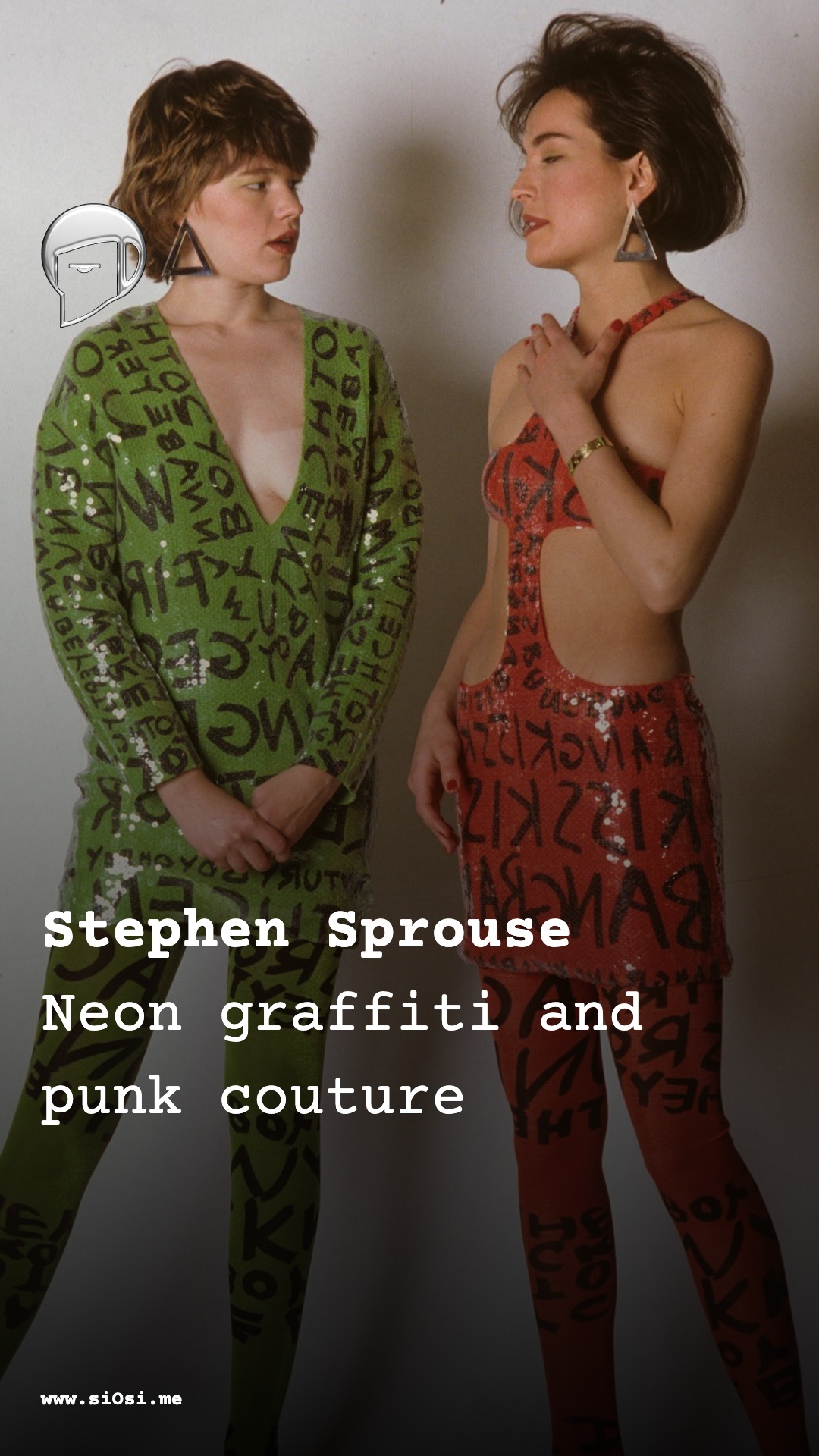
Neon exploded across the runway like a downtown club at 3am. Stephen Sprouse turned marker-scrawled graffiti into fluid patterns on chiffon and leather, letting Day-Glo pinks and electric greens pulse like city lights. His silhouettes stayed sharp and simple so the color and shine could do all the talking. Models looked like they had danced all night and were cutting through the show as a shortcut home. That mix of raw street energy and luxe finish still feels electric today.
Stephen Sprouse, born 12 September 1953, occupies a singular place in the visual history of late twentieth‑century style: he took the flicker of downtown neon, the rawness of punk, the graphic insistence of graffiti and translated them into a new kind of luxury, in which beauty was inseparable from velocity, noise and light. His work still feels like the afterimage of a nightclub – garments as luminous traces of movement, bodies half‑remembered in phosphorescent outline.
Visual language: neon, graffiti, speed
Sprouse’s signature aesthetic was built on Day‑Glo color, graffiti script and high‑shine, space‑age surfaces, composed with an almost painterly sense of rhythm. Critics and contemporaries repeatedly describe his palette in terms of extremity: pinks, greens and oranges tuned to the intensity of fluorescent signage, each hue pressed to the edge of perceptual comfort. On the runway these colors did not merely decorate the body, they seemed to radiate outward, claiming spatial territory around the wearer, creating an aura of artificial light in an otherwise dim room.
The graffiti, written with marker pens that scraped and looped across fabric, was central to this visual language. It was often illegible – words fractured into pattern, letters stretched into continuous lines that ran backwards and forwards across chiffon dresses, leather blazers, neon skirt suits. AnOther Magazine notes that his graffiti “eschewed language” and “pushed writing beyond the idea of a logo, deconstructing it into pure, instinctive pattern”, indicating a deliberate refusal of conventional branding in favor of a kind of automatic drawing. What might have been slogan becomes texture; text becomes something like sound waves, an optical echo of the music that hangs over his clothes.
Fabrics intensified this sensation of speed and artificiality. Contemporary accounts emphasise his use of space‑age materials, Velcro, and mirrored sequins, surfaces that catch and scatter light. The sequins in particular, “swarming with graffiti” across $1,500 dresses, convert the wearer into a moving screen on which urban marks flicker. Velcro straps and industrial closures introduce mechanical gestures into dressing: clothes that look as though they could be snapped on quickly, reconfigured, torn away, fitting the rhythm of club nights and subway corridors rather than drawing rooms.
Sprouse brought these elements together in silhouettes that were deceptively simple: T‑shirts, narrow pants, short dresses, close‑fitting jackets. Against the maelstrom of color and pattern, the lines of the garments remain almost minimal, like clean architectural forms flooded with street art. This restraint in cut heightens the drama of surface, allowing neon and graffiti to dominate the visual field, while the body, held within familiar forms, remains legible, agile, ready to move.
Silhouette, posture, and emotional presence
Photographs and runway descriptions from the early 1980s suggest a very particular bodily attitude in Sprouse’s work. Models appear as if caught mid‑escape: shoulders slightly hunched, strides long and careless, hair loose or aggressively styled, makeup sculpted but never pristine. A New York article quoted in Artnet observed that his runway figures looked “as though they’d spent the whole night partying and were using the runway as a shortcut home”, an image that captures the sense of lived‑in glamour. Clothes are not presented as static objects; they seem already inhabited, already used, still humming from the night before.
Silhouettes often hover between slim and slouch: skinny silk pants printed with Pop Art motifs; short dresses that skim but do not cling; jackets that are tailored yet slightly oversized, allowing the body to carry an air of casual disarray. This tension between precision and looseness gives Sprouse’s style its emotional charge. The wearer appears both composed and off‑kilter, impeccably curated and slightly unravelling. New York Times coverage at the time noted his “luxurious disarray”, extending even to his personal habits – Bloody Marys served in measuring cups, phone numbers written on his arm with felt marker – a domestic echo of the controlled chaos in the garments themselves.
Movement is central. Day‑Glo fabrics slice through space; sequins tremble with low light; graffiti lines follow the motion of walking, bending, dancing. Sprouse’s clothes rarely sit still in photographs; even in posed images, the energy is kinetic, as if the print might continue to travel off the edge of the fabric. This dynamic quality imbues the wearer with a kind of emotional electricity: one senses anticipation, restlessness, a refusal to be fully contained.
Philosophy of beauty: punk couture, uptown–downtown
Sprouse is frequently described as a pioneer of an “uptown sophistication with downtown punk and pop sensibility”, a mix that the CFDA later characterised as bridging “an unspoken gulf” between New York’s elite and its underground. Simon Doonan, reflecting on his impact, called his aesthetic “punk couture”, a phrase that encapsulates his attitude toward beauty and the body. Beauty, for Sprouse, was neither strictly polished nor purely anarchic; it emerged from the friction between precision tailoring and anti‑authoritarian surface.
He introduced street culture – graffiti, punk rock, grunge references – into clothing that was meticulously cut and often expensive. In doing so, he altered the emotional status of the body in fashion. The wearer is no longer a distant mannequin of perfection but a participant in urban life: someone who might ride the subway, listen to loud music, inhabit small apartments, yet still claim the optical intensity of luxury. This fusion of contexts articulates a democratic vision of glamour, in which the line between fine art, street art and fashion is deliberately blurred.
Sprouse’s fascination with Pop Art and space imagery further clarifies his philosophy. Silk pants photo‑printed with Pop Art, 3‑D prints developed in collaboration with NASA, T‑shirts bearing the NASA logo, all fold the language of mass media and technological aspiration into daily dress. The body becomes a site where high culture, low culture and futurist fantasy coalesce. In this view, beauty is not static; it is an ongoing negotiation between media images, technological dreams and the lived experience of the wearer.
His use of androgyny, noted in later reflections, underscores a challenge to conventional gendered beauty. Sprouse’s models often look sharp‑featured, angular, their clothing cutting across traditional masculine/feminine boundaries. The emotional presence is one of sensuality without softness, seduction carried by stance and gaze rather than by overtly erotic silhouettes. This androgynous cool feels especially contemporary, anticipating later explorations of gender fluidity in fashion.
Texture, color, and light as emotion
Sprouse’s textures are not merely tactile; they are emotional registers. Mirrored sequins, vinyl, high‑gloss synthetic fabrics and sheer chiffons operate like different instruments in a score. Sequins deliver glinting staccato, catching each flash of light; fluorescents wash the eye in broad strokes; graffiti lines beat a visual rhythm across the surface. The body wearing these clothes is enveloped in an environment of light, shadow and reflection, akin to the interiors of downtown clubs and galleries of the period.
The color stories in his collections often exist in deliberate high contrast: ultra‑saturated blocks of pink against electric green, deep black anchoring explosions of neon, cartoonish motifs interrupting monochrome fields. These contrasts create a mood of heightened alertness, as if the eye has been snapped awake. It is not a soothing palette; it vibrates, buzzes, carries the residue of nightlife and street signage. In the context of 1980s New York, such color reads as both celebration and warning: glamorous, but not safe; luminous, but slightly toxic.
Light, for Sprouse, seems almost a co‑author. Space‑age fabrics and reflective surfaces require illumination; they depend on spotlights, city glow, the intermittent flare of camera flash. In darkness, neon and metallics shift from exuberant to spectral, the garments like phosphorescent shadows around moving bodies. This dependence on light anchors his work firmly in an urban environment and gives it its enduring emotional tenor – an impression of nights spent in marginal spaces that, for a brief moment, feel like the center of the world.
Attitude toward the body and style
Sprouse’s clothes treat the body as both canvas and instrument. Graffiti traverses hips, chests, backs; Pop Art images wrap limbs; Velcro and straps imply that garments may be altered, adjusted, broken down. There is a subtle invitation to performance: to pull, fasten, unfasten, to let fabric swing. The body is not immobilised within couture; it participates in the making of the look.
Critics often emphasise his “exacting, raw, and widely experimental” approach. This duality – exacting yet raw – reveals a particular attitude toward bodily presence. Sprouse does not erase imperfection; rather, he frames it within sharp construction and deliberate chaos. A run in tights, a smudged pencil line of graffiti, a slightly skewed hem can coexist with immaculate cutting. The implied philosophy is that beauty can be heightened by traces of use, that glamour acquires depth when it accommodates disorder.
At the level of emotional register, his work projects defiance more than seduction, energy more than repose. The wearer of Sprouse appears unafraid of being seen, but equally uninterested in pleasing others. The clothes face outward – shouting in color, clattering in texture – yet the body inside remains self‑contained, almost private. This imbalance gives his style a curious tenderness: the garments act as armor made of light and graphics, protecting a figure who might otherwise be vulnerable in the city’s glare.
Contemporary resonance: afterglow and futurity
Today, Stephen Sprouse’s work continues to evoke a distinct glow: part nostalgia for a specific downtown moment, part recognition of its ongoing relevance. When luxury houses and contemporary designers revisit his graffiti scripts and Day‑Glo palette, they are not merely quoting an aesthetic; they are invoking a mood – the exhilarating collision of street and salon, of basement club and department store.
Viewed in archival images, his garments retain an almost uncanny contemporaneity. The androgynous silhouettes, the fusion of streetwear and high fashion, the insistence on graphic identity across the whole surface of the body feel entirely at ease in current fashion discourse. At the same time, the specific quality of his color and texture – that very 1980s intensity of neon, that analog, marker‑drawn graffiti – carries the melancholic beauty of a pre‑digital city. His work is suffused with the grain of film, the uneven glow of neon tubes, the material resistance of fabric to ink.
Emotionally, Sprouse’s legacy can be felt as a sustained chord of urban romanticism: a belief that the most battered walls, the most improvised marks, can be transformed into high beauty without losing their edge. In garments, this becomes a way of holding on to experiences of night, noise and risk, preserving them as color and line. His clothes still look as if they emerged from the backs of music venues and side streets, yet they also appear perfectly at home on a carefully lit runway. That dual presence – at once marginal and central – remains his most enduring contribution to fashion’s visual and emotional language.