
Sun in VirgoMoon in SagittariusFirst Quarter
Greta Garbo's Androgynous Lines and Slouch Hats
Greta Garbo turned a simple turtleneck into a full-on vertical statement that made every other neckline look loud. She strode through frames in tailored trousers and trench coats with collars flipped up like shields, never once teetering in heels. That slouch hat she loved dropped a shadow across her eyes and turned the face into pure architecture. The whole look felt like Art Deco made flesh: clean planes, matte red lips, and zero fuss. It still reads modern because it was never trying to perform.
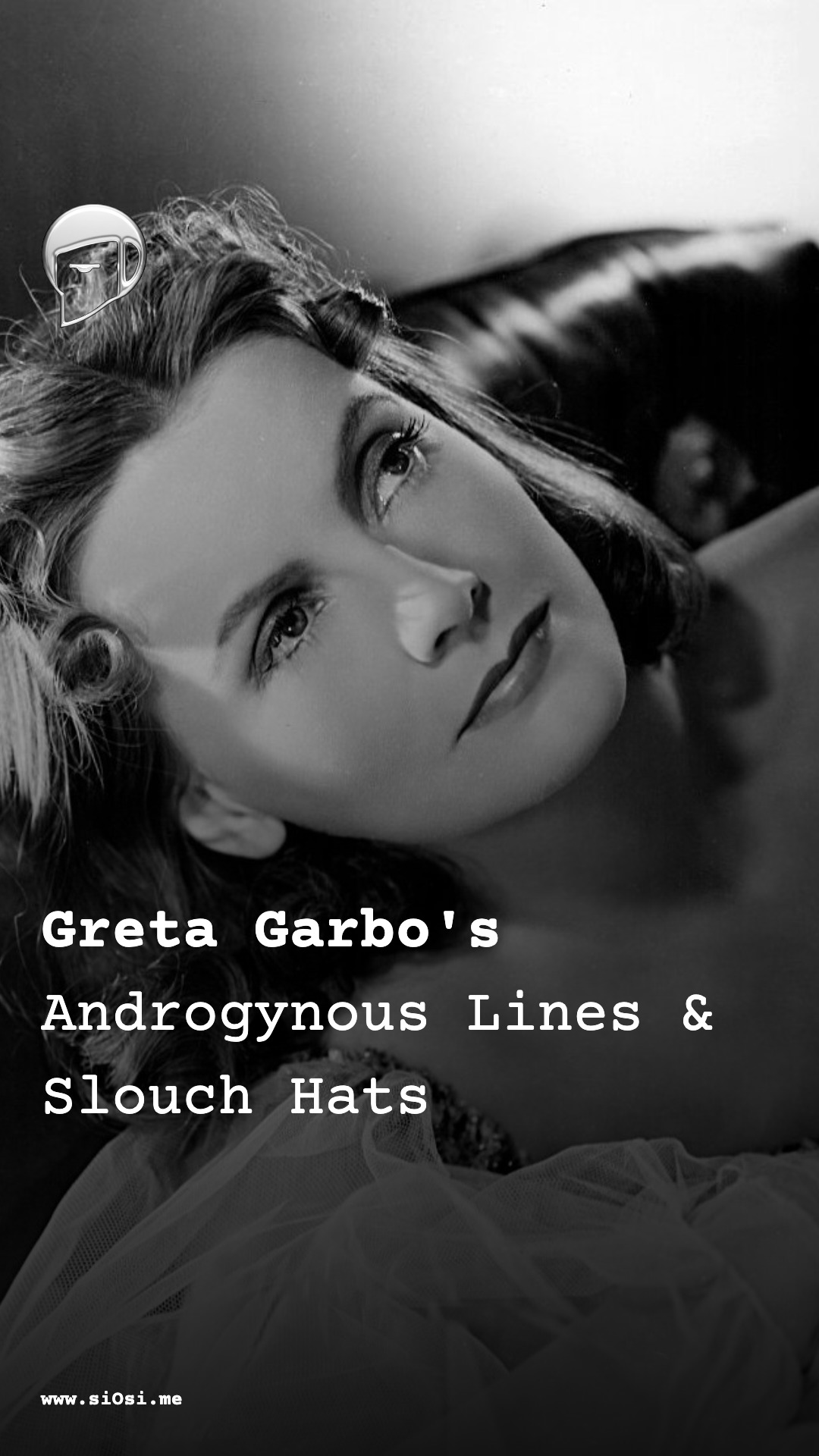
Greta Garbo, born 18 September 1905, entered cinema at the moment when modern beauty was learning to be abstracted – reduced to planes, shadows, and stillness. Her image did not merely adorn the screen; it re‑drew the coordinates of feminine style, making austerity sensual, androgyny luminous, and silence itself a kind of ornament.
Garbo’s face: architecture of light and restraint Her impact on beauty was first and foremost an impact of the face. Contemporary commentary repeatedly described her as “the face of the century,” “eternal,” “divine,” signalling that what audiences perceived was not simply prettiness but a sculptural presence that seemed to step outside time. Publicity stills and close‑ups emphasized an extraordinary complexion, a pale, even surface that took light with a velvety softness, interrupted only by the deliberate calligraphy of eyes and brows.
Her eye makeup was meticulously constructed: darkened, elongated lashes, carefully shaded lids, and strongly stylized brows that curved and arched with almost architectural control. In an era when cosmetics were becoming newly respectable, Hollywood stars helped normalize visible artifice – dark red lipstick, heavy mascara, and defined eyeliner – yet Garbo’s version of this new painted face was distinctive. The brows, highly arched and rounded, cut a clear, graphic line across the upper face, while the lips, typically matte and red, were shaped with disciplined symmetry rather than flirtatious softness. The result had a mask‑like quality that critics such as Roland Barthes read as a “mask‑effect”: a face that was both intensely expressive and mysteriously withheld, a surface that promised emotion but did not easily surrender it.
In photographs, the lighting often falls diagonally, chiselling cheekbones and hollowing the eye sockets so that bone and shadow collaborate to produce a feeling of remote intensity. This is Art Deco beauty: geometric yet fluid, modern yet strangely hieratic, as if the face were a polished relief carved from pale stone. Garbo’s features – full mouth, long nose, heavy‑lidded eyes – become less about individual idiosyncrasy and more about the way cinema can rearrange flesh into pure design.
Silhouette and movement: the androgynous body as erotic line If the face was a mask, the body was a line. Critics have written of the “angelical face and androgynous body” that together produced an unprecedented eroticism in Garbo’s screen presence. Her figure, tall, straight, and spare, lent itself to clothes that did not cling so much as articulate: trench coats, tweed suits, laced brogues, military‑style jackets, and trousers cut for stride rather than sway.
The costume designer Adrian was central to shaping this visual language. During the 1930s, he turned Garbo into one of the era’s most admired fashion icons, building a “Garbo girl” aesthetic that combined architectural clarity with fluid movement. His evening gowns for her were described as simultaneously architectural and flowing: long vertical panels, precise shoulders, and controlled drapery that allowed the fabric to fall in clean, unbroken lines, yet to move with a quiet, liquid grace when she walked. On screen, the effect is of a figure encased in light rather than in ornament – the dress becomes another plane in the composition, an extension of the geometry of her face.
Garbo’s androgyny was not merely a flirtation with menswear, but an integrated philosophy of dress. In The Single Standard (1929), the “brilliant idea” of wearing her lover’s shirt and pants was described as allowing men’s clothing to “burst onto the fashion scene of women’s wear,” accomplishing this more forcefully than even the innovations of Chanel. This was not only a costume choice but a re‑scaling of feminine silhouette: trousers that gave the legs a straight, unbroken contour; shirts that flattened the torso into a clean column; jackets that broadened the shoulders slightly and sharpened the line of the upper body.
Her tuxedo in The Single Standard became one of her most iconic fashion moments, a sharp black‑and‑white composition that redefined femininity by placing a female body inside the strict graphic grammar of male evening wear. Tailored trousers, chic trench coats, and structured shirts with stiff collars repeat this language of line and angle, their severity softened only by the movement of cloth and the curve of her face emerging from under a hat.
The garments invited different movement. In contrast to bias‑cut gowns which clung and rippled, Garbo’s preferred tailored silhouettes produced a body that strides rather than glides. She liked loose trousers “to stride in” and an old corduroy jacket with deep pockets “to sink her hands into,” creating not only a visual but a tactile aesthetic of comfort and self‑containment. On screen, this translates into a gait that is purposeful, with weight grounded in the heels, the upper body held high but relaxed – a refusal of ornamental fragility.
The everyday Garbo: turtlenecks, trench coats, hats and practical shoes Off screen, Garbo extended this androgynous clarity into a daily uniform that would come to define modern casual elegance. She introduced turtlenecks into women’s fashion: close to the neck, cutting a pure, unbroken vertical line from jaw to hem, the knit surface acting as a matte stage for the face. Worn with trousers or skirts, the turtleneck erases décolletage in favour of a cool, monolithic front, concentrating attention on the head, the hands, the posture.
Her trench coats, worn over sweaters, cinched at the waist with the collar upturned, became a template for a certain kind of intelligent modern chic. The coat is both shield and frame: the raised collar half‑conceals the neck, the belt defines the torso without exaggerating it, the long panels swish around the legs with a faint masculine authority. Photographs of Garbo in trench coat and beret show a figure whose clothes seem to repel gaze even as they attract it – privacy as style.
Hats were central to this self‑construction. She had a fondness for wide brims, turbans, headscarves – anything that could veil or edit the face, hiding a portion of herself “from the public eye.” Her preferred slouched felt hat, a fusion of fedora and relaxed brim, became so associated with her that such soft hats with high crown and drooping brim were simply called “Garbo” hats, igniting a craze among American women after she wore a man’s slouch hat in A Woman of Affairs (1928). The hat’s form is telling: the crown lifts the vertical axis of the head, the brim drops at an angle, cutting the eyes into shadow, while the felt surface absorbs light with a muted depth. It is a silhouette of withdrawal, turning the face into a secret.
Shoes follow the same logic of unadorned practicality. Garbo chose Oxfords and brogues instead of heels, insisting that “there’s nothing attractive about the suffering face of a girl with ill‑fitting shoes.” This remark captures her aesthetic ethic: beauty should never be the result of pain. The visual consequence is a step that is firm, unteetering; the body’s relationship to the ground is stable, and the line from shoe to trouser hem is straight, unbroken by a stiletto’s precarious angle.
Jewellery is reduced to a single string of pearls for evening and a solitary gold ring for day. These small points of light punctuate an otherwise streamlined surface, sparse notes in a visual score whose dominant quality is restraint.
Garbo and Art Deco: the modern icon Historically, Garbo has been read as an Art Deco icon, one of the cinema’s pivotal embodiments of that design style. Art Deco delights in smooth surfaces, sharp angles, stylized natural forms, and a glamorous modernity. Garbo’s screen image fits this perfectly. In modern‑set films of the 1920s, she appears amidst sleek interiors, geometric furniture, and reflective surfaces, her own body an extension of these forms.
Her face operates as a central motif: a pale oval framed by sleek hair, with eyebrows drawn in clear arcs and lips defined in sharp curves. These are Art Deco lines – precise, stylized, and abstracted from nature. The costumes reinforce the effect: cloche hats that hug the skull, trench coats that create clean verticals, and evening gowns whose long, flowing fabrics are arranged with architectural discipline. Garbo’s beauty is not ornamental in the old sense; it is constructed, like a facade, to catch and shape light.
The “floating face” described by scholars – a face that, in photographs and close‑ups, almost detaches from the body, hovering in a pool of darkness or mist – further aligns her with the Deco fascination with the mask and the icon. Once the conspicuous signs of fashion such as the “hairdo” were simplified or stripped away, Garbo’s image seemed to transcend trend, becoming an abstract emblem of modern beauty.
Philosophy of beauty and the body: comfort, privacy, and nonconformity At the level of attitude, Garbo’s style expressed a consistent philosophy. She did not follow trends; she generated them, often by choosing the opposite of expectation. Her choices were anchored in practicality and comfort – a simplicity that paradoxically produced a striking originality. Where other actresses embraced the bias‑cut gown and the long skirt length of the 1930s, she favoured tailored, simple clothes. Where high heels promised glamour, she chose flat lace‑ups. Where ornaments invited attention, she preferred streamlined surfaces and minimal jewellery.
This philosophy is inseparable from her desire for privacy. The use of hats, scarves, and high collars, the preference for concealing silhouettes, suggests a body that refuses to become spectacle, even as its image circulates endlessly. Beauty, for Garbo, is not exposure but control of visibility. The slouch hat that veils part of the face, the turtleneck that covers the throat, the trench coat collar turned up against the world – all these gestures transform the body into a secret that style protects.
Her androgyny is likewise ethical as well as aesthetic. Cross‑dressed images of Garbo show her in trousers, structured shirts with stiff collars, wide‑brimmed hats – clothing that emphasizes a character’s masculine presentation. In Queen Christina, her masculine clothes had an immediate impact on fashion, with heavy velvet jackets, double‑breasted coats, and broad linen collars appearing in American department stores, accessible versions of her film wardrobe. This adoption suggests that audiences recognized in Garbo’s dress a language of freedom: clothes that allowed women to occupy space with the same ease, stride, and authority as men.
Contemporary commentators describe her as “the first nonconformist,” the originator of the androgynous look that later stars would develop. Yet her nonconformity is quiet, almost ascetic. She does not flaunt masculine dress as provocation; rather, she inhabits it as though it were simply the most sensible, dignified way to clothe her body. The visual effect is radical, but the attitude is calm.
Enduring emotional and visual presence Today, Garbo’s image still carries a particular emotion: a cool, unhurried glow that mixes detachment with vulnerability. The eyes – heavy‑lidded, framed in dark lashes and strong brows – seem to regard the viewer from a distance that is not quite aloof and not quite inviting. The mouth, often closed or only faintly parted, holds its secrets. In still photographs inspired by Edward Steichen’s portraits of her in 1928, her hair and makeup are arranged to echo this aura: sleek waves, sculpted brows, and a neutral yet luminous complexion that makes the face appear suspended in soft shadow.
Her style feels contemporary precisely because it resists fuss. Turtlenecks, trench coats, brogues, wide‑brimmed hats, tailored trousers – these are staples of modern wardrobes, and in Garbo’s hands they already carried a sense of effortless, unornamented sophistication. The androgynous combinations she pioneered continue to haunt the runway and the street: tuxedos worn by women, masculine shoes with feminine faces, trousers as default rather than daring.
Emotionally, her visual language evokes solitude more than glamour. The streamlined clothes, the shielding hats, the minimal jewellery, the practical shoes, the careful but unsmiling maquillage – all suggest a person who moves through the world in a state of controlled inwardness. Yet this inwardness is what makes the image radiant. The camera records a body that refuses to perform incessantly, and in that refusal lies the peculiar intensity of Garbo’s beauty.
The glow that remains is not that of ornament but of form: the glow of a face that has learned to be architecture, a body that has become line, a style that conceived beauty as an art of restraint, comfort, and secrecy.