
Sun in LibraMoon in AriesFull Moon · Harvest Moon
Michael Dweck and the Hazy Glow of Montauk Youth
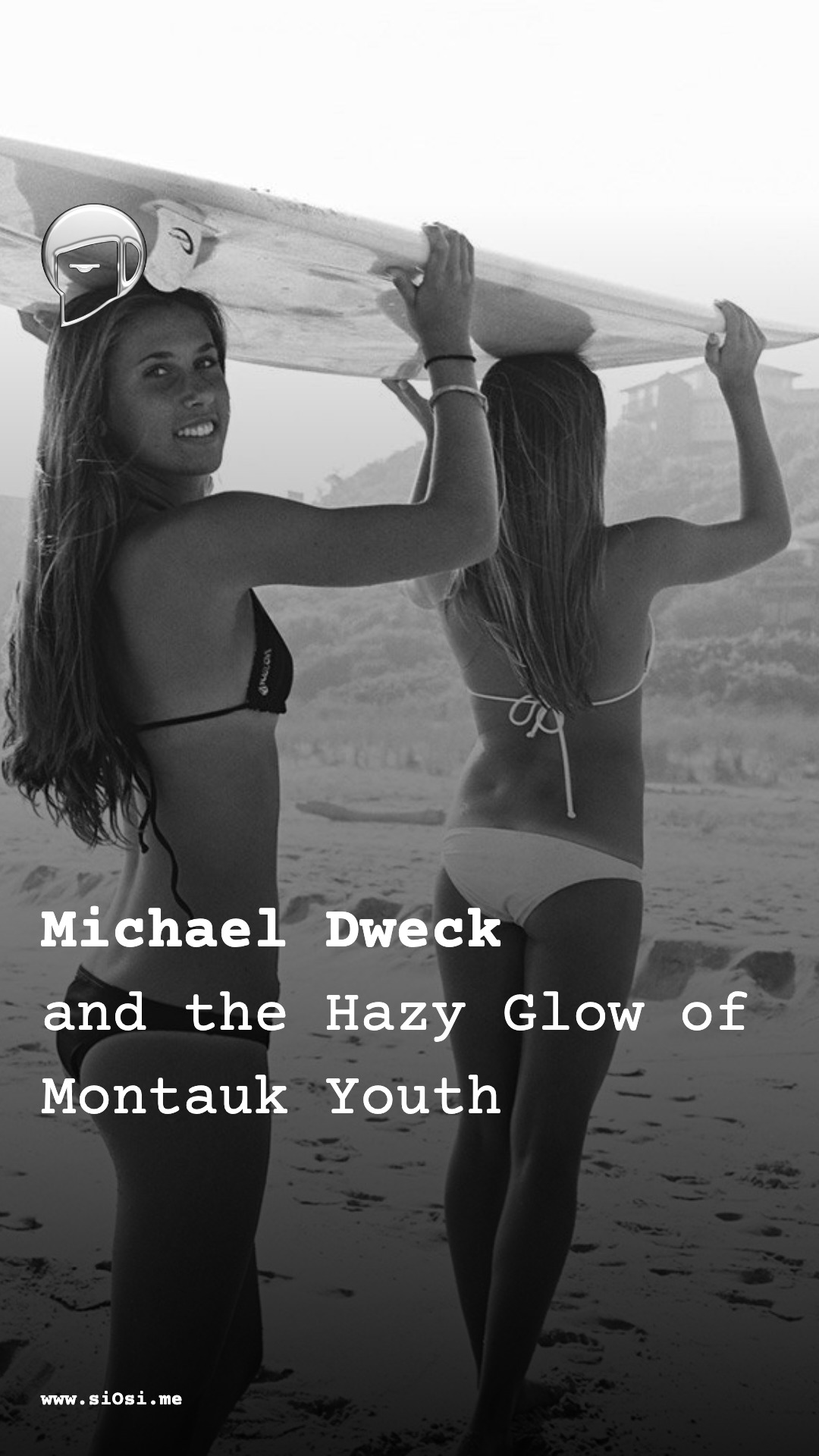
Salt spray and soft light turned ordinary surfers into legends. Michael Dweck froze Montauk’s bronzed silhouettes against that famous humid haze where edges melt and skin glows. No Photoshop, just real film catching wind-tangled hair and faded board shorts at the edge of the tide. His frames make youth feel both endless and already slipping away. Every shot whispers a coastal paradise caught mid-fade.
Michael Dweck’s work inhabits a precise intersection of sensuality, atmosphere, and mythic youth, casting the body and its environments as instruments of light, movement, and quiet seduction. Across surf coasts, racetracks, underwater realms, and Havana interiors, his images refine a visual language in which beauty is less an ornament than a condition of being – sun‑struck, water‑blurred, poised between paradise and its slow erosion.
Dweck was born in 1957 and first gained wide recognition with The End: Montauk, N.Y. (2004), a photographic cycle that has become a touchstone in contemporary visual culture’s imagination of coastal youth and surf romanticism. The project portrays Montauk’s old fishing community and its surfing subculture as a “real‑world paradise lost,” an American Arcadia of summer, youth, and erotic possibility. The images linger on bronzed bodies, boards, sand, and the mutable edges of sea and sky, blending nostalgia and fantasy with documentary observation. In fashion and beauty terms, the series crystallizes a visual ideal: tanned skin, wind‑tangled hair, salt‑softened fabrics, and lean silhouettes caught against a low, diffuse light that seems to caress more than illuminate.
Signature visual language: light, bodies, and atmosphere
Critics and galleries repeatedly return to Dweck’s handling of light as the core of his aesthetic. In Montauk, he describes the East End light as “so diffuse because of the humidity,” insisting that the softness is a natural condition rather than a digital construction: “There’s no Photoshop. I don’t use a digital camera. There’s no tricks. Everybody to me looks like that.” This insistence on film, humidity, and atmosphere gives his images an almost powdery grain. Skin appears luminous but never clinical, as though seen through sea spray or late‑afternoon haze.
His work repeatedly explores refraction – lens, water, and light combined to break the body into painterly fragments. In interviews he links this interest to studies of Impressionism, experimenting with how light bends and scatters across surfaces. The result is a visual language in which outlines are softened, edges bleed, and the human figure can dissolve into swirls of brightness and shadow. In the “Mermaid” series, the female form is abstracted “in a painterly swirl of light and watery refractions,” celebrating a kind of spiritual transformation achieved by shedding clothes and psychic weight in an underwater world. Here beauty is rendered as motion and translucence: hair flowing like seaweed, limbs floating, bodies neither posed nor fully visible, but glimpsed as currents of light and flesh.
Compositionally, Dweck works “always in narrative series,” with each photograph contributing to a larger atmosphere or story. He favors sequences that build a rhythm – surfers moving through waves, racers circling a track, Havana interiors opening into each other – so that the viewer experiences beauty as a cumulative mood rather than a single iconic image.
Silhouette, texture, and the sensual surf imaginary
In The End: Montauk, N.Y., Dweck’s silhouettes are spare and elongated: long‑limbed surfers, narrow boards, horizon lines that stretch without interruption. Bodies are often photographed in lateral profile or three‑quarter view, emphasizing the line from shoulder to hip, hip to calf – an aesthetic that recalls both classical athletic sculpture and 1970s surf photography. Yet the atmosphere is distinctly early‑21st‑century: there is an ease in posture, a casualness in bare feet on boardwalks, that feels aligned with contemporary bohemian style.
Textures are crucial. Sand and water become tactile fields, while clothing – when present – is usually soft, faded, and functional: worn T‑shirts, bikinis, board shorts. In many images, clothing disappears altogether, replaced by the texture of skin itself. The Observer describes “idyllic lives and landscapes” and notes that some shots focus on natural beauty, others on “beautiful women, many sans clothing,” all bathed in “enchanting, flattering light.” The sensuality here is understated. Dweck’s stated interest is “seduction, not desire,” and “being forever young” as a recurring thread in his work. This distinction is significant in aesthetic terms: seduction in his images is a tonal quality – a way the camera lingers, the body reclines, the light strokes surfaces – rather than explicit eroticism.
The Harper’s Bazaar account of his Montauk work describes “stunning black and whites of a bohemian‑influenced Montauk,” capturing the town before the influx of high finance and nightlife culture. Black and white here serves as a kind of temporal filter, stripping color to emphasize bone structure, shadow, and contour, giving the surf scene a timeless glamour. Another Bazaar piece notes that The End began as an attempt to “build creative walls around a very particular, cloistered scene–its characters, its setting, its lifestyle” and then capture an “idealized impression” of that world. The idea of “creative walls” suggests an almost fashion‑editorial approach: a circumscribed universe of bodies, props, and light conditions within which beauty can be studied and mythologized.
Philosophy of beauty and the body
Across interviews and critical texts, a clear philosophy emerges: beauty is located in youth, privilege, and environments in flux, yet Dweck’s gaze is more atmospheric than judgmental. The gallery description of his practice notes that he is “known for his seductive photographic style and pursuit of alluring subject matter, principally the female form and locales that offer their own particular enchantments.” His overarching narrative is described as a “somewhat upended version of the theme Paradise Lost and Regained,” favoring “privilege, youth, beauty, and the temptations of the flesh,” yet always recording and fictionalizing what is “inevitably receding and thus ever elusive.”
In his own words, he speaks of capturing “places that are going through change, that are isolated – Montauk, Cuba, Aripeka,” pairing the idea of “being forever young” with seduction. Beauty, in this formulation, is temporal: a moment of grace before transformation, the shimmer on the surface of a culture about to shift. In the Habana Libre project, he describes trying to create a “freewheeling atmosphere within very controlled environment,” framing large ideas in “simpler settings” and letting them “bloom.” He prefers to start with a notion, find subjects that embody it, then “pull it from them and their motion,” allowing “alluring human forms and their subtle suggestions, the faces of culture in transition, the gulf between perfect seduction and dull, reductive sexuality” to shape the image. There is a nearly choreographic understanding of the body here – the photograph is not posed so much as coaxed, with motion and atmosphere determining the final beauty.
His approach to women, especially in the “Mermaid” series, has been described by a gallery director as capturing women “in our natural state without any inhibitions: light, lively, carefree and confident.” The series suggests an ideal of liberated femininity: unclothed not for display, but to shed social weight; underwater, removed from gravity and gaze; dissolved into refractions of light. The emphasis on “spiritual transformation” and a meditative isolation positions beauty as internal light made visible, not merely external adornment.
Cinematic extension: movement, speed, and hypnotic rhythm
Dweck’s transition into filmmaking with The Last Race retains this aesthetic and extends it into motion. Critics describe the film as “a surprisingly beautiful and immersive examination of the dying world of stock car racing on Long Island,” with racing scenes that create an “impressionistic, hypnotic effect” searching for emotional truth rather than literal representation. Another critic attributes this aesthetic directly to Dweck’s background as a photographer. Visually, stock car racing is an unlikely subject for beauty, yet under his lens it becomes another ritual of light and velocity: headlights in dusk, dust rising from tracks, bodies and machines looping in rhythmic circuits.
The impressionistic style – blurred motion, rhythmic repetition, attention to surfaces – aligns with his earlier work on surf and water. Movement becomes an aesthetic element akin to fabric or hairstyle, shaping the emotional presence of the image. The cars are less industrial objects than extensions of bodies, and the track a kind of horizontal catwalk of speed. In the context of fashion and style, one can see how Dweck’s attention to line and motion migrates from surfboards and swimmers to vehicles and crowds, preserving a consistent visual ethos: youth and subculture seen at the moment just before disappearance, rendered with a hypnotic grace.
Today’s emotional resonance
Contemporary commentary continues to frame Dweck’s imagery as “exhilarating, sensual and provocative, with a sexy and hypnotic visual rhythm.” His photographs of surfers in Montauk are still circulated as emblems of summer freedom, their bronzed bodies and gentle sea light evoking an almost archetypal coastal glamour. The observer who notes Montauk’s “lasting allure” speaks of “idyllic lives and landscapes,” in which natural beauty and human bodies cohabit in a state of sun‑warmed ease.
At the same time, there is a faint melancholia that adheres to the images today. The End was from the outset an elegy for a way of life “at once fading and being reinvented with each new season,” a “paradise lost” that is also perpetually reimagined. In the years since, Montauk itself has transformed, and Dweck’s photographs have acquired the aura of a visual archive of a more intimate, bohemian coastline. Their beauty feels both immediate and historical: the tan lines, surfboards, and offhand nudity read as tokens of a specific early‑2000s surf chic, yet the underlying vocabulary of light, youth, and sea remains timeless.
His underwater mermaids still suggest a quiet utopianism of the body: a desire for weightlessness, privacy, and a reconciliation between sensuality and spiritual calm. The Havana work, with its controlled yet freewheeling atmosphere and focus on “faces of culture in transition,” resonates in an era acutely aware of cultural change and gentrification. Across these settings, the emotional glow of Dweck’s work today is one of suspended time: a luminous pause before the inevitable movement of history, in which bodies, places, and styles hold briefly to an ideal of ease.
Lineage and influence in fashion, beauty, and style
While Dweck is positioned primarily as a fine‑art photographer and filmmaker, the stylistic vocabulary of his images aligns strongly with fashion editorial aesthetics. His repeated focus on narrative series, alluring human forms, and atmospheric settings echoes the structure of fashion campaigns, and his framing of “privilege, youth, beauty, and the temptations of the flesh” as a kind of paradise lost mirrors the mood of many luxury and coastal lifestyle images. The Harper’s Bazaar coverage, which presents his Montauk photographs in a fashion‑culture context, underscores this alignment. The tanned surfers and “pretty people” become avatars of a particular style of bohemian chic: minimal clothing, maximal light, an attitude of relaxed entitlement.
Moreover, his self‑conscious differentiation between “perfect seduction” and “dull, reductive sexuality,” and his preference for subtle suggestion rather than overt display, mark an aesthetic stance that has influenced how bodies are framed in aspirational imagery. Beauty here is always part of a larger atmosphere – a mood of leisure, isolation, and suspended time – rather than an isolated glamour shot. In this sense, Dweck’s work participates in a broader cultural turn toward lifestyle narratives in images of fashion and beauty, in which context and environment are integral to how the body is perceived.
The enduring emotional presence of his work lies in its ability to make youth and sensuality feel both intimate and mythic. Whether surf, mermaid, racer, or Havana interior, each image offers a small, carefully lit universe in which beauty is not merely seen but remembered – as if one were looking at the visual residue of a summer already past, a race already run, a dive already surfaced.