
Sun in VirgoMoon in GeminiThird Quarter
Psycho’s restraint still rewrote beauty
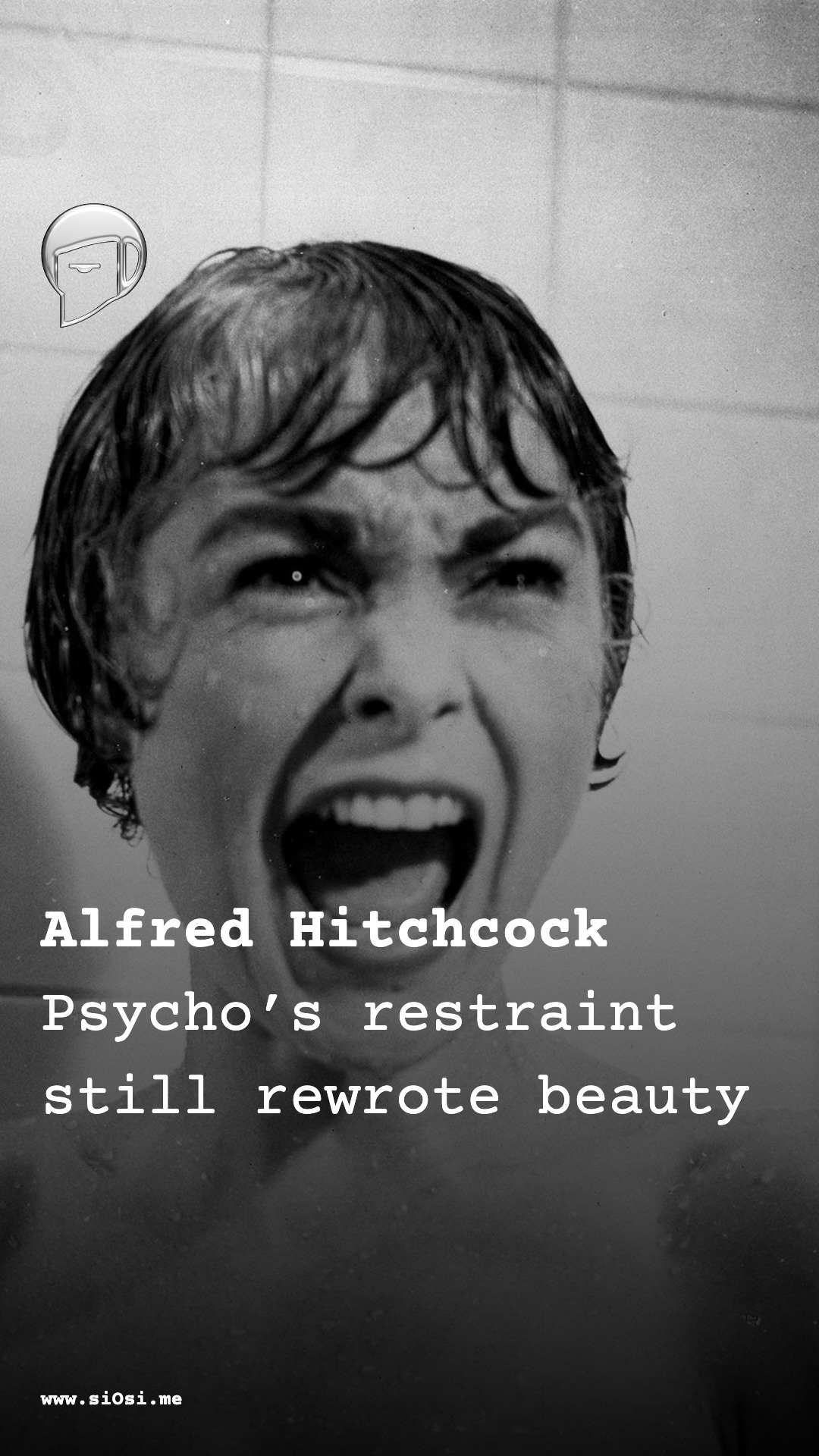
That shower curtain still slices through every calm moment. Hitchcock dressed Marion in plain light wool that never wrinkled and switched her from white to black lingerie to mark the slide into trouble. The sturdy Olga bra and half slip turned ordinary fabric into something electric with risk. Everyday motel towels and lowered blinds made the ordinary feel loaded. One vivid detail lingers: water catching on skin under bright clinical light before everything fractures.
Alfred Hitchcock’s Psycho entered cinemas in September 1960 with a visual language that felt almost ascetic, yet it altered the emotional vocabulary of screen beauty and style with quiet precision. Its aesthetic is one of restraint, familiar fabrics and silhouettes, cut through with brutal punctuation of light, water and violence, leaving a lingering sensation of vulnerability in the body and suspicion in everyday spaces.
The visual philosophy: ordinary surfaces, destabilized
Hitchcock’s guiding principle in Psycho was visual familiarity. He wanted clothing, underclothing and suitcases, the mundane textile life of his characters, to look as though they had been taken directly from ordinary American wardrobes, so that the audience would recognize everything and feel lulled by its normalcy. The shock of the film’s violence inheres in this tension: the horror arrives not in Gothic capes or stylized masks but in a motel towel, a shower curtain, a simple half slip and bra.
This choice reflects a philosophy of beauty that is suspicious of glamour. Instead of idealized perfection, Hitchcock favours bodies locked into routine, styles chosen for practicality. Janet Leigh’s dress as Marion Crane was made of a very light wool chosen specifically because it resisted wrinkling, allowing the garment to maintain its calm, unrumpled surface through multiple takes. Beauty here is not opulent or expressive, it is a smooth façade, its reliability making the eventual rupture feel more obscene.
Hitchcock and his cinematographer John L. Russell avoid many of the expressive devices of classic black‑and‑white cinema, such as dramatic Venetian blind shadows; the blinds in Psycho are generally lowered, denying decorative striation of light. Instead, the film’s visual texture is flat, its rooms almost barren. This spareness pushes attention onto small variations – the curve of a brassiere, the weight of a curtain, the gloss of wet tile – and gives everyday surfaces a faintly ominous charge.
Marion Crane: the body in lingerie and light
The costuming of Marion Crane, designed by Rita Riggs with wardrobe supervision by Helen Colvig and in some accounts linked to Edith Head’s influence, is central to the film’s emotional impact. Her lingerie, particularly the half slip and substantial brassiere, becomes an obsessive image repeated several times in the first half of the film. Hitchcock’s advertising campaign even featured her seated on a bed in a bra, body turned slightly so that the breasts are displayed, transforming a commonplace undergarment into a focal point of desire and danger.
The sets of underwear are carefully coded in black and white – “Janet Leigh’s black and white sets of underwear to indicate both good and evil in Psycho” as Caroline Young observes in her study of Hitchcock’s heroines. Early in the film, Marion is seen in white lingerie that reads as “risqué yet interpretably ‘good’,” a nod to purity tinged with sexual curiosity. After she steals the money, she appears in black underwear, a blunt visual metaphor for moral descent that still feels striking because of the simplicity of the palette. Hitchcock specified this all‑black‑and‑white range to draw sharp contrasts, allowing fabric colour – or its grayscale equivalent – to carry ethical weight.
These garments were not couture fantasies. Marion’s bra was an Olga brand model, familiar to ordinary women at the time. Its construction is sturdy, with wide straps and full cups, emphasizing containment rather than softness. On screen, the bra creates a clear architectural line over the chest, a kind of armour that paradoxically makes the exposed body more vulnerable. The half slip, hugging the hips and upper thigh, outlines the lower torso with a neat border. Together they form a silhouette that is modest by contemporary standards, yet the repetition of these pieces – in bed, dressing, undressing – turns their seams and elastic bands into emotional markers of guilt, desire and fear.
Marion’s outerwear continues this logic of controlled lines. Her light wool dress maintains a tidy sheath around the body, refusing wrinkles and so resisting temporal disarray. The fabric’s smoothness gives her a composed, secretarial poise, which makes the moment when her body collapses in the shower all the more devastating, a clean vessel abruptly emptied.
The shower scene: water, skin and the violation of sanctuary
Hitchcock’s shower sequence is perhaps the most influential aesthetic event in Psycho, a meticulously styled encounter between the human body, domestic architecture and murderous intrusion. With the infamous scene, Hitchcock “spoils that calming and soothing feeling of hot water, flushing away the tiredness of a long day.” The bathroom, tiled and plain, is visually neutral: white surfaces, simple fixtures, the ordinary plasticity of a shower curtain. Into this banal cleanliness enters a choreography of cuts, each one slicing water, skin and light into fragments.
The lighting is bright, almost clinical, erasing shadows so that texture is conveyed not by darkness but by the gloss of moisture. Water threads down Marion’s face and shoulders, catching highlights that trace the curvature of the body in soft strokes. This luminosity evokes a momentary serenity, a small private glow of relief, before the curtain is torn aside and the scene disintegrates into stabbing, screaming and the sound of water continuing to run, indifferent. The contrast between the anonymity of the attacker’s silhouette and the vulnerability of Marion’s exposed shoulders has permanently altered how cinema imagines bodies in bathing: the shower is no longer merely a site of cleansing and sensuality but a space of radical exposure.
The curtain itself is crucial. Its thinness, its translucency against the backlight, makes it an almost skin‑like membrane. When the knife slashes through, the puncturing of vinyl reads as a surrogate mutilation of flesh, allowing Hitchcock to imply violence within censorship constraints. The visual language here is all about substitution: water standing in for blood, the curtain for skin, the rapid montage of shots for the prolonged gaze that is withheld. The viewer experiences a flood of sensory impressions, yet is denied the graphic image, creating a unique emotional texture of horror interlaced with frustration and imagination.
In contemporary eyes, the scene retains a peculiar power. The black‑and‑white palette, the grain of the film stock, the absence of explicit gore, all combine to produce an almost dreamlike clarity in which every droplet feels hyperreal. The sequence evokes a cold, clinical terror, a sense that intimacy itself – the naked body under warm water – is fundamentally unsafe. It has influenced countless subsequent depictions of bathrooms and showers, which often echo the stark tiling, the bare bar of soap, the flimsy curtain as symbols of latent threat.
Norman Bates: casual familiarity and the uncanny boyishness
If Marion’s costumes are engineered for moral symbolism, Norman Bates’s attire is designed to be unremarkable. Hitchcock wanted Norman “dressed casual or ‘familiar’ so that the shock was greater when the big reveal took place.” His clothing belongs to the standard norm of the time – simple shirts, sweaters, trousers – fabrics and cuts that avoid any flamboyance. This ordinariness is crucial to the film’s emotional architecture: Norman’s style is comforting in its smallness, his boyish neatness and soft knitwear suggesting vulnerability rather than menace.
Visually, Norman embodies the aesthetic of the quietly misaligned. His posture is often slightly hunched, his movements hesitant, his gestures folded inward, all of which produce an impression of modesty and social awkwardness. The casual clothing reinforces this impression, as if he is perpetually stuck in a provincial adolescence. When the final revelation arrives, this mild style collapses into something grotesque: the idea that monstrosity might inhabit the most ordinary sweaters and slacks, the most uncertain smile.
This has had a long‑lasting influence on how cinema and popular culture dress the “boy next door” figure as potentially dangerous. The decision to avoid stylistic markers of villainy – no sharp suits, no dark cloaks – reorients the viewer’s intuition about threat. Ugly behaviour may reside in soft fabrics and gentle colours; horror may wear familiar brands. The emotional impact is a quiet distrust of casual male dress, an awareness that the non‑descript can conceal the unspeakable.
Mrs Bates’s bedroom and the weight of Victoriana
Hitchcock uses domestic decor and costume to delineate another kind of aesthetic burden: the stuffed Victoriana of Mrs Bates’s bedroom. The room is “crammed” with nineteenth‑century trappings that are already anachronistic by 1960. Heavy furniture, lace, framed portraits, and layered textiles gather around the unseen matriarch, enveloping her presence in an almost suffocating nostalgia. The effect is to treat décor as a kind of clothing for the dead, a fabric of memory in which Norman is trapped.
The Victoriana in the bedroom stands in contrast to the relative bareness of other spaces. Its elaborate textures – carved wood, patterned cloth, lace curtains – conjure a femininity that is rigid, overdetermined, and spectral. The emotional tone is one of preserved decay: the beauty of the objects is undeniable, yet they seem airless, drained of life. In cultural terms, this has contributed to the visual association of Victorian domestic style with repressed, overbearing motherhood and with a suffocating, antique femininity, a trope that echoes through later horror and Gothic films.
Hitchcock’s heroines and the controlled silhouette
Across his films Hitchcock is known for a particular silhouette for his leading women: cool, muted suits with high necklines and minimal cleavage, often in blue‑green‑grey palettes. Psycho extends this tradition. Marion Crane’s suit belongs to this lineage of tailored restraint, a garment that shapes the female body into a narrow column, always appropriate, always contained. Such costumes have influenced fashion images of the mid‑century “icy blonde” – a woman whose beauty is immaculate and whose clothing suppresses overt sexuality while quietly emphasising precision of cut and line.
For Hitchcock, the body is beautiful when it is controlled, when its horizons are defined by seams and structured shoulders. The emotional presence of his heroines arises from the tension between this control and the turmoil beneath: fear, desire, guilt, all hidden under wool and silk. In Psycho, this tension is literalized by the transition from suit to underwear, from public silhouette to private contour. The film teaches viewers to read beauty as a double surface, a polished exterior and an underlayer that is far more naked and frail.
Enduring emotional and aesthetic resonance
Viewed today, Psycho still carries a peculiar glow – not of warmth, but of clear, metallic light reflected on wet tile and bone‑white porcelain. Its beauty lies in its discipline: the refusal of decorative excess, the reliance on simple fabrics and stark contrast, the way black and white garments map the fault lines of human intention. The film’s visual language has seeped into both fashion imagery and broader aesthetic consciousness. White bathrooms are no longer merely hygienic; they are potential theatres of vulnerability. Black lingerie does not simply signify seduction; it may whisper of transgression and doom.
Emotionally, the film leaves a residue of unease around the most ordinary acts: checking into a roadside motel, undressing after work, stepping under a stream of hot water. Beauty, in Psycho, is never separate from risk. The smooth dress that does not wrinkle, the familiar bra brand, the casual sweater – these are all instruments through which Hitchcock destabilizes the viewer’s trust in surfaces. The body appears both meticulously composed and terrifyingly exposed, and it is this duality that continues to give Psycho its chilling, strangely elegant power.