
Sun in LibraMoon in PiscesWaxing Gibbous
Timur Novikov's Bold Beauty Shift
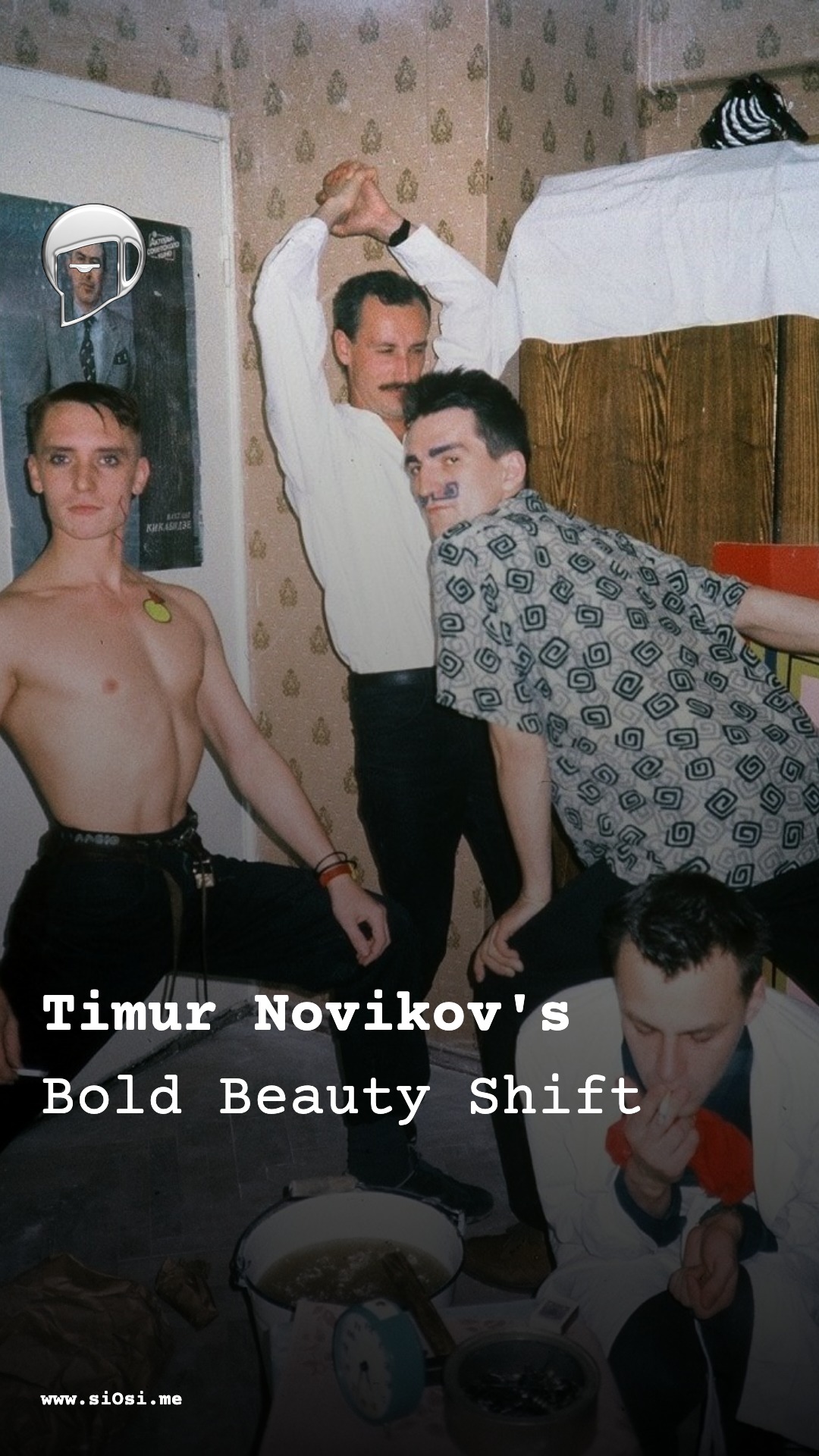
Timur Novikov turned Soviet drab into pure style fire. First came the New Artists with their wild color blocks and graphic tees lighting up Leningrad clubs like sunrise flags. Then he flipped to Neoacademism, preaching classical bodies and dandy poise from a squatted academy on Pushkinskaya 10. The result? A cult of calm, sculpted beauty that still feels fresh today. One vivid detail: those crisp marble folds and tailored jackets turning everyday dress into ritual.
Timur Novikov, born 24 September 1958 in Leningrad, occupies a singular place in late Soviet and post‑Soviet visual culture: his work is a sustained, almost devotional attempt to return beauty, classical form and consciously styled life to the center of artistic practice, at a moment when both official and underground art were suspicious of elegance as such.
His impact unfolds in two major aesthetic constellations: the anarchic, brightly gestural world of the New Artists of the 1980s, and the later, ceremonially restrained Neoacademism and the New Academy of Fine Arts, founded in 1989, which elevated classical beauty, dandyism and a cult of form into a coherent visual doctrine.
Early visual language – the New Artists and youth style
In the early 1980s, Novikov’s circle, the New Artists, cultivated a deliberately rough yet jubilant visual language that spilled across painting, film, fashion, interiors and performance. Their work, influenced by Russian Futurism and the absurdist OBERIU tradition, embraced gestural freedom, a kind of painterly exuberance that translated easily into clothing, posters and stage sets. Brushstrokes were often broad and unrefined, contours open rather than precise, as if style existed in the energy of the line rather than its accuracy.
Color in this period tended toward bright blocks and graphic contrasts: saturated reds and yellows, firm stripes, flat silhouettes, and simplified emblematic motifs such as suns and geometric signs. According to contemporary accounts, Novikov’s designs from the 1980s used color as a declarative field – large zones of primary tones that read at a distance like flags of youth subculture. When later transposed onto T‑shirts and sweatshirts, these motifs produced garments whose beauty lay not in tailoring but in planar rhythm, in the dialogue of stripe and block, in the sunrise‑like glow of simple pictograms on the chest.
The impact on fashion and youth style was subtle yet pervasive. In St Petersburg’s underground clubs, clothing functioned as mobile canvases: painted jackets, graphically treated shirts, and hand‑altered textiles echoed the New Artists’ visual vocabulary. Movement through space – dancing, walking, performing – became a way of animating flat imagery, turning blocks of color into streaks and pulses. The silhouette remained largely casual, even utilitarian, but the surface became charged: a site of playful rebellion against both Soviet drabness and the conceptual austerity of much nonconformist art.
Emotionally, this early phase radiates a boyish optimism and improvisation. The beauty offered is impure, noisy, sometimes kitsch, yet suffused with a belief that style can be invented in real time from whatever materials are at hand: cheap fabric, stencil, aerosol, hand‑cut paper. It is a beauty of immediacy, of spontaneous adornment, where the body is less sculpted object than flickering carrier of graphic signs.
Neoacademism – a cult of classical beauty
Around 1989, Novikov inaugurates his most consequential aesthetic project: Neoacademism and the New Academy of Fine Arts. This shift marks a profound reorientation of his visual language. Against the “destructive forms of modernism and postmodernism”, as he polemically framed them, Neoacademism proposes a reactionary yet paradoxically avant‑garde stance: the rehabilitation of classical beauty, the human figure, and historical forms, using both traditional and digital means.
According to analyses of the movement, the New Academy aimed at a “universal rehabilitation of the concept of beauty”, placing idealised classical form – the bodies of Apollo and Venus, the compositional clarity of academic painting – at the center of its practice. Visually, this entailed:
-
Silhouette and body: A return to the sculptural, proportioned body, often male, treated as an object of formal veneration rather than psychological introspection. Figures are typically shown with controlled musculature, stable posture and balanced contrapposto, echoing antique statuary and Socialist Realist athletic types. The line around the body is clean, continuous, almost caressing, emphasizing contour over internal agitation.
-
Lines and shapes: Composition tends toward symmetry or carefully weighed asymmetry, with strong verticals and horizontals. Architectural backdrops and ornamental frames often recall neoclassical Petersburg façades and Empire interiors. Decorative elements – laurel wreaths, medallions, draperies – delineate space in soft arcs and crisp edges, creating a choreography of curve and angle that feels ceremonious rather than spontaneous.
-
Color and light: Neoacademist works frequently favor a restrained palette: creams, stone greys, marble whites, muted blues and reds derived from historical painting and architecture. When bright color appears, it is contained within ordered zones, more heraldic than gestural. Light is modeled rather than flat, producing calmly glowing flesh, satin highlights on fabric, and gentle shadows that sculpt the figure without violence. The overall atmosphere is that of clear daylight or polished interior illumination – a cultured brightness that suggests contemplation rather than spectacle.
-
Texture and fabric: Textures recall classical drapery and Petersburg luxury: smooth marble, fine wool, silk, polished wood, gilt surfaces. Draped fabrics fall in weighty, legible folds, emphasizing gravity and structure, not fluttering accident. Clothing in Neoacademist imagery and practice often evokes dandyism: tailored jackets, crisp shirts, academic robes, uniforms, all worn with an almost liturgical precision. Materiality is elevated – fabric as ritual skin around the ideal body.
-
Posture and movement: If the New Artists celebrated restless movement, Neoacademism privileges poised stillness. Bodies stand, sit or recline with studied elegance, as if inhabiting a continuous classical tableau. Gesture becomes minimal, codified: a turned head, an outstretched arm, a bent knee. Movement appears not as improvisation but as a sequence of poses, a discipline of beauty.
This aesthetic was not merely pictorial. The New Academy, housed in squatted rooms on Pushkinskaya 10, conceived itself as a total environment of style, where interiors, dress codes, manners and pedagogy all reflected the cult of beauty. Accounts describe an atmosphere of deliberate theatricality: walls adorned with reproductions of Old Masters, students pursuing drawing from antique casts, and an ethos of Petersburg dandyism recoded through kitsch‑classicist forms.
Neoacademism’s emotional tenor is paradoxical. On one level, it exudes serenity and nostalgic reverence: a longing for an ordered world where beauty is both standard and refuge. On another, it carries an unmistakable irony, a self‑aware “aesthetic extremism”, as one museum text calls it, in which the cult of beauty becomes almost militant, a conscious stance against perceived cultural decay. This tension – between genuine devotion to form and playful simulation of conservatism – gives the work its peculiar glow: simultaneously solemn and slightly theatrical, like a costume ball in a crumbling palace.
Beauty as doctrine – philosophical attitude to the body
Neoacademism’s visual program arises from an explicit philosophy. Novikov’s writings and later scholarship describe his project as a reactionism that seeks salvation in beauty, offering classical form as antidote to crisis in contemporary art.
Several key attitudes emerge:
-
Beauty as ethical and existential principle: The New Academy declares a “cult of beauty” as a mode of life‑building, not simply taste. Beauty is treated as stabilizing force, a way to preserve human dignity amidst social and aesthetic upheaval. The body, stylised and idealised, becomes the primary site of this cult: to depict, dress and pose it beautifully is to resist chaos.
-
The body between Antiquity and Socialist Realism: Neoacademist imagery consciously merges Classical antiquity with the monumental bodies of Socialist Realism, adopting the latter’s idolisation of the athlete while filtering it through antique harmony and sensuality. The result is a hybrid type: the modern Russian body seen as a reborn ancient statue, simultaneously civic and erotic, public monument and intimate object of contemplation.
-
Anti‑modernist, metamodern stance: Scholarly work interprets Neoacademism as one of the first metamodern movements in post‑Soviet visual art, oscillating between irony and sincerity in its relation to historical forms. Novikov’s “adoration of positive classicist forms and tropes” sits alongside a highly stylized aversion to modernism and postmodernism, yet his own art is frequently described in postmodern terms. This double attitude is visible in the work’s surface: classical motifs rendered with just enough excess or kitsch to signal that the devotion is performative as well as real.
In terms of beauty and the body, this philosophy yields a notable emotional effect: the viewer senses both care and distance. The depicted bodies are perfected rather than vulnerable, but their perfection is presented as something one may inhabit aspirationally, through style, posture, study. Beauty here is not raw sensuality; it is achieved, educated, rehearsed.
Fashion, youth culture, and the afterlife of his style
While Novikov’s projects were primarily artistic, their fashion and style impact is substantial. The New Artists’ broad, graphic shapes and bright blocks of color fed directly into Leningrad youth culture in the 1980s, shaping how a generation dressed for clubs, concerts and informal gatherings. Clothing became an extension of painting: T‑shirts and sweatshirts carried bold stripes and emblematic sunrises, rendering the torso as a luminous sign.
Later, Neoacademism transformed this relationship to dress into something more ceremonial. The New Academy cultivated a form of Petersburg dandyism: carefully chosen jackets and shirts, hair often styled with classical neatness, bodies arranged in interiors almost like figures in a salon painting. Fashion here did not chase novelty; it reenacted and re‑coded historical elegance, juxtaposing academic robes and uniforms with contemporary garments, sometimes with a deliberate hint of camp.
The afterlife of Novikov’s style continues into the twenty‑first century. Contemporary designers have drawn on his 1980s graphic vocabulary – bright color blocks, stripes, sunrise motifs – for capsule collections, recognizing their enduring clarity and emotional charge. These translations into modern streetwear confirm the resilience of his early aesthetic: even stripped of historical context, the motifs retain a playful yet strangely dignified glow.
In museums and archives, Neoacademist works are now framed as part of a larger exploration of “absolute beauty” in post‑Soviet art, emphasizing their attempt to reconcile classical form with digital technology and contemporary media. Some artists associated with the New Academy combine antique iconography with computer graphics and media art, producing images in which the smooth gradient of a screen coexists with the marble contour of a statue. The visual impact is one of uncanny timelessness: the classical figure lit by a subtly synthetic light, the body at once ancient and pixelated.
Today, Novikov’s work feels calmly radiant, simultaneously nostalgic and forward‑looking. The early New Artists material evokes the warmth of youth subculture: painted jackets in smoky rooms, improvised stages, color skating across bodies in motion. Neoacademism, by contrast, casts a cooler, more deliberate light: a studio where casts of Apollo stand beside computers, a room where young people rehearse classical poses in modern clothes. In both, beauty is not incidental ornament; it is the central drama, the axis around which body, fabric, light and space silently revolve.