
Sun in VirgoMoon in LeoNew Moon
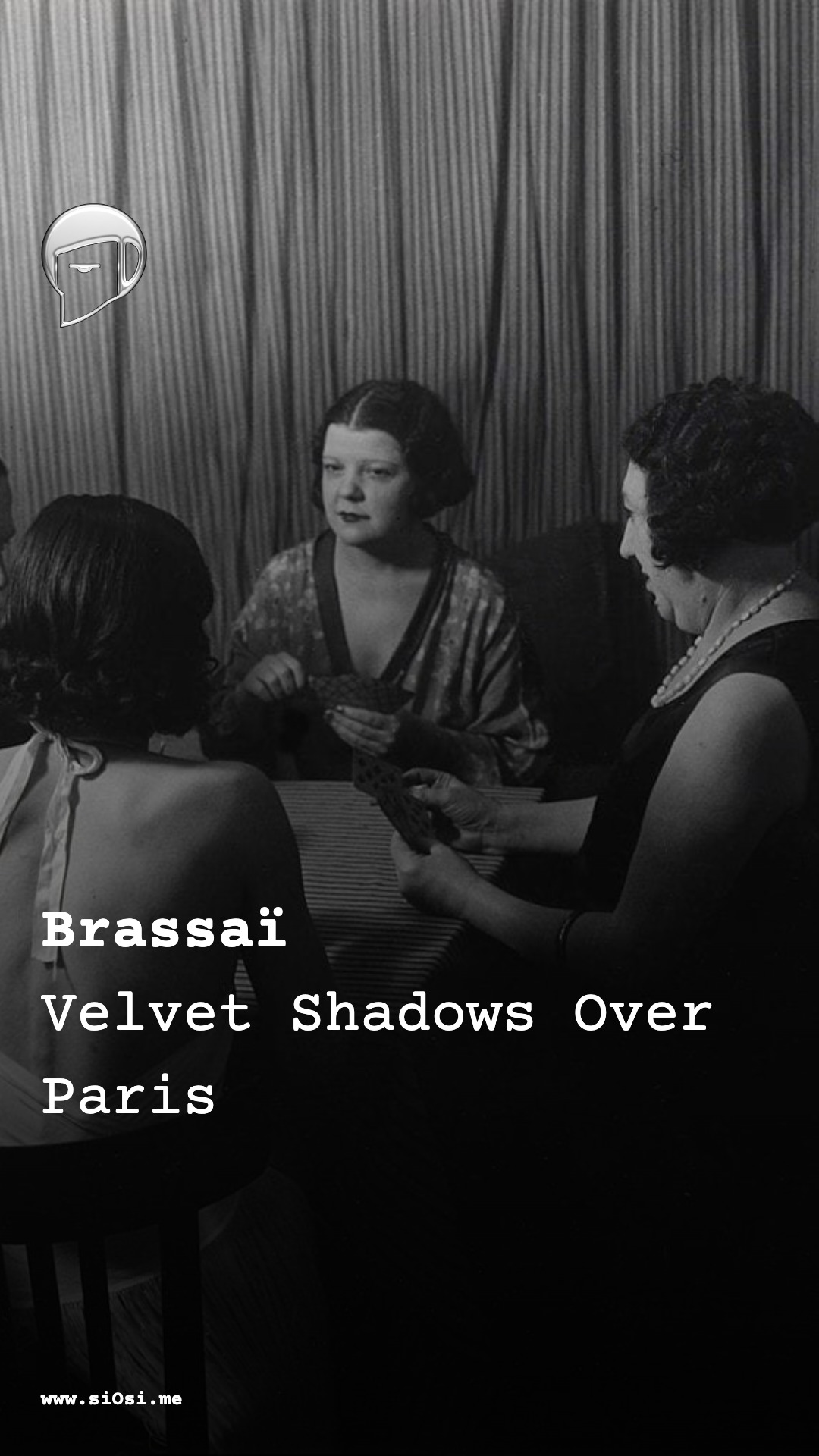
Brassaï's Velvet Shadows Over Paris
Brassaï made the night feel like couture fabric. Wet cobblestones catch light like reptile scales under streetlamps while coats and hats carve bold silhouettes against the dark. His Paris de nuit turns fog into soft velvet and café smoke into sheer muslin. Every frame shows how beauty lives in texture, posture and half-lit glances. The result is quiet glamour that still feels fresh today.
Brassaï was born on 9 September 1899, and with him entered a gaze that would dress the modern city in velvet shadow and cold light, teaching the twentieth century to see night as a kind of couture for streets and bodies alike. His photographs of Paris in the 1930s, gathered in the book Paris de nuit in 1933, remain among the most powerful visual codifications of urban style, eroticism, and nocturnal glamour.
His work is not fashion photography in the conventional sense, yet it has profoundly shaped the visual grammar of fashion, beauty, and urban style: the silhouette against a glowing streetlamp, the gleam of a wet pavement as though it were satin, the intimate pose of a couple in a café framed like a dressmaker’s fitting.
Night as a garment: silhouette, line, and atmosphere
Brassaï’s most enduring contribution is the way he treats night itself as a fabric – thick, absorbent, quietly luxurious – against which every human figure is cut like a pattern piece.
In Paris de nuit he repeatedly composes images where small, intensely luminous areas puncture large fields of black, as if pinpricks in a dark velvet curtain. Light reflected in wet cobblestones or diffused by fog defines the edges of forms: a hat brim, a shoulder line, the arc of an umbrella, a wrought iron railing. Critics have described how he used long exposures and a painterly sense of composition to frame these constellations of light, creating what he called his “little boxes of night.”
Formally, this produces a very specific silhouette culture:
- Figures are often framed in three-quarter profile, so that coats, dresses, and hats are read as masses rather than mere garments, their volumes floating against darkness.
- Architectural lines – bridges, staircases, façades, and balustrades – become the skeletal corsetry of the image, structuring the soft drape of night and fog.
- Lamps and windows create halos that echo the circles of hats or coiffures, repeating circular motifs around the head and shoulders so that hair and light seem allied.
Where earlier city imagery often emphasised clarity and daylight, Brassaï’s Paris is a city in eveningwear: streets as long black coats, shopfronts as sequined panels, the Seine a dark silk ribbon catching stray sparks of neon. The overall impression is of a metropolis tailored for mystery.
Texture and surface: smoke, stone, skin
The sensory richness of Brassaï’s photographs owes much to his meticulous staging of texture.
In the streets, the materials of the built environment – stone, metal, glass, water – are turned into a tactile repertoire:
- Cobblestones glisten like reptile scales after rain, each stone catching a micro-reflection, suggesting a city wrapped in a finely beaded train.
- Fog softens facades, giving them the powdery bloom of worn velvet or brushed suede.
- Ironwork and lampposts appear as dark, polished bones, their curves echoing the lines of Art Deco furniture and jewellery.
Indoors, the textures shift from mineral to human:
- Café interiors glow with tobacco smoke that functions like translucent muslin, veiling faces and garments while catching stray highlights.
- Mirrors in bars and dancehalls double and fragment figures, creating overlapping layers of skin, fabric, and light – as if the scene were draped in multiple sheer textiles.
- The polished surfaces of tables and banquettes throw back faint glints, suggesting the subdued sheen of satin evening shoes or patent leather belts.
His portraits of night-workers, drinkers, and lovers often stress the tactility of skin: worn faces, rouged cheeks, hands resting on tables, all subtly lit to reveal pores, wrinkles, and cosmetic textures rather than effacing them. In Brassaï, beauty is not smoothness but density – the accumulation of experience, smoke, and light on a surface.
The body in shadow: posture, gesture, and emotional style
Brassaï’s subjects inhabit the night with a particular postural style. Unlike the heroic, forward-thrusting bodies of modernist advertising, his are often folded, leaning, resting: bodies that surrender weight to chairs, banquettes, walls, and to each other.
His café couples often sit in quietly intimate configurations: shoulders inclined, hands loosely joined, heads slightly bowed, cigars and cigarettes held in fingertips that suggest both nervousness and languor. These gestures form a kind of emotional choreography, a set of small, repeatable movements through which desire, boredom, complicity, and fatigue become visible.
In brothels, bars, and nightclubs, the body is framed with a delicate balance between display and withdrawal:
- Prostitutes may be posed with arms akimbo or hands on hips, but the surrounding darkness presses in, softening any blunt exhibitionism with an air of distance.
- Dancers in the “Bal Nègre” and other dancehalls appear mid-sway or mid-step, their movements caught in long exposures that blur edges and turn limbs into soft arcs. The result is not a frozen gesture but a faint trail of motion, as though dance were stitched into the air.
- Patrons lounging at tables are often captured from slightly above or behind, so that shoulders and backs become the primary forms, subtly eroticising posture rather than facial expression.
This treatment of the body contributed to an enduring iconography of urban nonchalance: the slouching drinker, the leaning smoker under a streetlamp, the couple pressed into a doorway. These poses echo through later fashion imagery, where coats are worn open, shoulders relaxed, and bodies appear to rest against the architecture of the city rather than dominate it.
Light as cosmetics: a theory of beauty in chiaroscuro
Brassaï’s work articulates an implicit philosophy of beauty grounded in chiaroscuro: beauty as the interplay of concealment and revelation. Historians have noted that he approached night photography with “systematic discipline and poetry,” using longer exposure times and carefully controlled lighting to build a psychologically charged space.
In many images, light functions much like makeup:
- Street lamps contour faces from the side, emphasising cheekbones and nose bridges while letting the rest fall into shadow, a natural analogue to later sculpting with cosmetics.
- Neon signs and bar lights cast coloured tonalities that, even in black and white, register as distinct planes of brightness, echoing the way rouge or lipstick isolates zones of attention on the face.
- Reflections in rain or mirrors create highlight spots that resemble the glossy accents of pomade in hair or lacquer on nails.
Yet his beauty is never purely cosmetic. It is grounded in the lived textures of the city: stubble, fur collars, wool overcoats, smudged eyeliner. The effect is to democratise glamour, giving the aura of a cinematic close‑up to anonymous workers and marginal figures. Britannica and museum accounts emphasise how his photographs treated even illicit or marginal subjects with formal restraint, maintaining a balance between empathy and observation.
Clothing, style, and the wardrobe of interwar Paris
While Brassaï did not work for fashion houses, his images are an invaluable archive of street fashion and nightlife attire in interwar Paris. His camera lingers on specific sartorial elements:
- Coats and outerwear: Long overcoats, fur collars, and heavy wool fabrics appear repeatedly, their bulk carving solid silhouettes against thin lines of lampposts and railings. The coat becomes a portable piece of architecture, shaping the body into a vertical mass.
- Hats and headwear: Cloche hats, felt fedoras, and berets punctuate his scenes, often catching a narrow rim of light that separates the head from the dark background. They read almost like halos of cloth, marking social role and gender with quiet precision.
- Eveningwear and uniforms: Waiters’ jackets, dancehall musicians’ suits, and the occasional uniformed figure introduce sharper lines and brighter surfaces, creating points of visual authority within otherwise blurrier compositions.
- Accessories: Cigarettes, walking sticks, and handbags become small, bright nodes of attention, often the only fully lit object in a frame. They operate as punctuation marks in the syntax of the image, much as jewellery does in fashion photography.
What is striking is the lack of theatrical exaggeration. Even in brothels and cabarets, the clothes remain relatively restrained, their drama arising from setting and light rather than overt extravagance. This aligns with Brassaï’s preference for images that are “sharp, deliberate, and stable,” rather than embracing the speed and spontaneity celebrated by other avant‑garde photographers of the period. The result is a visual repertoire of understated glamour, where a simple dark coat in the right light becomes as iconic as any couture gown.
The emotional temperature of Brassaï’s Paris
Critics have described Brassaï’s Paris as a “psychological space of the imagination,” a city that becomes more emotionally charged at night. His images oscillate between tenderness and menace, intimacy and estrangement.
- Empty streets and deserted stairways feel haunting but not hostile, their emptiness more akin to a stage awaiting actors than a threat.
- Scenes in bars and cafés balance conviviality with solitude: even when tables are crowded, a sense of private reverie sits between figures.
- Brothel interiors and clandestine venues are recorded with a calm, almost liturgical stillness, as if the rituals of desire and transaction were simply another nocturnal liturgy of the city.
Time magazine, writing on his work, observed that his greatest achievement was to make “the night something to see,” turning what had been a time of invisibility into a spectacle rich in subtle emotions and visual nuance. The BBC has noted that his photographs are central to the enduring perception of Paris as a romantic realm, eternally suspended in misty twilight. This emotion – a kind of tempered romanticism tinged with weariness and dream – remains strongly legible today.
Influence on fashion, beauty, and visual culture
While Brassaï is primarily situated within the history of art photography, his imagery has had a pronounced and lasting influence on fashion photography, urban branding, and the visual language of luxury and nightlife. Contemporary commentators emphasise how his merging of street photography and fine art helped define the idea of vernacular photography – everyday scenes rendered with cinematic drama.
Several aspects of his practice have become standard in fashion and beauty imagery:
- Nocturnal glamour: The trope of a model leaning under a streetlamp, walking alone on a wet city street, or framed in a doorway with neon behind her, flows directly from the atmospheres Brassaï codified.
- High contrast, low light: His strong contrasts between light and dark, with faces partially veiled in shadow, prefigure later uses of dramatic low‑key lighting in editorial photography to convey sophistication and mystery.
- Narrative street scenes: The notion of fashion photography as a kind of narrative street tableau – models embedded in cafés, bars, or metro stations rather than isolated in studio space – draws on Brassaï’s blend of documentary and staged composition.
Moreover, his commitment to night as a time of fantasy, ambiguity, and play has deeply informed urban aesthetics in cinema, advertising, and design, where cities are often presented as nocturnal theatres for the self, places where identity can be tried on like a coat and illuminated from a chosen angle.
How his work feels today
Encountered today, Brassaï’s photographs still emit a soft, phosphorescent glow. They feel less like historical documents and more like preserved moods. Viewers stepping into these images enter a world where the metallic tang of rain, the dry sweetness of tobacco smoke, and the warmth of wool coats seem almost tangible.
The emotional resonance is complex:
- There is nostalgia, but it is not sentimental. The grit of the streets, the visible fatigue on faces, and the unsentimental depiction of brothels and back alleys keep sentiment in check.
- There is romance, but it is quiet, lodged in small gestures – a shared cigarette, a mirrored glance – rather than grand declarations.
- There is melancholy, a sense that the night is both a refuge and a fragile stage that will be dismantled at dawn.
Art critics have likened his night images to dreams in which shadows reveal more than they conceal, possessing “crude and revelatory qualities.” His Paris is a city where beauty resides in partial visibility, where style is not a mask but a set of small accommodations between body, fabric, and light.
For fashion and beauty, this legacy endures as a kind of ethical aesthetic: an insistence that elegance can coexist with wear, that glamour can be found in ordinary faces, and that the most alluring sheen may be the one cast across a damp pavement at midnight. Brassaï’s vision continues to colour how we imagine the stylish city at night – not as a blaze of spectacle, but as a murmuring field of shadows, illuminated here and there by human presence.