
Sun in VirgoMoon in CapricornFirst Quarter
Zandra Rhodes: Born to Make Prints Sing
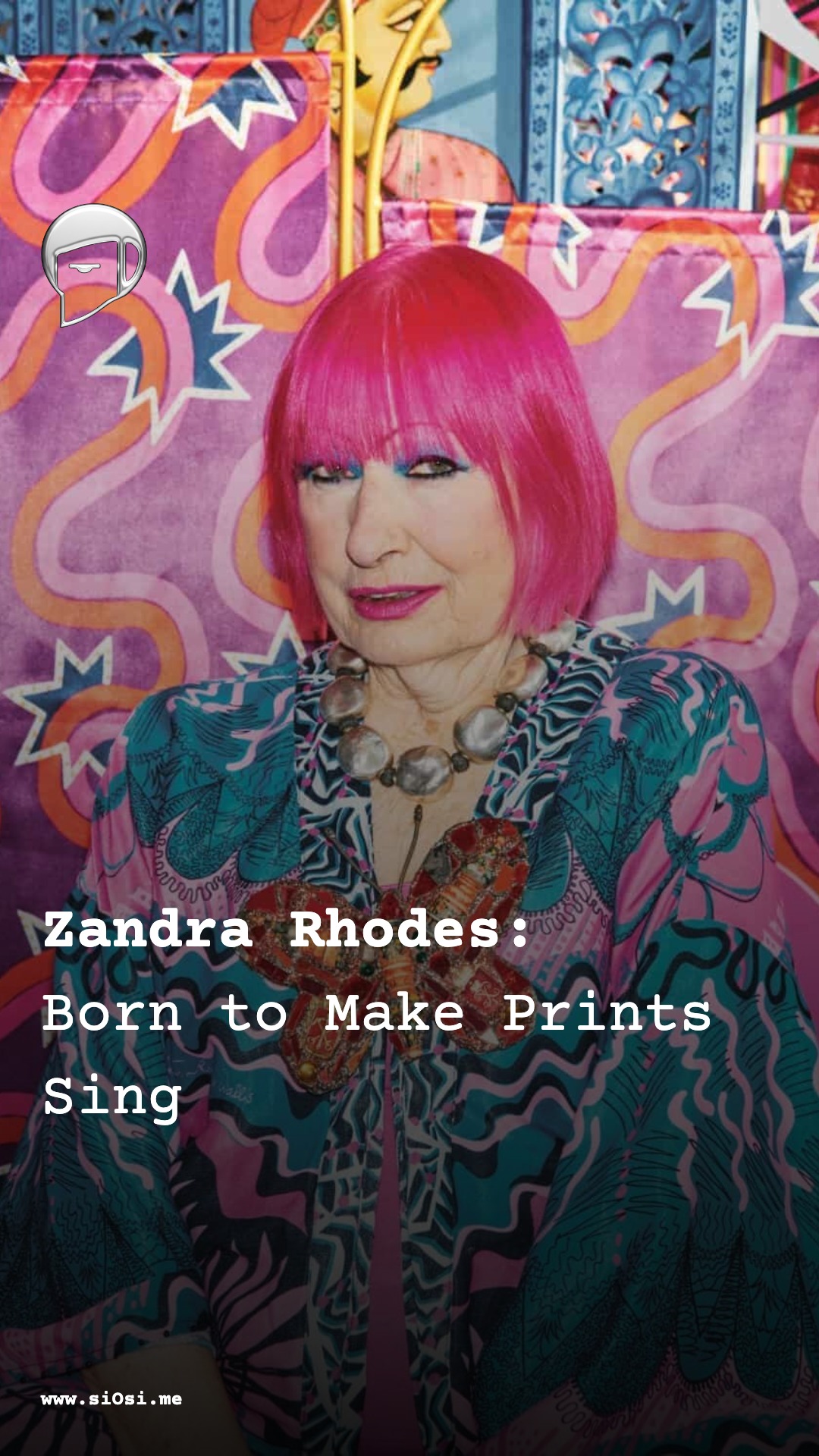
Zandra Rhodes dropped into the world in 1940 and made color feel like pure joy on the body. She let prints lead every cut, so those wiggly lines and floating lilies shaped the silhouette instead of any stiff pattern. Think electric fuchsia on chiffon that drifts with every step and seams left bare like a punk love letter. Her own neon-pink bob became the ultimate accessory, proof that the head is just another canvas for the same vibrant energy. The result is clothes that still glow with life decades later.
Zandra Rhodes, born 14 September 1940, enters fashion history not simply as a designer of clothes, but as an architect of visual emotion – shaping how color, print, and movement can inhabit the body like a joyous aura. Her work is best understood as a continuous experiment in how textiles themselves can dictate silhouette, mood, and presence, turning fabric into a kind of chromatic atmosphere around the wearer.
Her signature visual language
From the beginning, Rhodes insisted that the print must lead the garment. She has described how, in her 1969 collection, the textile design determined the final shape so thoroughly that the dress could almost be made without a conventional paper pattern. This inversion of hierarchy – where motif and line on cloth guide the cut – produces silhouettes that feel grown rather than constructed. Garments are often composed of simplistic base shapes that become complex through layering, smocking, and shirring, allowing the printed surface to expand and contract over the body in soft swells rather than rigid planes.
Her textiles are intensely graphic yet fluid: repeated motifs that oscillate between stylized nature and abstract symbol. Rhodes’s prints have drawn from organic material and travel – chevron stripes linked to Ukrainian patterning, emblems inspired by North American Indigenous symbols, Japanese flowers, calligraphy, shells. These references are translated into a distinctive hand, frequently marked by her so‑called “wiggles”: undulating lines, looping contours, and pulsating borders that trace the edges of a dress, hem, or sleeve like a drawn vibration. On chiffon, these lines appear to hover rather than sit, making the body seem suspended inside a moving graphic field.
Often, pigment is applied in pale or white overlays onto diaphanous fabric, as in the “Lovely Lilies” pieces with white printed pigment on chiffon, or the quilting over swirling screen‑printed motifs used as borders. The effect is of light floating on light: an interplay of translucent ground and opaque mark that reads almost like watercolor captured mid‑air. Screen‑printed silk chiffon and printed wool felt are among her principal materials, each exploited for different emotional registers – chiffon for dream and drift, felt for sculptural clarity.
Color and emotional presence
Rhodes’s palette is famously electric. Interview profiles describe her “psychedelic side of haute punk” articulated through bright fuchsia and tangerine tones, bold flower motifs, and signature paisley‑like patterns. She speaks of color as “powerfully emotional,” a direct expression of her lived experience – wonder at nature, excitement in travel, the joy in human encounters. Her garments “sing with life on the body,” according to exhibition texts, harnessing print and color to make clothes vibrate with a sense of animation rather than static decoration.
Fuchsia, especially, recurs as a kind of personal emblem. She has long maintained neon‑pink hair, calling pink “a very happy colour,” and pairing it with rainbow‑hued makeup and a hot‑pink London apartment. Her hair and face become extensions of the same chromatic philosophy that governs her textiles: the body is not neutral canvas, but an active participant in color. Pink hair, saturated lids, and bold lip tones frame her own presence as if she were one of her garments – a living print, a figure inscribed in color. This continuity between self‑presentation and design deepens the sense that her work is less about isolated objects and more about an ongoing chromatic lifestyle.
Texture, movement, and silhouette
Rhodes’s silhouettes favor floating volumes over strict tailoring. Simple shapes are layered into cascading forms that respond to gravity with slow delay: chiffon panels trail slightly behind a step, sleeves drift open around the wrist, hems flutter rather than swing. Techniques such as smocking and shirring gather fabric into textured surfaces that expand and release with movement, so the wearer feels encased in a gently shifting skin of pattern.
Her approach to structure often subverts conventional polish. During the punk era she famously experimented with reversed exposed seams, tears, and jewelled safety pins – not as mere shock tactics, but as a way to keep the making visible on the surface. Deconstructed designs, visible seams, and strategic rips create garments that carry their own construction as ornament. The emotional effect is a tension between fragility and exuberance: chiffon torn yet jeweled, seams exposed yet rhythmic, suggesting that elegance can coexist with disruption.
Even outside punk, there is a tactile insistence on the handmade. Commentators note her emphasis on hand drawing, hand stitching, beading, and hand finishing in her London atelier, where prints are first painted or drawn, then translated into screens for each color layer, and finally hand‑screen‑printed onto fabric that is cut and sewn individually. This labor is not hidden; it lives in the slight irregularities of line, the small variations in print placement, the presence of beaded details that catch light differently with each movement. Rhodes’s clothes feel touched, carrying an intimacy of making that translates as warmth on the body.
Face, hair, and bodily philosophy
Rhodes’s own appearance is integral to understanding her philosophy of beauty. Her neon‑pink bob, occasionally flirted with green streaks or feathers attached to the ends with eyelash glue, is less a hairstyle than a visible belief that the head is another surface for pattern. Rainbow‑hued makeup – vivid eyeshadow, strong blush, layered lip colors – frames the face as a small, concentrated canvas of her broader palette. Interviewers repeatedly describe her as instantly recognizable, precisely because her personal aesthetic mirrors the vibrancy of her collections.
When asked how she defines the clothes she makes, she answers simply: “Gorgeous,” emphasizing that her main goal is to make someone feel “very gorgeous.” Beauty here is not restraint or minimal perfection, but a feeling of enlargement, of being wrapped in joy. She notes that fashion has “no rules” and that a designer must make their own. This refusal of rigid prescription informs her treatment of the body: she does not seek to correct or conceal, but to surround, adorn, and delight. Her reliance on fluid shapes and forgiving drapes suggests a body allowed to move, breathe, and be seen inside color rather than controlled by it.
In interviews, she links her creativity to “love and enthusiasm for life and people,” describing her designs as “colourful, printed and dramatic” and insisting that wearing color and print “makes you feel joy” and “makes outfits sing with life.” The body, in her view, becomes a celebratory site, a place where experiences are translated into visual rhythm. The emotional presence of a Rhodes garment is therefore one of uplift – a glowing, almost theatrical happiness that does not erase complexity, but circumvents dourness.
Punk, romanticism, and the aesthetics of rupture
Rhodes is often associated with punk, sometimes called “The Princess of Punk,” a title acknowledging her radical approach to fashion through brilliantly bold prints guiding the shape of designs. Her contribution to punk aesthetics is markedly different from harsher, industrial interpretations: she dreams up a punk that is deconstructed yet luxurious, a romance of rips and safety pins held in chiffon and bright color. Exposed seams and strategic tears interrupt the perfection of the dress, but the surface remains emphatically decorative, printed, and often delicately finished.
This hybrid – punk’s disruption joined with chiffon’s lightness and graphic print’s exuberance – reshapes the emotional temperature of rebellion. Punk in Rhodes’s hands is less nihilistic than celebratory contradiction. The body is both protected and exposed: veiled in floating fabric yet visibly traced by seams and gaps. Such garments visualize tension, but resolve it through color. They seem to say that rupture can be spectacle, that resistance can shimmer.
Exhibitions and contemporary resonance
Recent exhibitions, such as “A Life in Print,” underscore that Rhodes is “first and foremost” a textile designer whose mastery lies in using print as a structural influence on garment shape. Curators emphasize how her skill in harnessing print and color makes garments “sing with life on the body,” a phrase that speaks directly to the sensory impact of her work. Reviews note that pattern “informs the piece,” dictating how fabric is cut, draped, and layered. This approach continues to feel striking today, in a fashion culture often dominated by logo placement or silhouette‑led design.
Her lilies motif, reimagined in later collaborations, exemplifies her enduring sensibility: arcs of lilies arranged in maximalist style to bring an “iconic expression of peace and romance” to functional objects. Here again, line and floral form are orchestrated to wrap daily life in a kind of soft visual music. The lilies motif carries a calm rhythm, a soothing curve, yet rendered with enough scale and contrast to remain confidently present.
Today, Rhodes’s work still feels like the visual equivalent of laughter in a room – bright, layered, and unmistakably alive. The textures are airy, the colors saturated yet hopeful, the prints simultaneously graphic and tender. To look at one of her gowns is to see movement pre‑written into the fabric: the path a sleeve will take through air, the flicker of light across sequins, the way a border of wiggles will ripple as someone turns. To wear such a piece is to step into a carefully composed field of color where the body is invited not to disappear, but to glow.
In an era increasingly conscious of sustainability, Rhodes has spoken about high‑quality design that lasts, and the need to move away from constant change in both home and wardrobe. This attitude deepens the sense that her clothes are meant to endure, not only materially but emotionally. They are garments of continuing joy, pieces that maintain their chromatic aura even as decades pass. The punk rips, lilies, wiggles, and fuchsia still read today as affirmations: the body as site of pattern, color as feeling made visible, fashion as a lived, luminous lifestyle rather than a fleeting image.